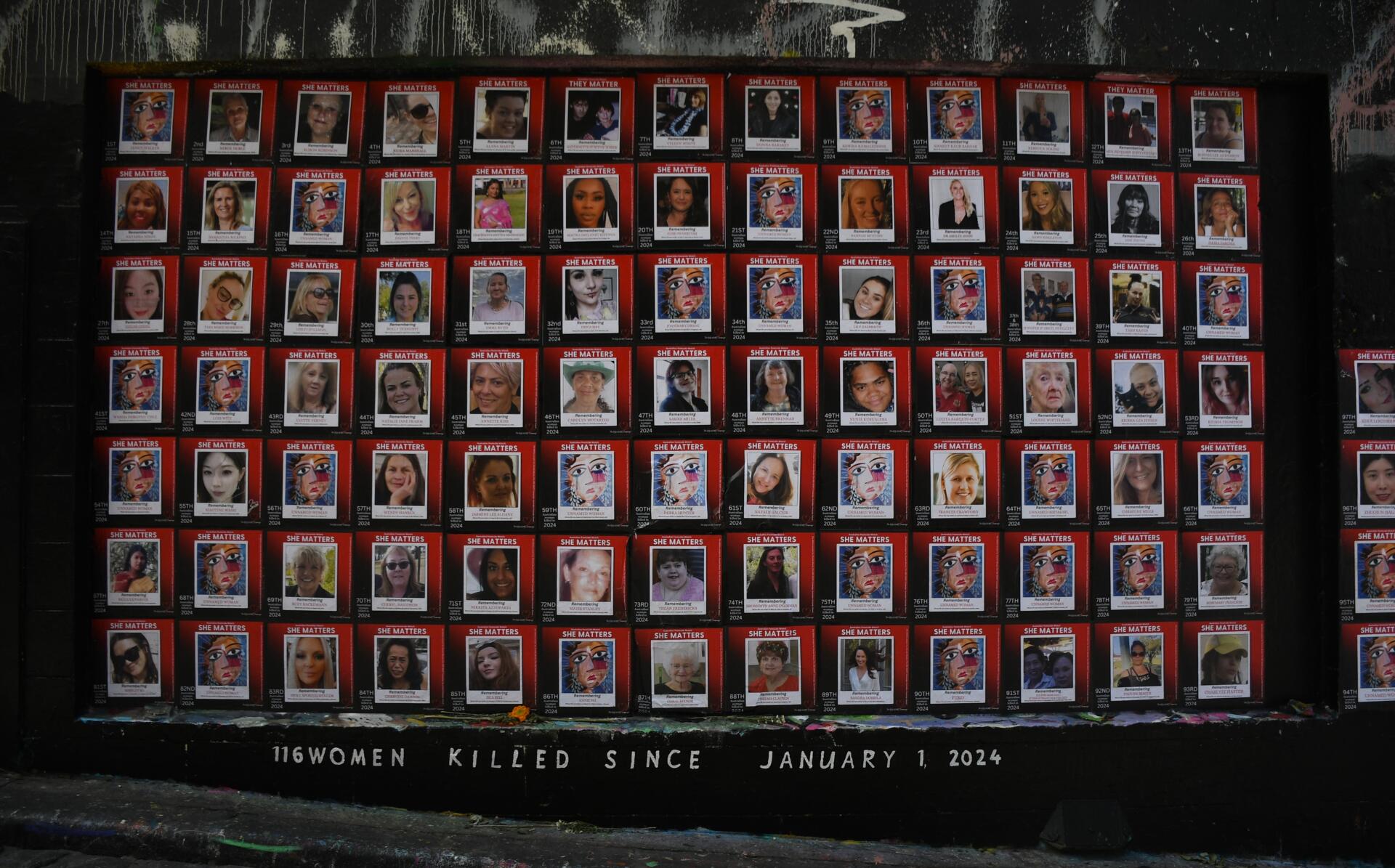
Melbourne’s Hosier Lane is a world-renowned riot of colour, graffiti layers thick on top of graffiti until it peels in an ever-evolving pastiche of street art. But one mural which appeared on the south wall, just off Flinders Street, remains untouched: a shrine originally featuring 116 faces, each one a woman allegedly killed by violence since January last year.
Four days after it appeared on International Women’s Day on 8 March, the memorial was already outdated. As of 1 May, the number stands at 127.
The accumulating toll is maintained and published by journalist and femicide researcher Sherele Moody, who founded The Red Heart Campaign and Australian Femicide Watch, a self-funded project dedicated to tracking and documenting the stories of Australian women and children lost to violence.
Moody said the mural’s location in Hosier Lane was a strategic and deliberate choice. Erecting it in a legal and ever-changing street art destination carried some risk that it could be painted over and just vanish anytime – and that exposure, that threat to its existence is the point, she said.
“It represents the temporary and fragile nature of womens’ lives,” said Moody, who constructed the memorial alongside a team of volunteers led by artist Dans Bain.
“I often have that discussion with families who’ve lost someone to violence. They’ll say to me, “I just spoke to her or I just kissed her good night the night before”,” she said.
“One day she is here and the next day she could be gone”.
Australian women are allegedly murdered at a rate of one per week according to Australia’s National Research Organisation for Women’s Safety (ANROWS).
Behind this accumulating death toll are grieving families, exhausted advocates, and frontline workers carrying the weight of a crisis that was largely unmentioned by political leaders in the election campaign until the deaths of 7 women over 7 days forced it back onto the agenda
It was in the horrified aftermath of the Bondi Junction stabbings that, on 28 April, Prime Minister Anthony Albanese declared gendered-violence a “national crisis”.
Six months later, his government pledged $4.7 billion to protect women’s safety, reaffirming its commitment to end gender-based violence “in one generation” as outlined in the National Plan to End Violence against Women and Children 2022–2032.
Last week, following another spate of alleged killings of women across Australia both major parties proposed additional measures and funding to combat gender-based violence.
Labor’s ‘Commitment to Women’ statement announced plans to invest an additional $8.6 million in men’s behaviour change programs and perpetrator interventions like ankle bracelet monitoring. They also proposed new measures to curb financial abuse and coercive control.
The Coalition’s ‘Commitments to Address Family and Domestic Violence’ proposed an additional $90 million package focused on strengthening bail laws, criminalising the use of mobile phones to perpetuate harassment, and the implementation of a National Domestic Violence Register.
But until then, the issue had barely rated a mention from either major party over the election campaign despite mounting public pressure for urgent action on gender-based violence.
An analysis by The Citizen of 1,000 of the most Instagram posts from the two leaders, reveals a stark absence of messaging around women’s safety.
Both parties devoted the overwhelming majority of their public messaging to economic concerns, including cost of living, jobs and energy prices.
Dutton’s captions mentioned keywords related to cost of living in 293 posts, followed by 227 posts about the Australian economy, and 96 about climate and energy. Albanese’s feed follows a similar pattern.
In contrast, acknowledgement of women’s safety, domestic violence, or gender-based violence were rare. Just five posts by Dutton, and 18 by Albanese, representing only 0.5 per cent and 1.8 per cent of their respective feeds.
While social media posts do not directly equate to legislative priorities, they help shape public narratives and reflect the political zeitgeist, according to the Pew Research Centre.
With Albanese’s 461,000 followers and Dutton’s 54,000, Instagram remains a powerful agenda-setting tool increasingly used to connect with voters and define important issues.
“The failure of our political leaders to speak up on issues related to the safety of women and girls reflects a broader gap between rhetoric and meaningful, sustained political leadership,” said Professor Kate Fitz-Gibbon, an international research leader in the field of violence against women and femicide from Monash University.
“Australians are looking to political leaders for reassurance that this issue is being taken seriously,” she said.
“The lack of visibility on platforms like Instagram undermines trust and signals to victim-survivors that their safety is not a national priority.”
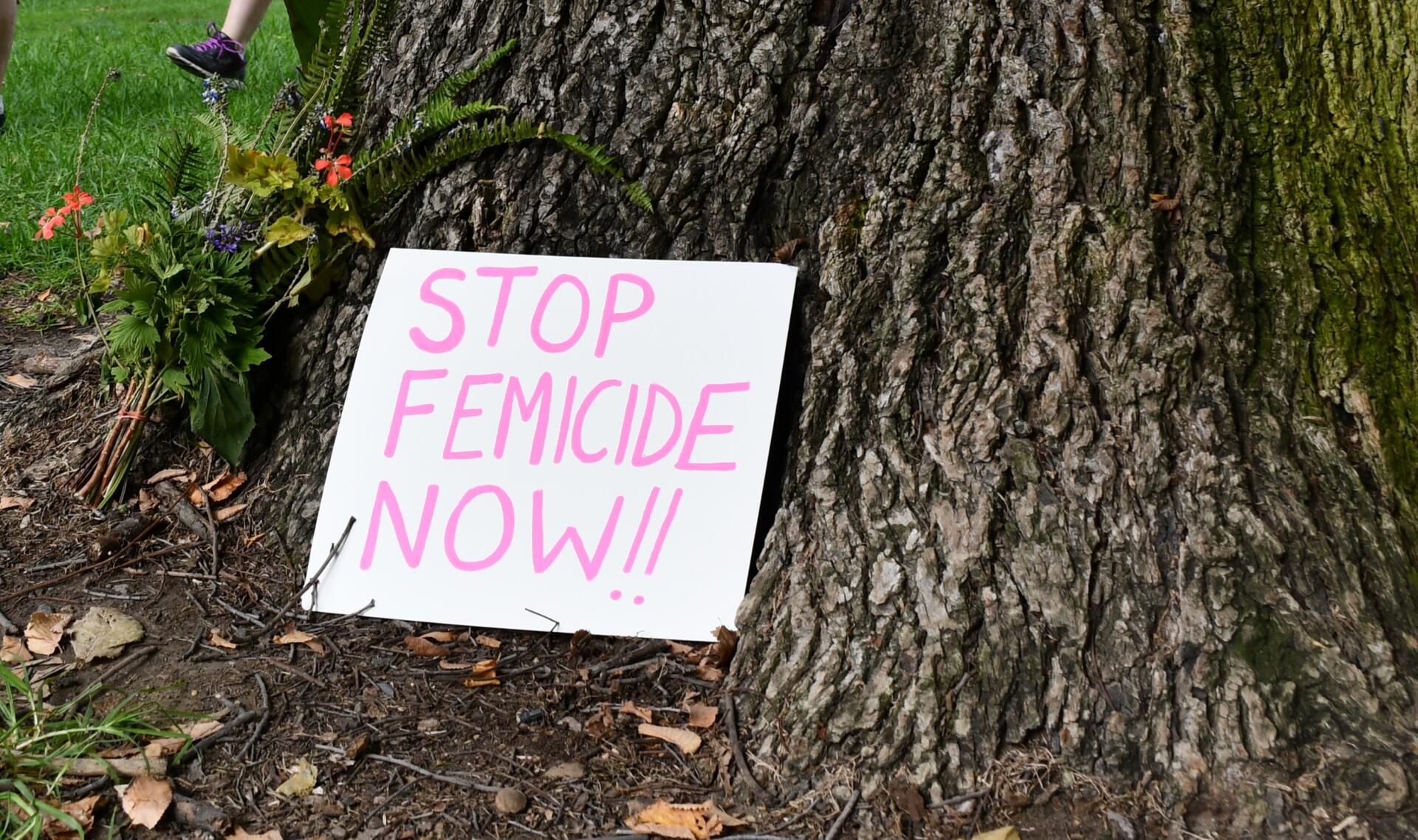
Femicide refers to the intentional killing of women and girls motivated by her gender. It is the most extreme form of gender based violence, according to UN Women. Photo by Ashleigh Wyss
Journalist and femicide researcher Sherele Moody said the scarcity of political messaging communicates to voters how little “Australian politicians care about women’s lives”.
“Social media is a vitally important tool for anyone, especially for politicians,” said Moody.
“They have obviously decided that murdered women are literally worth less than two per cent of votes,” she said.
“It is a reflection of their attitude about violence against women, about male violence, about ensuring that we have enough funding to keep women alive, that we have policy that ensures that perpetrators are held to account and that the resources are there moving forward for us to end the killing of women.”
Twenty-four Australian women have been killed by violence in 2025, according to Australian Femicide Watch. Their toll includes Australian women and children killed overseas, as well as undetermined deaths where violence is suspected.
Another volunteer-led initiative, Destroy the Joint’s Counting Dead Women reports 14 women have been killed so far in 2025. Last year, the toll reached 78, up from 64 in 2023, the highest toll since 2015, when 85 women were killed.
There is no official national toll of all women killed by violence in Australia. However, recorded rates of gendered violence are on the rise.
The rate of women killed by a current or former partner jumped 28 per cent between 2021–22 and 2022–23, marking the first increase in decades. Since the late 1980s, rates of intimate-partner homicide had fallen by 66 per cent, according to the Australian Institute of Criminology.
“Progress on addressing domestic, family and sexual violence in Australia has been glacial.” said Professor Fitz-Gibbon.
“These deaths are not inevitable; they are preventable,” she said.
“It is time we treated this crisis with the urgency it demands, which requires at the bare minimum funding for crisis response services commensurate with the scale of the problem.”
The Albanese Government’s pre-election 2025-2026 budget, while promising cost-of-living relief for Australians, offered little new investment in the services and interventions needed to address Australia’s escalating family and gender-based violence crisis, according to Safe and Equal, Victoria’s peak body for specialist gendered violence services.
While the organisation welcomed funding to improve access to the family law system and targeted support for First Nations communities, as well as broader investments in women’s healthcare, the lack of significant new funding left advocates disappointed.
“Victim survivors deserve better. Women and children deserve better” Safe and Equal CEO Tania Farha said in a press release.
“It’s disappointing that the Commonwealth Government decided to address the cost of beer rather than increase support for victim survivors,”
The Coalition’s budget reply focused on concerns about crime and community safety, including tightening bail laws.
“As the federal election looms, maintaining momentum on women and children’s safety is crucial, no matter its outcome,” said Professor Fitz-Gibbon.
“Accelerating efforts to improve women and children’s safety is not a matter of political convenience; it is a moral imperative.”
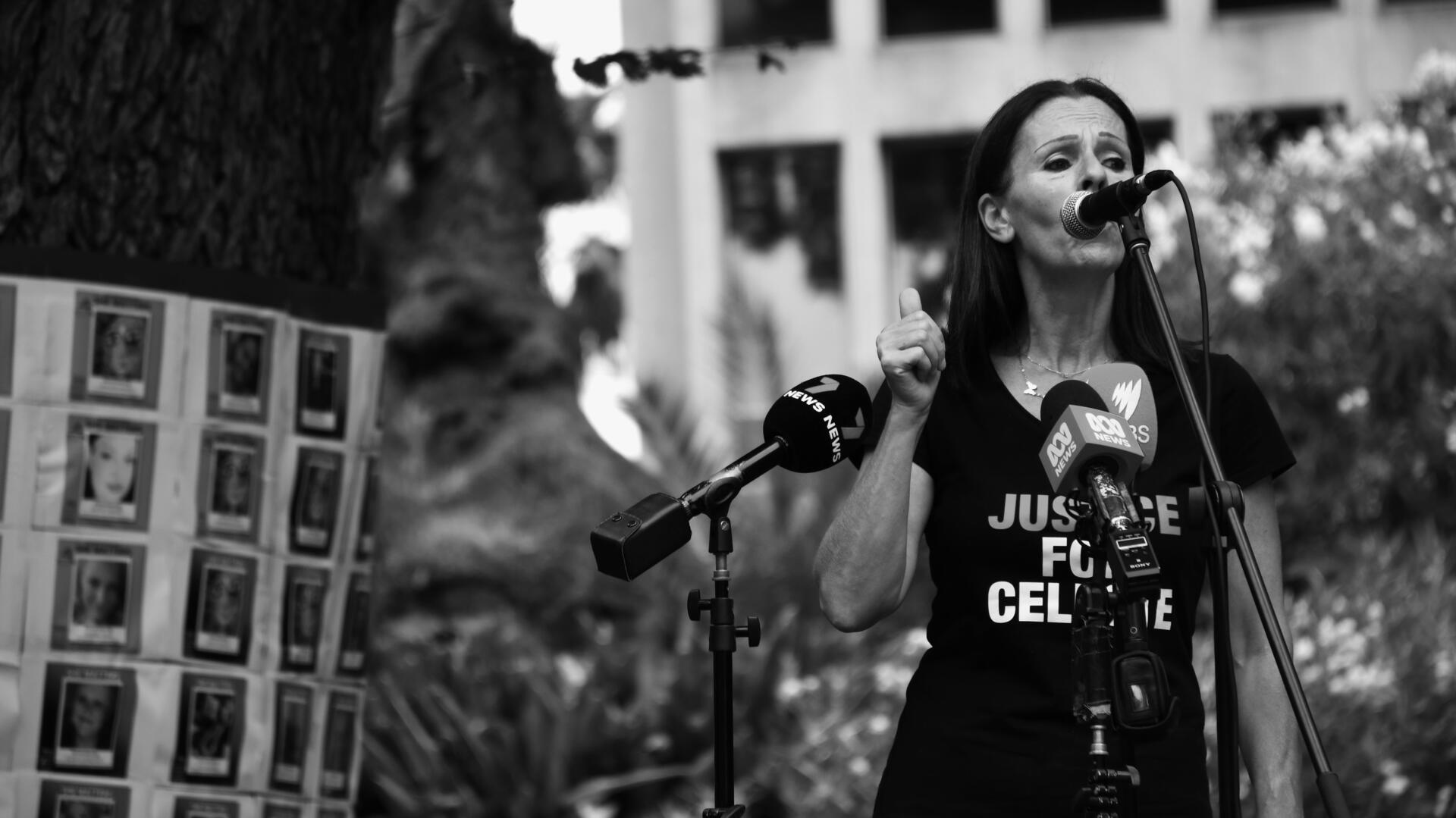
Aggie Di Mauro speaking at the Melbourne She Matters: Stop Killing Women Rally. Photo by Ashleigh Wyss
A week after her daughter, Celeste Manno was memorialised in the Red Heart Campaign’s Hosier lane memorial, Aggie Di Mauro was among the speakers present at the She Matters: Stop Killing Women Melbourne Rally calling for urgent law reforms to protect women.
Her demands included tougher sentencing, enforcement of stalking laws, and electronic ankle-bracelet monitoring for high-risk offenders, including those outside of the domestic violence context.
Celeste Manno was murdered in 2020 by a former coworker who stalked her obsessively even after he was charged for breaching an intervention order.
“We are done funding a system that protects perpetrators over victims,” said Di Mauro.
“We want a justice system that defends the innocent, not the guilty. We will only elect a government that delivers real justice”.
“We will only elect a government that protects women.”