“I actually hated physics in high school, because I never understood it,” Christine Lee said. “I even almost dropped the subject entirely.”
That changed in her final year of high school in Malaysia, when a female physics teacher began connecting classroom theories to the real world.
“Everything started to make sense,” Lee said.
“This one teacher changed my mindset towards physics completely. She sparked a curiosity I never knew I had.”
Lee had originally planned to go to medical school but instead chose to pursue physics at university.
She moved to Australia in 2016 to study at the University of Melbourne, where she did her undergraduate degree in physics and then her masters, finally completing a PhD in astrophysics earlier this year.
During her undergraduate studies, Lee met another influential woman, University of Melbourne astrophysicist Professor Rachel Webster. She encouraged Lee to apply for vacation research programs—short-term university research placements that allow undergraduate students to work alongside academic researchers during semester breaks.
“My first vacation research experience was in astrophysics, and I never left,” she said.
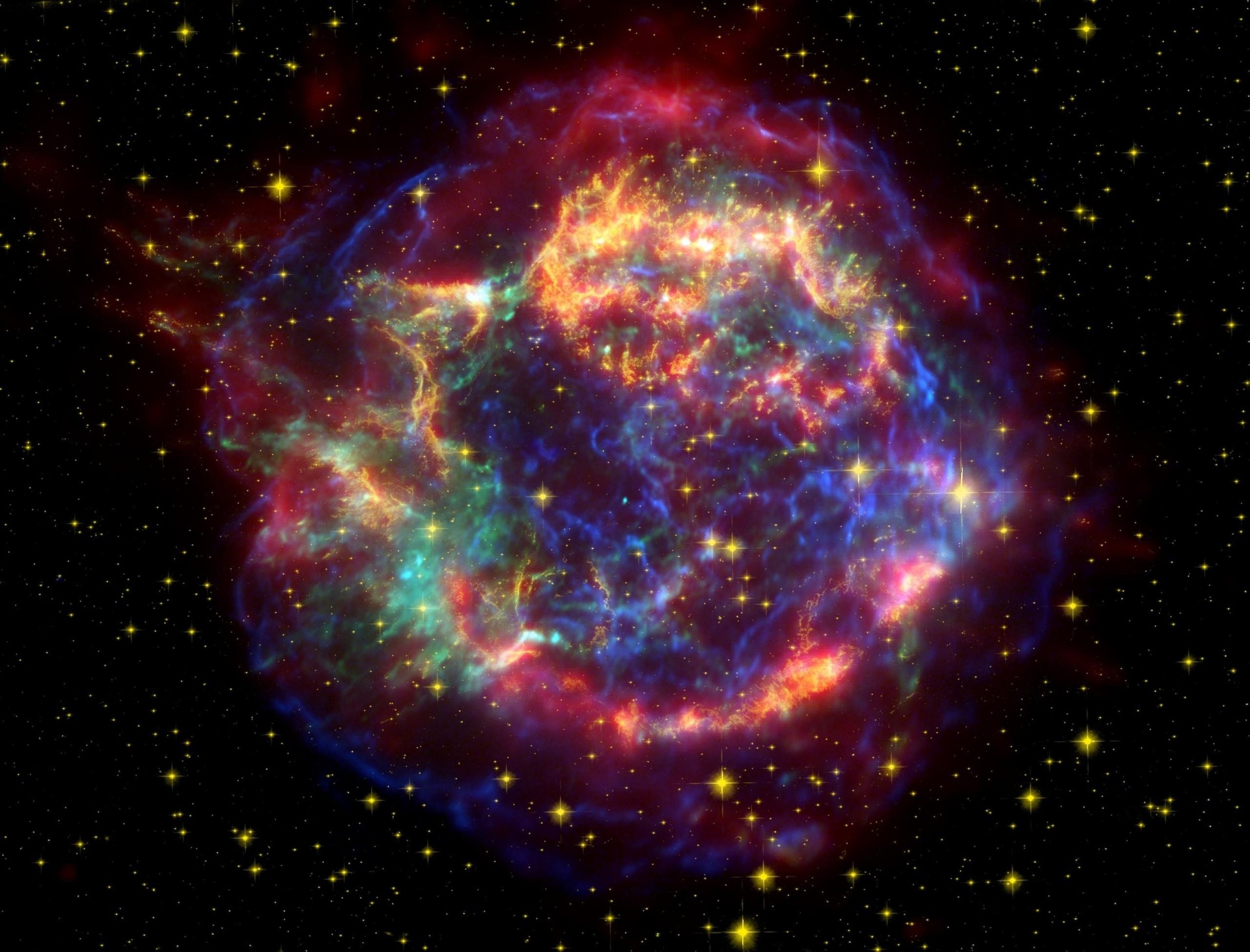
Now, Lee studies core-collapse supernovas, the explosions caused by collapsing stars.
She hopes her research will help scientists better understand the formation of heavier elements in the universe and what occurs within dying stars.
What is a core-collapse supernova?
Stars maintain their stability by consuming fuel and creating energy that pushes against gravity. However, that fuel eventually runs out.
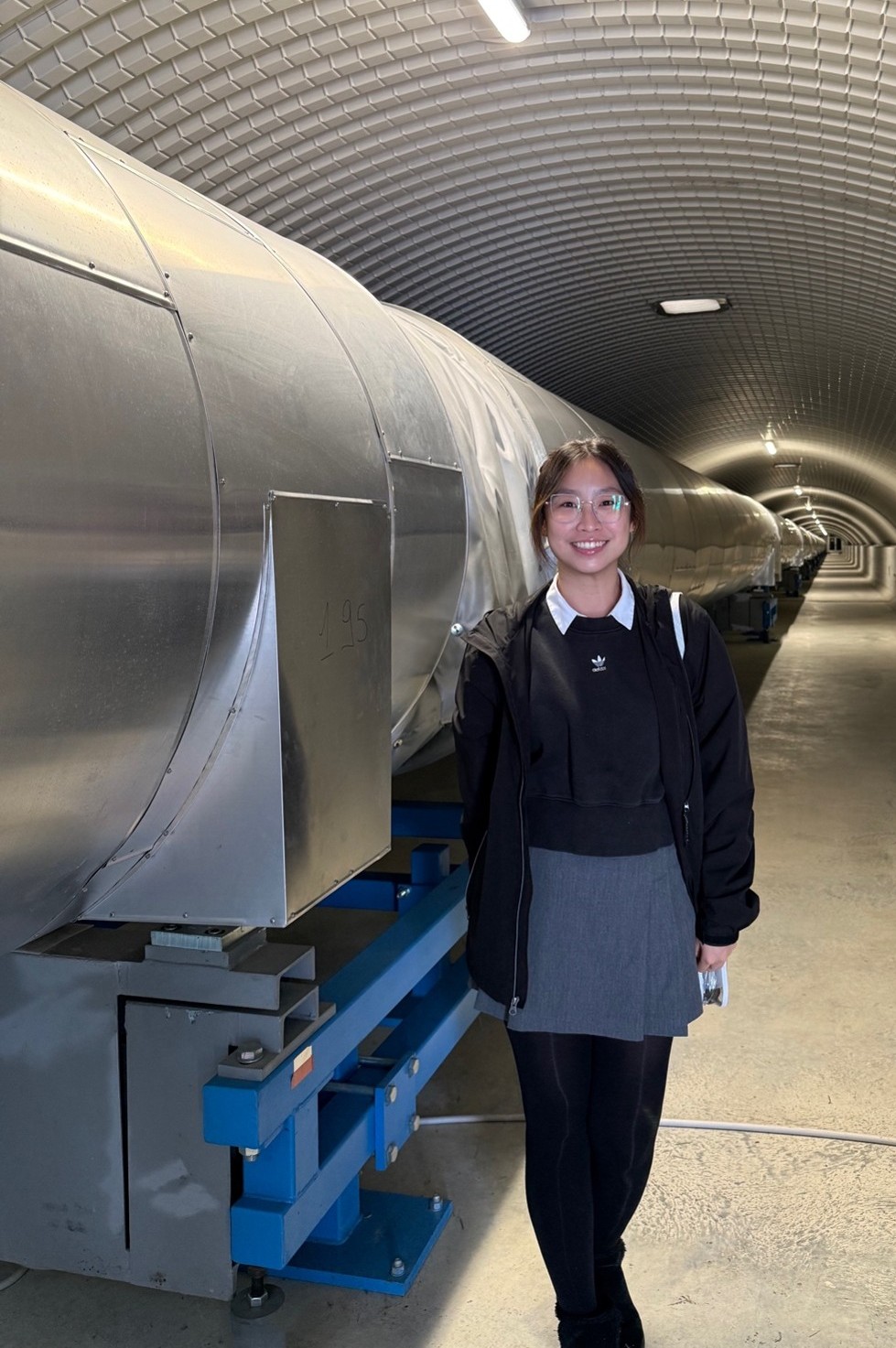
Christine Lee with the Virgo gravitational-wave detector in 2026. Virgo is one of the observatories used by scientists to search for gravitational waves from cosmic events. Photo: Supplied.
A core-collapse supernova is an explosion that occurs when a star runs out of fuel and collapses under its own gravity.
After the core collapses to produce a neutron star, additional material falls onto the dense core and bounces back outward, resulting in the supernova explosion.
When material at the heart of a collapsing star is crushed, it creates an incredibly dense proto-neutron star.
“This material is so dense that one teaspoon of it could weigh as much as the entire human race combined,” Lee said.
As material continues falling onto this core, it eventually reaches a point where it can no longer be compressed further. Instead, the material rebounds outward, creating the explosion known as a core-collapse supernova.
Why are these explosions important?
Core-collapse supernovas produce the extreme energy needed to create many heavier elements in the universe, such as gold, silver, and platinum.
Stars can only produce elements through normal fusion processes. According to the US Department of Energy, heavier elements require much more extreme conditions to form.
“One of the few places where we can get this amount of energy is a core-collapse supernova,” Lee said.
That phenomenon is at the heart of Lee’s research.
“If we understand how a supernova works, that will help us understand our cosmic origin,” she said.
Lee said gravitational waves also play a major role. She described gravitational waves as similar to the ripples created when something falls into water.
These waves are created as material falls unevenly onto the collapsing proto-neutron star.
Unlike light and other electromagnetic signals, gravitational waves can travel through space unobstructed.
Because of this, such waves can help researchers look further into stars, in a way that observations through traditional electromagnetic signals cannot do.
“They can carry information from inside the star out to us,” Lee said.
How do scientists detect them?
Since the first direct detection of gravitational waves in 2015, observatories such as the US-based Laser Interferometer Gravitational-Wave Observatory (LIGO) have recorded signals produced by merging black holes and neutron stars.
But, according to Lee, signals from supernovas are much harder to find.
“The gravitational waves that we have found so far are from black holes smashing into each other, or neutron stars smashing into each other,” she said.
Because supernova signals are much weaker, researchers would need a supernova to occur within the Milky Way galaxy to see it clearly.
But supernovas are rare in the Milky Way, occurring only once every hundred years. The last observed supernova in our galaxy was in 1604.
“So, what we’re doing at the moment is really the preparation work to catch these gravitational waves when they get to us.” Lee said.
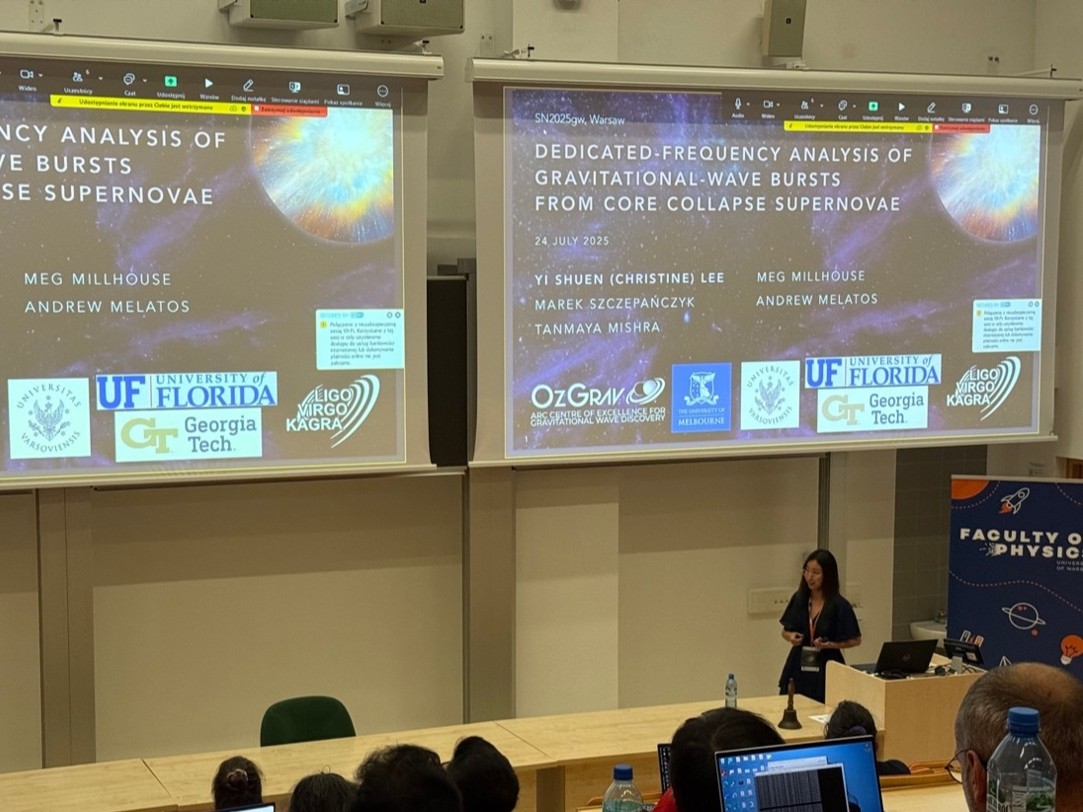
Christine Lee presenting her supernova research. Photo: Supplied.
What are researchers still trying to uncover?
Although scientists understand the broad process behind supernovas, many questions remain unanswered.
“We still don’t know what is really causing the explosion outwards,” Lee said.
Scientists know material rebounds outward during the explosion, but the exact process driving it is still unclear. This uncertainty is part of what keeps Lee motivated.
“There’s just new things that we don’t know,” she said.
“They carry information that would never have reached us from the electromagnetic spectrum that we know and love.”
Lee said researchers were still waiting for the next nearby supernova within the Milky Way galaxy.
“We don’t know when it will explode, but we are really hoping it’s going to come someday within our galaxy,” she said.
“When it happens, it could reveal new physics.”
Lee described gravitational waves as “a new way to observe the universe”.
“So we can see things that are hidden behind things, things that don’t emit light,” she said.
“I hope people can understand a little bit more what a gravitational wave is and how important it is for us to understand our universe better.”
***