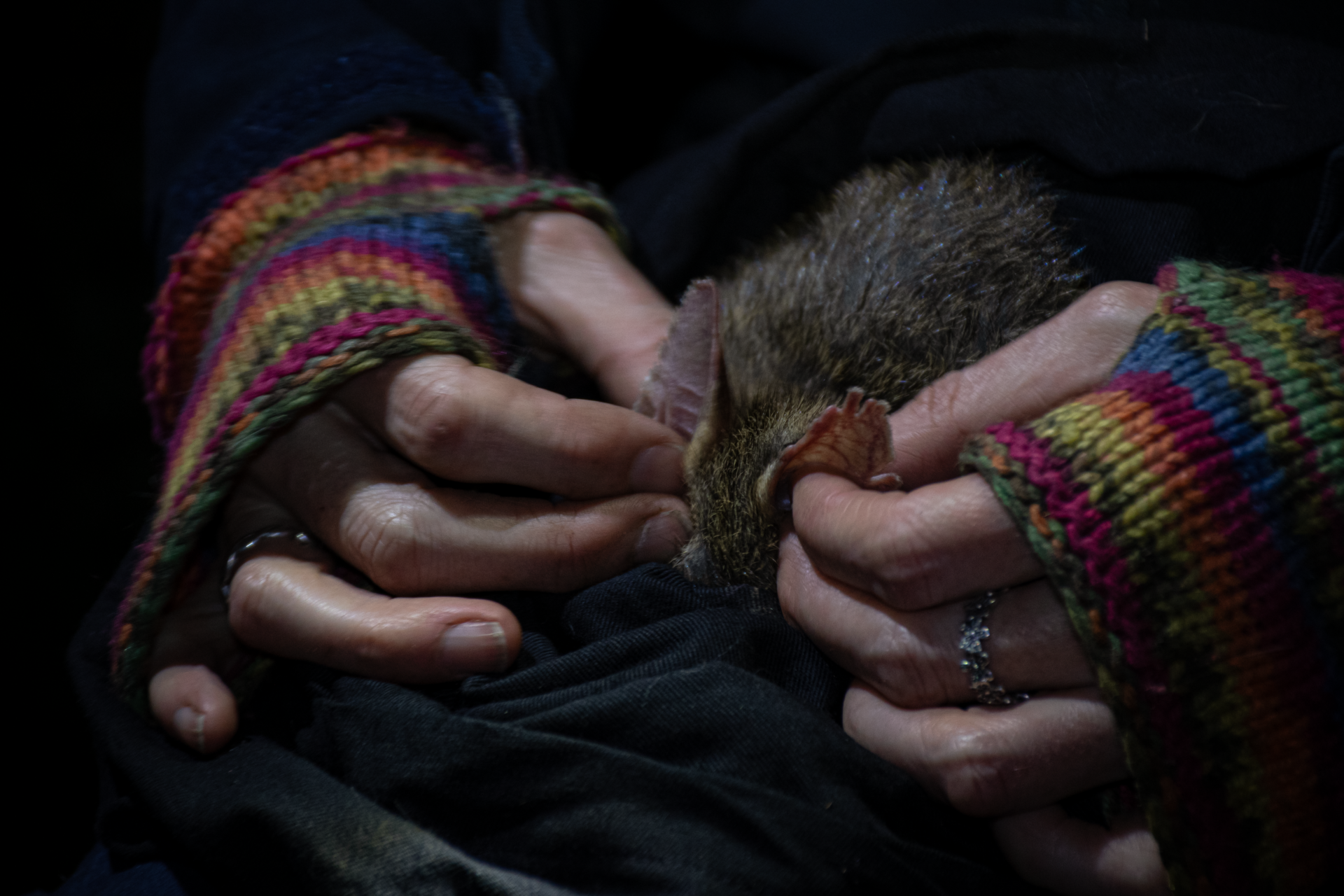
Even soaked with rain, the black calico sack is warm where my palm supports the weight of a tiny creature that should not exist.
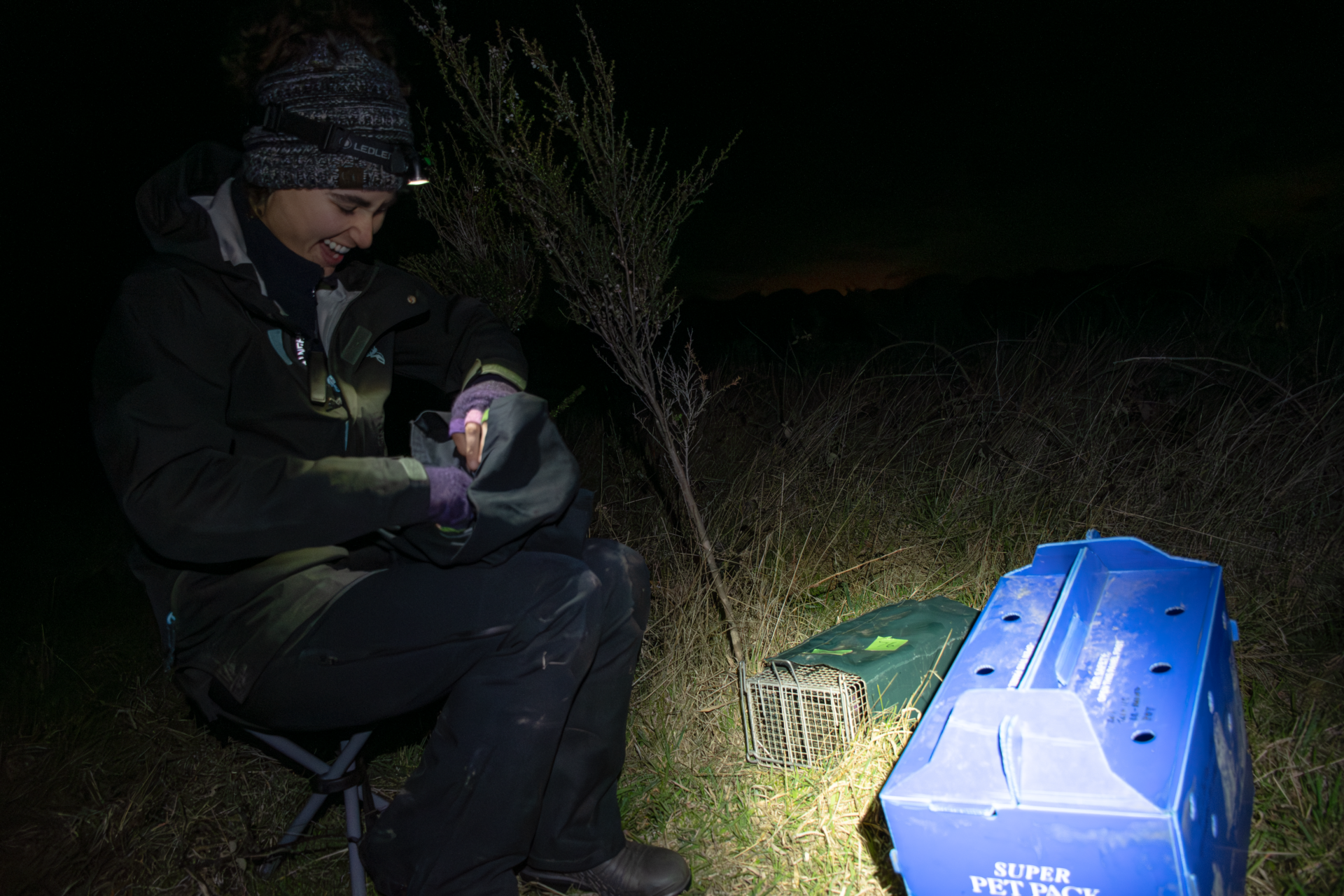
She had been waiting for us in one of the steel traps laid out earlier that afternoon, small cages baited with a tantalising mix of oats and peanut butter. As soon as our headtorches caught the wire, Amy Coetsee grins and declares there was a “bandi” well before the rest of us were close enough to peer through the wire.
Amy kneels, fitting the black calico over the mouth of the trap before sliding open the door. Sometimes the inhabitant needs coaxing, a tilt of the cage or a puff of air. Other times, they shoot straight into the bag like a punted football.
This one shuffles in almost politely. Amy unfolds a camping stool and sits with the sack between her legs. Following practiced motions, she hooks the calico onto a hanging scale. Healthy, just a little under a kilo. The soft electronic chirp of the scanner confirms this is a repeat customer.
Sex, weight, body condition, some scat in a tube. No need for an ear punch, its genetics are already on record. While it has no injuries or parasites, Amy observes two lactating teats and gently checks its pouch. Inside are two tiny, furless joeys, pink and curled up against the warmth of their mother’s belly.
Whether out of trust or resignation, the mother barely reacts to her examination, even with two pouch young to protect. When Amy is finished, she holds the bundle out to me, the faintest wriggle in the calico as the bandicoot adjusts her weight inside.
“Do you want to release her?” she asks casually.
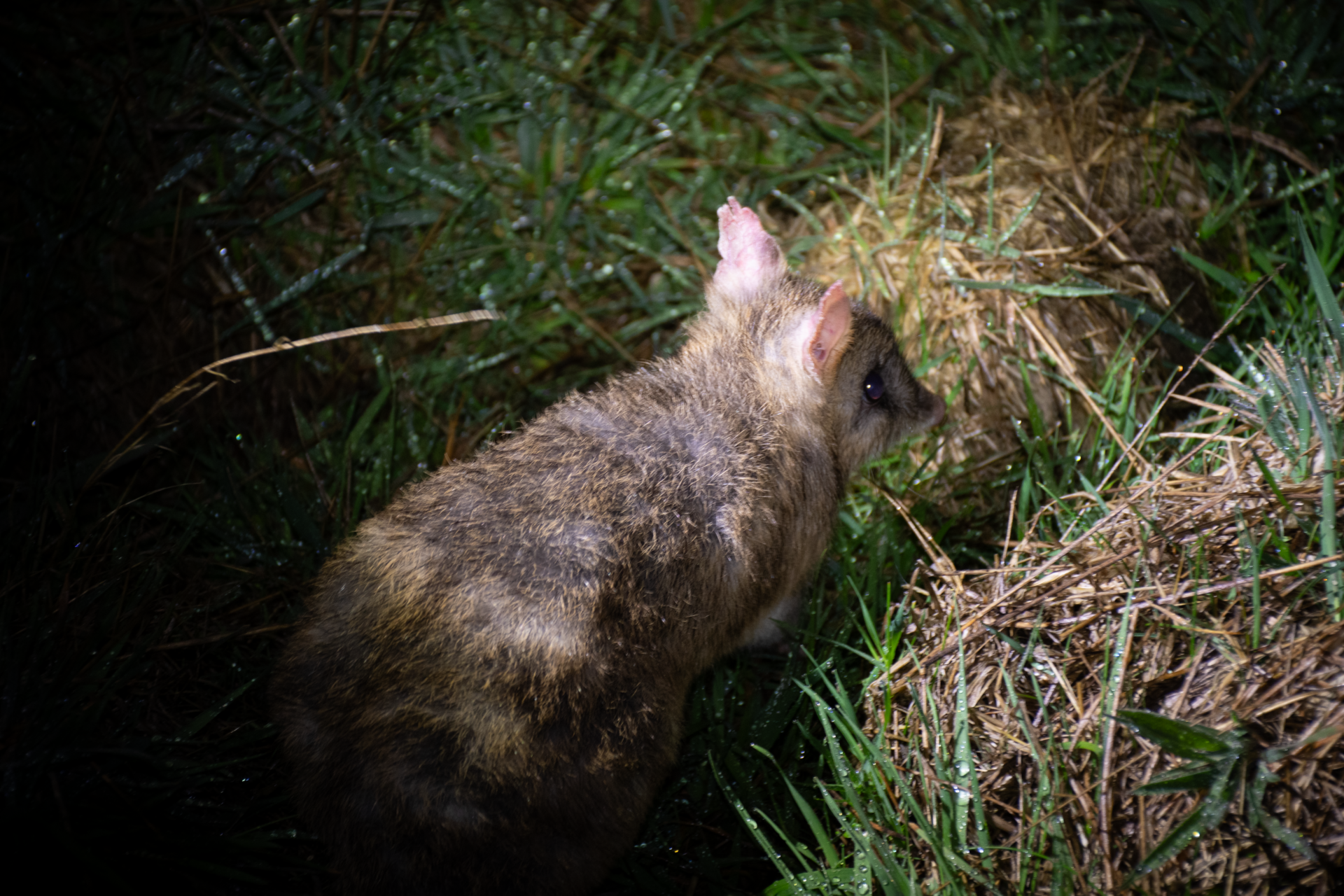
Amy Coetsee inspects a male bandicoot for parasites, his torn ears are a common sight on males, who often get into territorial skirmishes. Photo by Ashleigh Wyss.
Not long ago, eastern barred bandicoots (Perameles gunnii) all but vanished from the Australian mainland. Once abundant across Victoria’s native grasslands, 99 per cent of their habitat has since been destroyed through land clearing to accommodate agricultural and urban growth.
Magnifying this loss, predation from introduced species like the European red fox (Vulpes vulpes) and domestic and feral cats almost annihilated the eastern barred bandicoot. The last surviving wild population in Hamilton, in Victoria’s west, collapsed during the 1980s.
In 1988, the Eastern Barred Bandicoot Recovery Team, a network of conservation groups, state agencies and research institutions, captured the last of the eastern barred bandicoots and established a captive breeding program. Members of the network, which includes what is now the Department of Energy, Environment and Climate Action (DEECA), Parks Victoria, and Zoos Victoria, aimed to prevent the little diggers going extinct.
Early attempts to reintroduce bandicoots into fenced reserves on the Victorian mainland repeatedly failed; just one fox can wipe out the entire local population.
The eastern barred bandicoot was declared extinct in the wild in 2013, another marsupial fast living up to Australia’s grim post-colonisation track record of mammalian extinctions. It was a period of “doom and gloom” says Amy, of empty traps and failed releases perpetually thwarted by foxes.
Taking a new approach, Zoos Victoria released bandicoots into the wild on French Island in 2019.
An ecological fort protected by a moat in the form of Western Port Bay, French Island has – by improbable luck and intense vigilance from rangers – remained fox-free, offering the eastern barred bandicoot its first real chance at recovery. Their numbers flourished, and in 2021 they were reclassified and upgraded to endangered.
In most retellings of the conservation of eastern barred bandicoots, this is where it concludes, a binary reclassification from lost to redeemed, a happy ending.
This is not to downplay the accomplishments, decades of hard work and tenacity of the researchers and conservationists who got them there, least of all the woman who handed me that calico bundle. It is simply to say, on French Island, conservation success is as entangled with unique characters and local politics as it is with the zigzag, non-linear logistics of bringing back wild creatures from the brink.
French Island is a rustic paradise 80 kilometres from the bustling heart of Melbourne, bordered by rocky coasts, mangroves and heathlands which give way to untouched grasslands and bush. It is part of the traditional lands of the Bunurong people of the Kulin nation, who, for thousands of years, visited the island for seasonal food gathering.
Two-thirds of the island’s 170-square-kilometre landmass is protected national park, a biodiverse haven where more than 500 species of indigenous plants take root, the calls of 230 bird species fill the air, and where animal species like the long-nosed potoroo (Potorous tridactylus) bound through leaf litter and koalas sleep curled in the forks of sparse mana gums.
You will not find wallabies, wombats, black rats or possums here, but echidnas waddle along tracks, swamp hens stalk the roads and wedge-tailed eagles soar overhead.
Amid this remoteness, islanders live by a mantra of self-sufficiency and persistence dictated by the demands of off grid living. With no mains power or water, residents generate their own. Solar panels, battery generators and the occasional noisy wind turbine. Rainwater is collected in tanks while farmers nervously watch their dams amid current drought conditions.
There are no services on the island – no police, no hospital, no supermarket, and no church. If you need anything beyond what you can grow, fix, or borrow from a neighbour, you go to the mainland.
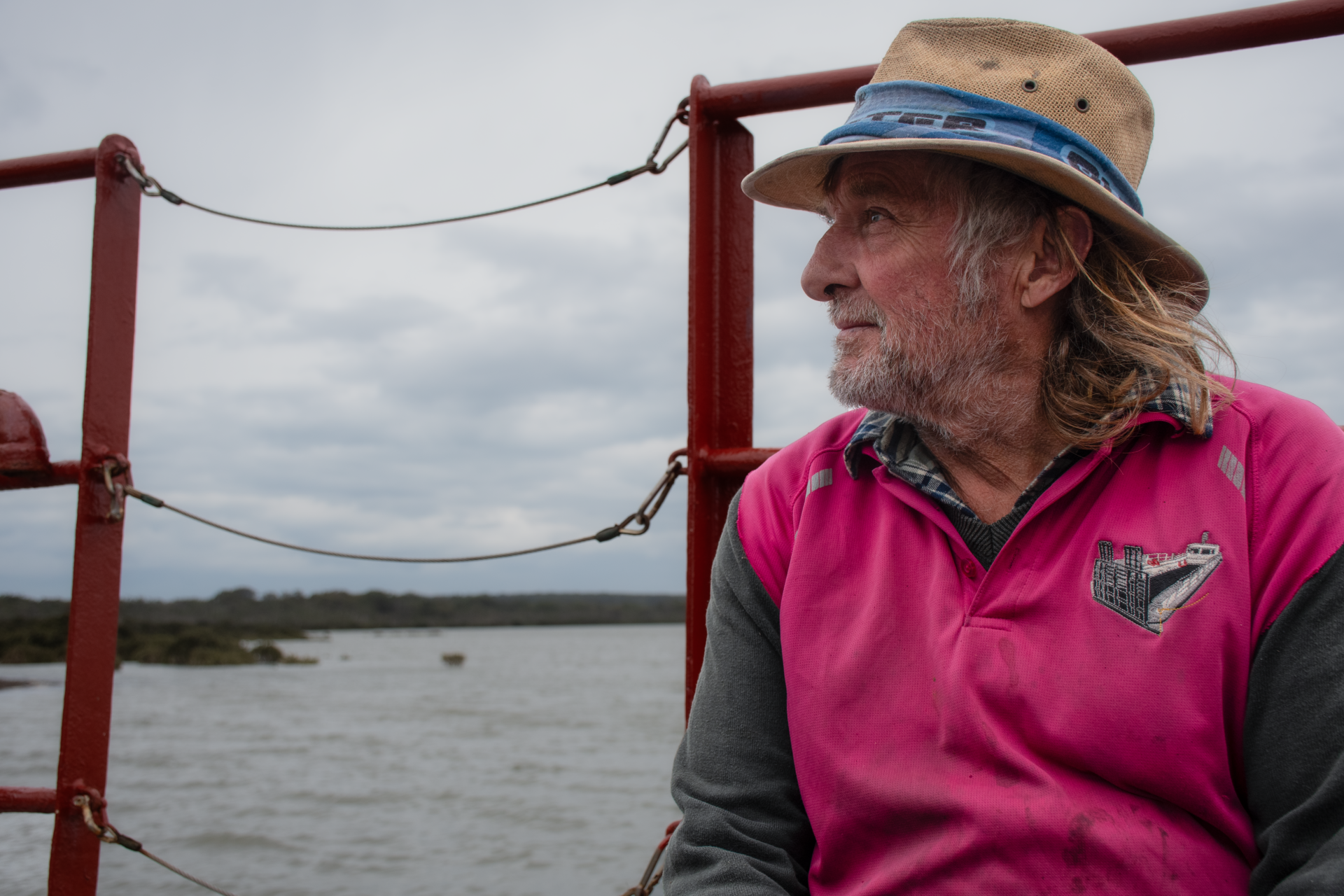
Bruce Chandler, who grew up on French Island and now works aboard the barge remains skeptical about the introduction of bandicoots, echoing his late brother’s advocacy for the island’s potoroos, a population once critical to hampering industrial development on the island. Photo by Ashleigh Wyss.
Bruce Chandler sits perched against the rail of the Spirit of French Island, chatting to me mid-shift through the open window of my Forester as we cruise across Western Port Bay.
“This is our highway,” he says, gesturing to the water.
Departing from Corinella, the barge service is the only way to bring a vehicle across the bay and one of two ways on and off French Island. The other is a ferry from Stony Point, a temperamental service that shuts down when the weather turns sour. A minor inconvenience for some; far more catastrophic for an ageing community with a median age of 52 where the only way off during a medical emergency may well be by airlift.
French Island is an unincorporated territory, operating without the supervision of a local council. Local matters are instead governed by the French Island Community Association, led by 10 representatives whose role in the community play to their strengths, whether they are lawyers, accountants, or local business owners. Some work in the city, others hail from families who have stuck around for generations. Here, the small town cliche rings true. Everyone knows everyone on French Island.
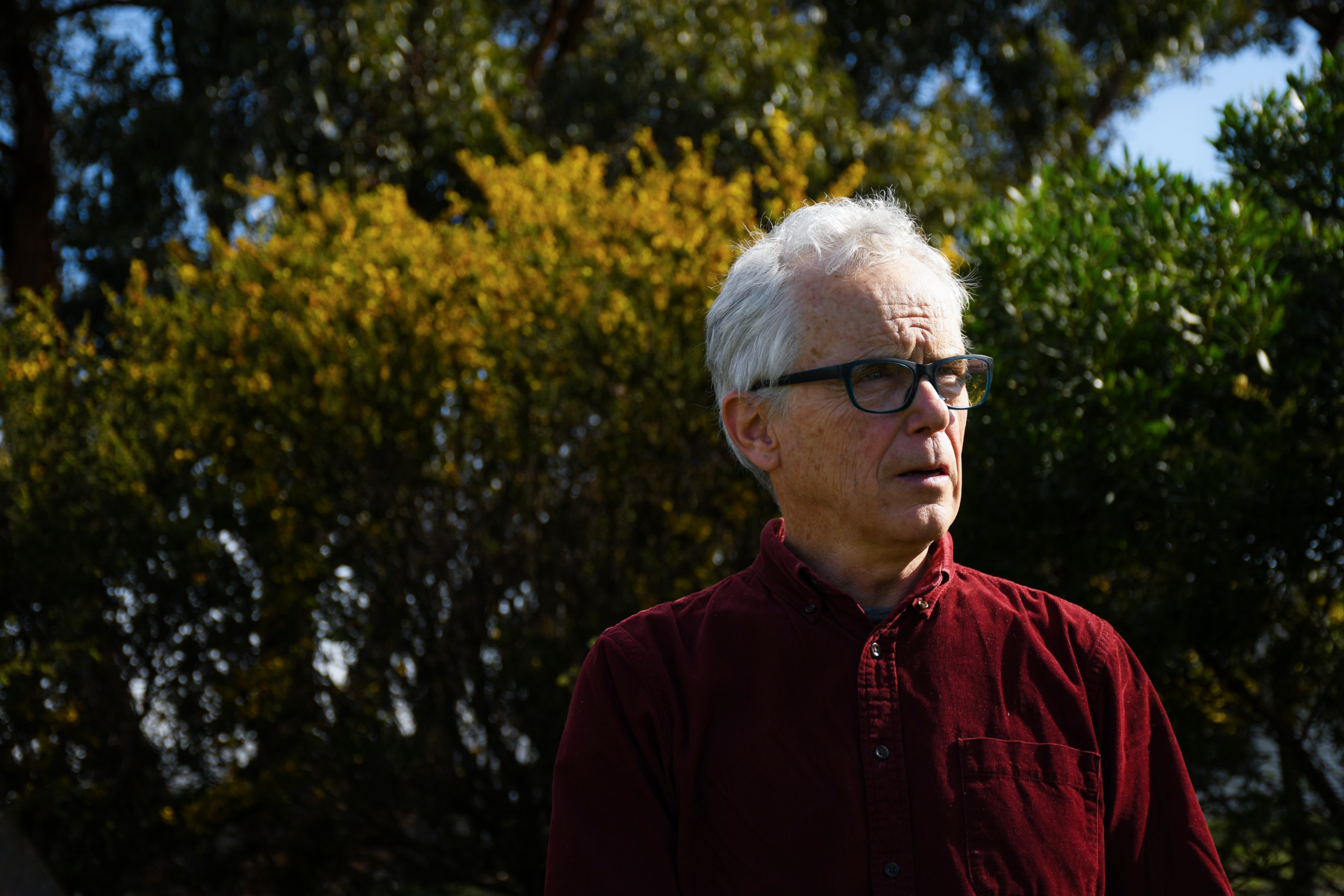
Alan Pentland traded Melbourne stages for French Island bushland, becoming the steward of 75 acres of revegetation. He has planted thousands of trees to create a wildlife corridor and pens a community newsletter, Off the Grid. Photo by Ashleigh Wyss.
“I won’t say there’s nowhere else like it,” says resident Alan Pentland, an actor and comedian who runs a BnB from a protected conservation covenant. “But I’ve never heard of anywhere like this place before.”
“For a population of 120… we’ve got one of everything down here… it’s a very diverse group of people.”
By his reckoning, roughly a third of the islanders are old farming families whose history date back to early colonists, another third are nature-loving “tree changers”, and the rest are simply “people who are here because they don’t want anyone to know where they are”.
During my time on the island I stayed with Phil and Yuko Bock at the French Island Eco Inn, the first bit of civilisation you spot after stepping off the Tankerton Jetty. Over dinners at their table, Phil – an avid storyteller with a hundred lives worth of tales – would map out who lived where, while Yuko – famous for her cooking – sent me off one night with a container of brownies to feed the bandicoot trapping crew.
“Most island residents are generally like-minded regarding environmental conservation and enjoy living here thanks to it remaining relatively undeveloped,” Phil explains.
I learn from him that French Islanders are proud of their independence and fiercely protective of their privacy. While there persists an element of tall-poppy scepticism, in times of grief or crisis, the neighbours who seem the most aloof are often the first ones at your door to help.
That instinct to look after their own in some ways extends to the island’s wildlife. But welcoming an endangered species is one thing, surrendering the island’s autonomy is another.
The closeness of their community and suspicion of external authority is likely why the process to release bandicoots on French Island took more than 12 years. The real challenge came not from the logistics of translocation, or any kind of ecological constraint, but social license.
Amy Coetsee is a threatened species biologist with Zoos Victoria and has studied the eastern barred bandicoot for more than 20 years.
Hailing from the UK, she began her PhD with the University of Melbourne at a time where there were only 100 bandicoots left on mainland Australia. The first time she ever saw a bandicoot was at Woodlands Historic Park, a bushland tucked behind Melbourne Airport.
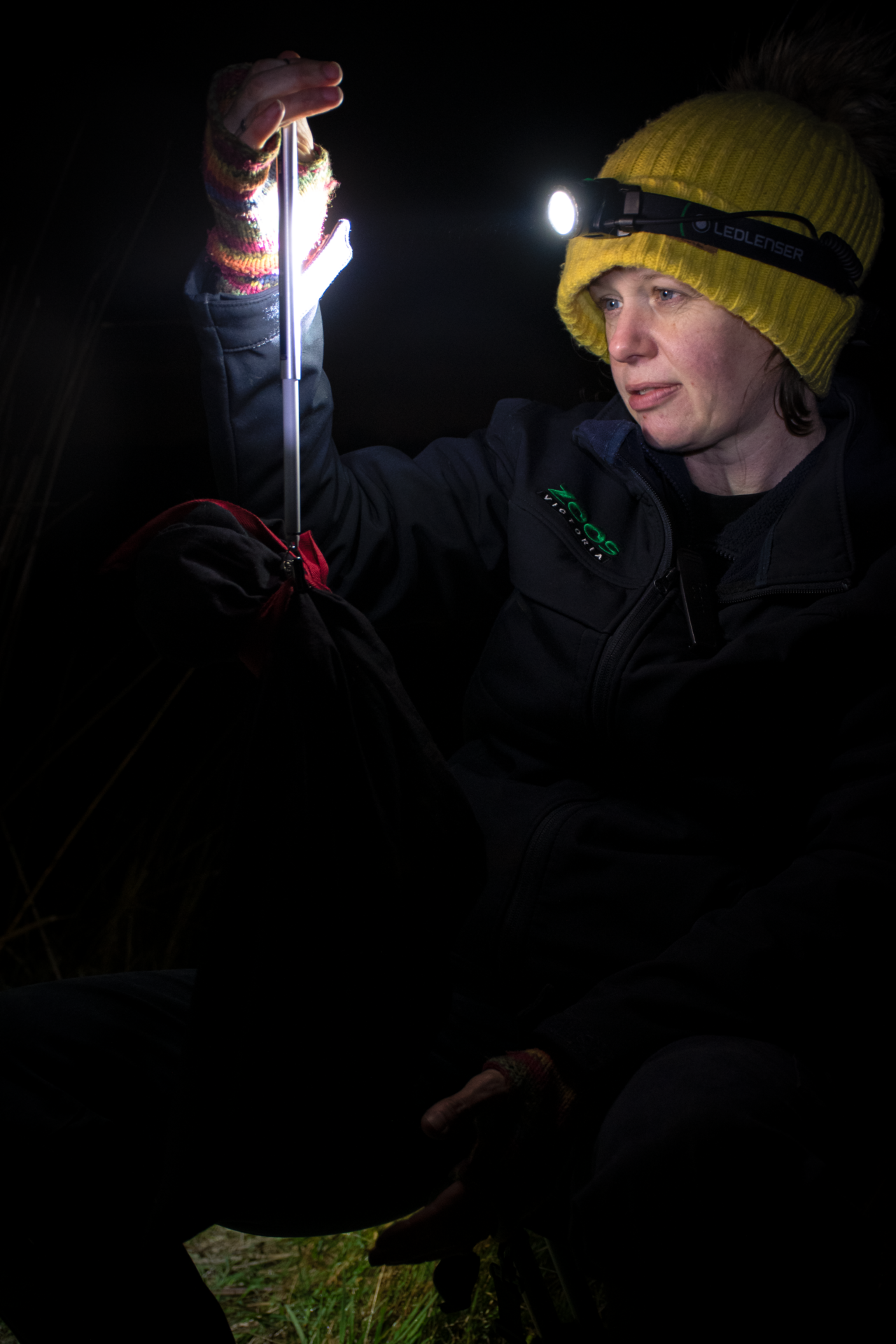
Amy Coetsee uses a hanging scale to weigh a potoroo after retrieving it from a trap. Photo by Ashleigh Wyss.
“I remember checking the traps and we were getting nothing, nothing, nothing. And in the very last trap we had a bandicoot,” Amy says. “We never saw them again at Woodlands until we reintroduced them in 2013, so it was bittersweet.”
The turning point came when conservationist Richard Hill, then chair of the Bandicoot Recovery Team, suggested looking at Victoria’s islands, following Western Australia’s use of isolated land masses as predator-free refuges.
The recovery team was split, Amy says. “[H]alf the team were like, let’s go for it, we don’t know what else to do and the other half of the team, the more purists, were like, ‘No. It’s outside of the historical range, so therefore we shouldn’t put them there’.”
The proposed introduction of bandicoots on French Island was polarising from the beginning, including a calamitous 2007 community meeting in which few of the white-haired attendees could hear the pitch being delivered by Richard and Amy. Those who could were less than enthused.
Being conservationists, not social scientists, “We were quite naive in thinking that [approval] would be easy to get,” Amy says.
Islander’s objections were varied, and many were reasonable. Some worried that having bandicoots on their land would restrict how they managed their properties, including potential impacts on farming livelihoods, one of the island’s most relied-on sources of income. Others feared bandicoots would eat tubers from rare native orchids or displace food sources relied upon by native species like the long-nosed potoroo. Others warned that bandicoots would doom a mystery invertebrate not yet “known to science,” Amy recalls.
Perhaps the most worrisome objection was the possibility that the bandicoot would become another koala.
The iconic Australian marsupials, now rife across French Island and known locally as “teddies,” are not native to the island. They were introduced in the late nineteenth century in a well-intentioned rescue mission after logging and hunting for the fur trade devastated their mainland population in Victoria and rendered them close to extinction in South Australia.
Free from predators and chlamydia that plague koalas elsewhere, French Island’s abundant population became a genetic ark. Most Victorian and South Australian koalas are descended from animals originally translocated from French Island.
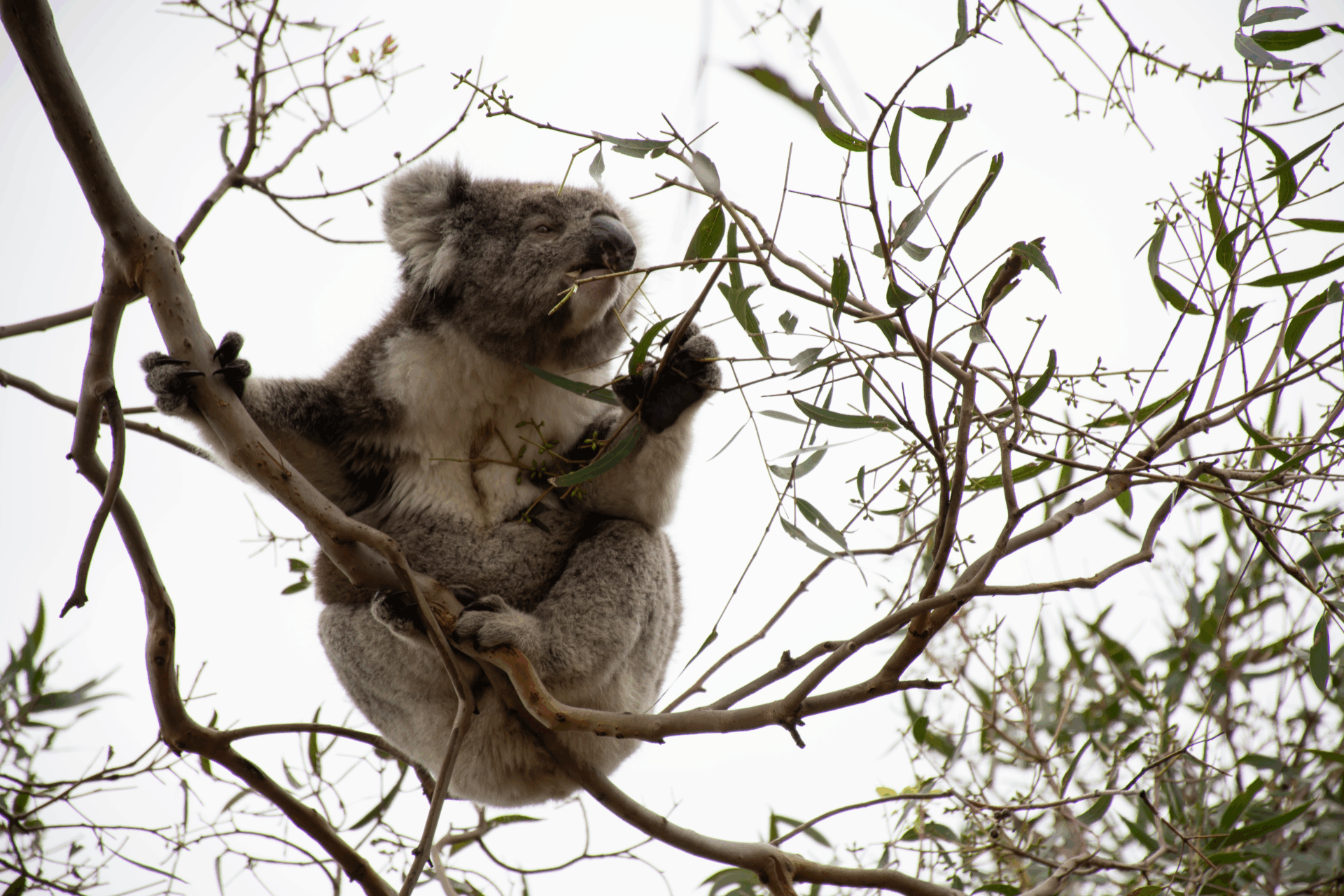
A koala snacking on leaves off Clump Road. In what should otherwise be a postcard perfect scene of Australia’s wildlife, the koala population of Victoria’s French Island are facing a dire future due to starvation induced by overabundance. Photo by Ashleigh Wyss.
However, the success of this conservation comes at a deepening cost. Despite relocation and sterilisation programs, French Island’s koalas have reportedly over-browsed gums and eucalypts to the point of tree death and starvation.
The issue weighs heavily on residents, so when the bandicoot proposal was first raised, it sounded like history repeating itself. Another noble quest to save a species from being lost forever, only for islanders to be saddled with a burden that degrades the rest of their isolated, ecologically pristine safe haven.
A second community meeting on bandicoots fared only slightly better. In 2010 a trial release of 20 non-breeding animals barely scraped through by one or two votes.
French Island was the project Amy least wanted to inherit when she joined Zoos Victoria in 2011.
“I’d heard all the horror stories,” she says. “How was I supposed to turn this around? I don’t particularly like talking to people.”
Amy’s strategy to win French Island’s support took years. Every fortnight she would make the four-hour return trip from her Sunbury home and spend entire days sitting in French Island’s only shop with a cuppa and a taxidermied bandicoot. A conversation starter.
It was not a sales pitch, she says. She wanted to get to know people, for them to decide whether they wanted to talk to her and whether they could trust her.
After six years of her fortnightly vigil in the general store, many were still sceptical. In 2017, after a successful trial release on Churchill Island, Amy organised for a ferry to take the community to dinner and a spotlight night visit to see how the bandicoots were thriving. Warned no one would come, she ended up filling the boat.
“I can talk about bandicoots all day,” Amy says, “but unless people see a bandicoot for themselves, they’re not going to care. And so I thought the only way I can do that is to show them what they’re like.”
In 2019 French Island voted again.
When release day came, French Islanders joined the Zoos Victoria team to set the first bandicoots free into Bluegums parkland on the island’s southern tip.
Prior to their release, bandicoots were given a helping hand by coinciding conservation work dating back to 2010. The Feral Cat Free French Island project aims to transform the already fox-free remote refuge into a safe haven completely free of invasive predators. As feral cat numbers are driven down, islanders and researchers say they have noticed a surge in wildlife, with bandicoots, initially released in Bluegums, appearing in every corner of the island.
The ripple effects of cat management have extended well beyond bandicoots. Other native species are becoming noticeably abundant, including the island’s diverse array of native birds and the long-nosed potoroo.
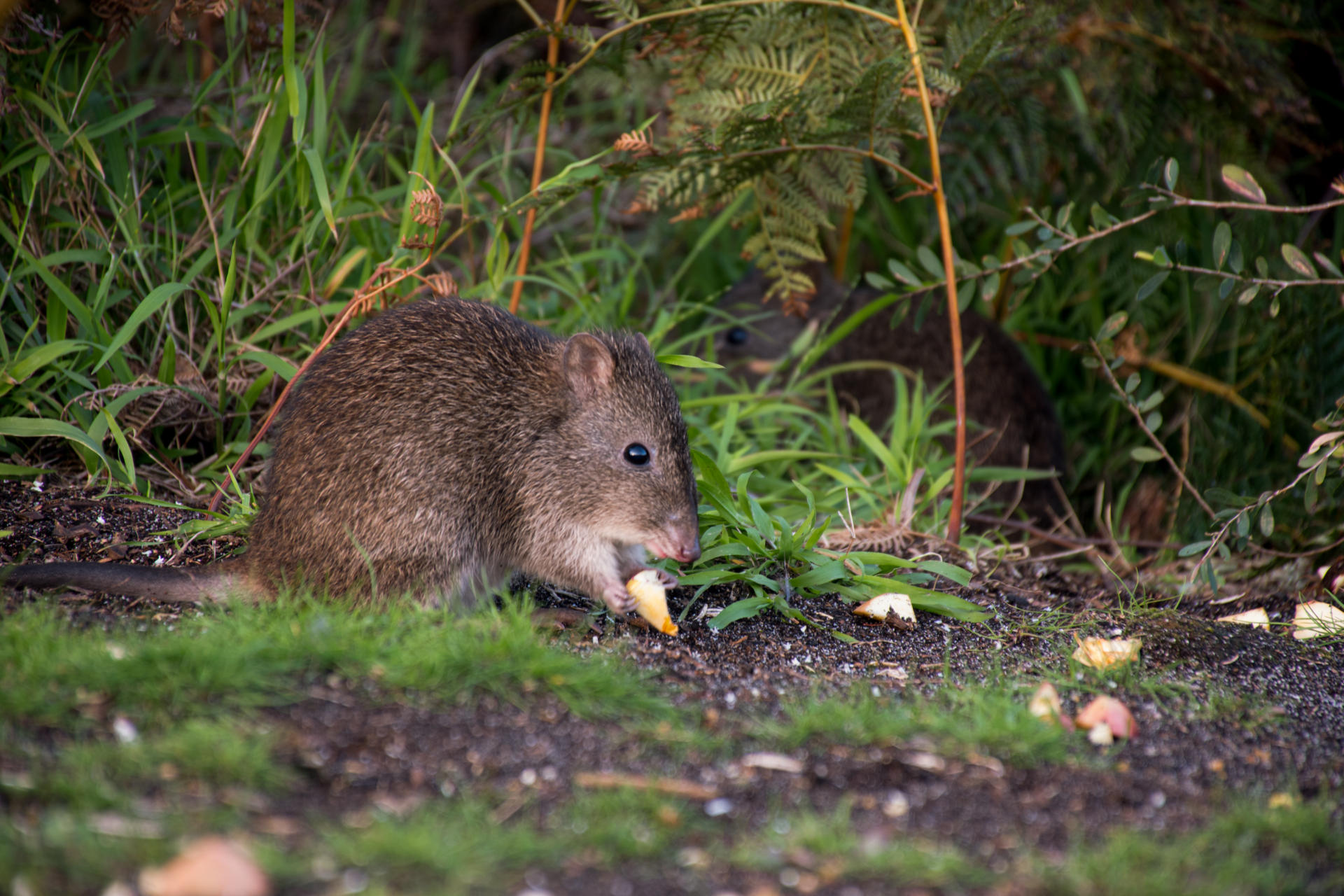
Two well-fed potoroos lingering skeptically at the edge of national park and garden where they have been provided with their dinner. Photo by Ashleigh Wyss.
One of the smallest macropods – members of the kangaroo family with a trademark “boing-ing” gait – the small marsupial is officially listed as vulnerable across Australia, one step shy of endangerment.
An adult potoroo, tufted with soft brown fur, falls into the critical weight range at 700-1500 grams. While less famous than the eastern barred bandicoot, their size means their downfall was similarly predicated by the fact that they are, according to Deakin University graduate researcher Meg Farmer, “perfect snack size” for introduced predators like cats and foxes.
Meg is impossible to keep up with on trapping nights. She powers through the grass while I, in heavy gumboots donned as armour against snakes, try not to trip over blackberry bushes every few metres in an effort to not lose her in the dark.
Utterly effervescent when it comes to all things potoroo, Meg is relentless. During her honours year, she set a 15-hour record on French Island: after laying traps mid-afternoon and beginning her survey at 8.30pm she stayed out counting pots until 6am.
Like bandicoots, potoroos are ecosystem engineers, Meg explains. Their diet of invertebrates, larvae and underground fungi means they are diligent diggers, tilling soil and leaving conical shaped holes as they search for their favourite treats. In the process, they increase soil turnover, water filtration, aid in seed dispersal, and contribute to the spore dispersal of mycorrhizal fungi so beneficial for soil and plants. This outsize role in maintaining ecosystem health means when potoroos disappear, whether snatched up by predators or lost to bushfires, soil compacts and forest regeneration can suffer.
“They’re little guys that pack a big punch,” Meg says.
Meg Farmer wrestles with a sassy, “karate-master” potoroo during a routine health check. Photo by Ashleigh Wyss.
When she started her research amid the rejuvenated feral cat project, potoroos were a rarity. An almost demoralised Meg was half-convinced their existence was a myth.
Desperate, the vegetarian at one stage went through a KFC drive through to buy 10 buckets of popcorn chicken (a favourite bait for feral cats, according to Meg) and even asked for their discarded waste oil, hoping potoroos would also find their 11 secret herbs and spices irresistible. The baffled teenage managers at all six of KFCs she asked understandably declined.
Over time, and after working through a menu of bait options, Meg finally captured her first potoroo with the same peanut and oat mix loved by bandicoots.
“It’s like, oh, they forage for fungi… you think they’re so dignified. No, they just like drunk girl food,” Meg says.
Between cats, traps, snackfoods and arks: the lesson French Island teaches is that as you pull one conservation lever, unintended, as well as calculated consequences emerge. The feral cat project, for instance, was temporarily paused in 2022 due to concerns over non-target trappings of bandicoots and potoroos and restarted in 2023 using cage trapping and targeted thermal shooting guided by a vast camera array across the island.
“Trap happy” potoroos now dominate bandicoot trapping nights, biannual population surveys by Zoos Victoria with volunteers from both on and off the island. On just one night in Bluegums, scribbled clipboard shorthand shows “pots” (43) far outnumber “coots” (seven) across 81 traps.
Potoroos are native to the island, but even locals who have lived on French for decades say many had never seen the shy nocturnal creatures with their own eyes until cat eradication began to make an impact.
Six years ago, it was literally a game of cat and mouse. Potoroos would “white knuckle” their way through life by avoiding cats both temporally and spatially, Meg says, lying low during their most active hunting times and foraging after dusk, hiding in thick underbrush and avoiding open spaces.
In the absence of fires and foxes, “they can survive, not thrive,” she clarifies.
Now, with a lower density of cats, potoroos are emerging earlier, even before the sun sets. Many are utterly blasé about humans, and if you sit quietly, will hop right up to your feet, although a sudden movement or a bird of prey flying overhead is all it takes to send them bounding back into the bush.
With the continuation of feral cat management, both bandicoots and potoroos have a real chance to flourish on French Island.
But, when you are trying to restore the natural world, it doesn’t take much to tip the scales.
Off Bayview Road, one resident lays out a veritable feast for the potoroos that emerge from the brush nightly to snack on her offerings of apples and sunflower seeds, holding the morsels up in their little t-rex-like paws.
She is certainly not meant to feed them, but to her it is an essential appeasement ritual, a loving way to ward the pots away from her garden.
Around the island, potoroos have become notorious vegetable patch tyrants, with incriminating camera shots capturing the creatures munching on stolen carrots.
At Keith and Lois Airs’ property, pots and coots are tunnelling under netting and savaging produce.
“You wouldn’t mind if they ate the whole one tomato,” Keith says exasperatedly, “They nibble on this bit. Nibble on another bit… but if you say okay to them, they’re the things you’ve got to put up with.”
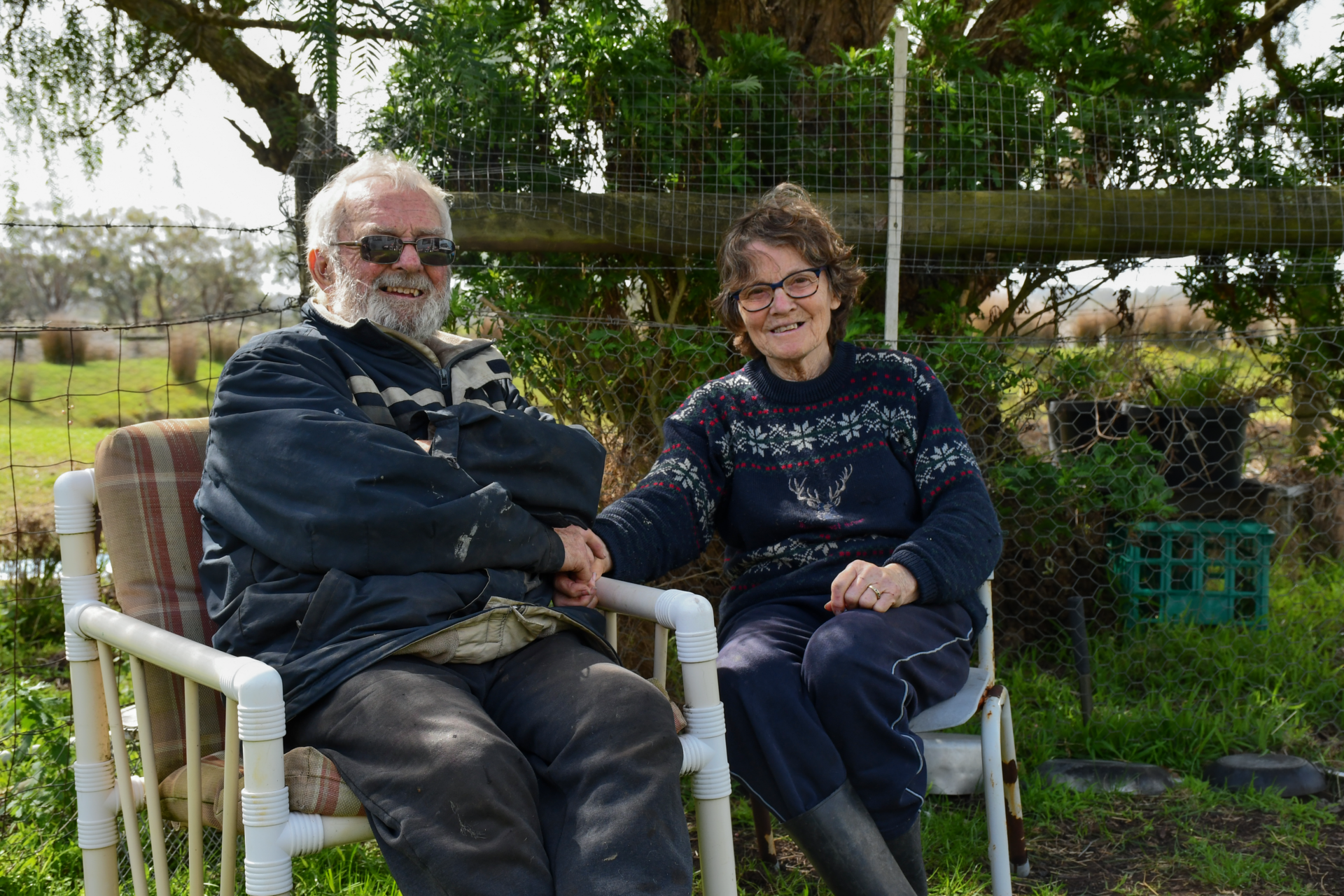
Lois and Keith Airs at their French Island home. Keith – a Vietnam veteran and CFA captain – and Lois – who grew up on the island and once ran its bus tours — have been integral to the island’s volunteer-powered backbone for decades. Photo by Ashleigh Wyss.
Despite the damage, the Airs have welcomed potoroo traps onto their own property for population surveys. Lois, who grew up on the island and is integral to the community’s volunteer-powered backbone, has put her hand up for trapping “more times than [she] can count,” only slowed down by blackberry thickets, her advancing age and the 3.00am finishes.
Meanwhile bandicoots – accused by islanders of preferring pasture and paddocks over native grasslands – have gotten a worse rap, reportedly turning farmland into burrowholed warzones.
Or have they? One indirect consequence of fewer cats is that other invasive species populations have swelled. Controlling feral cats, and monitoring domestic ones, is essential for threatened species conservation. But it also removes a predator that once kept pests like rabbits and rodents in check. Several islanders also say they are observing an uptick in snakes, a pattern they believe is related to an increase in small prey.
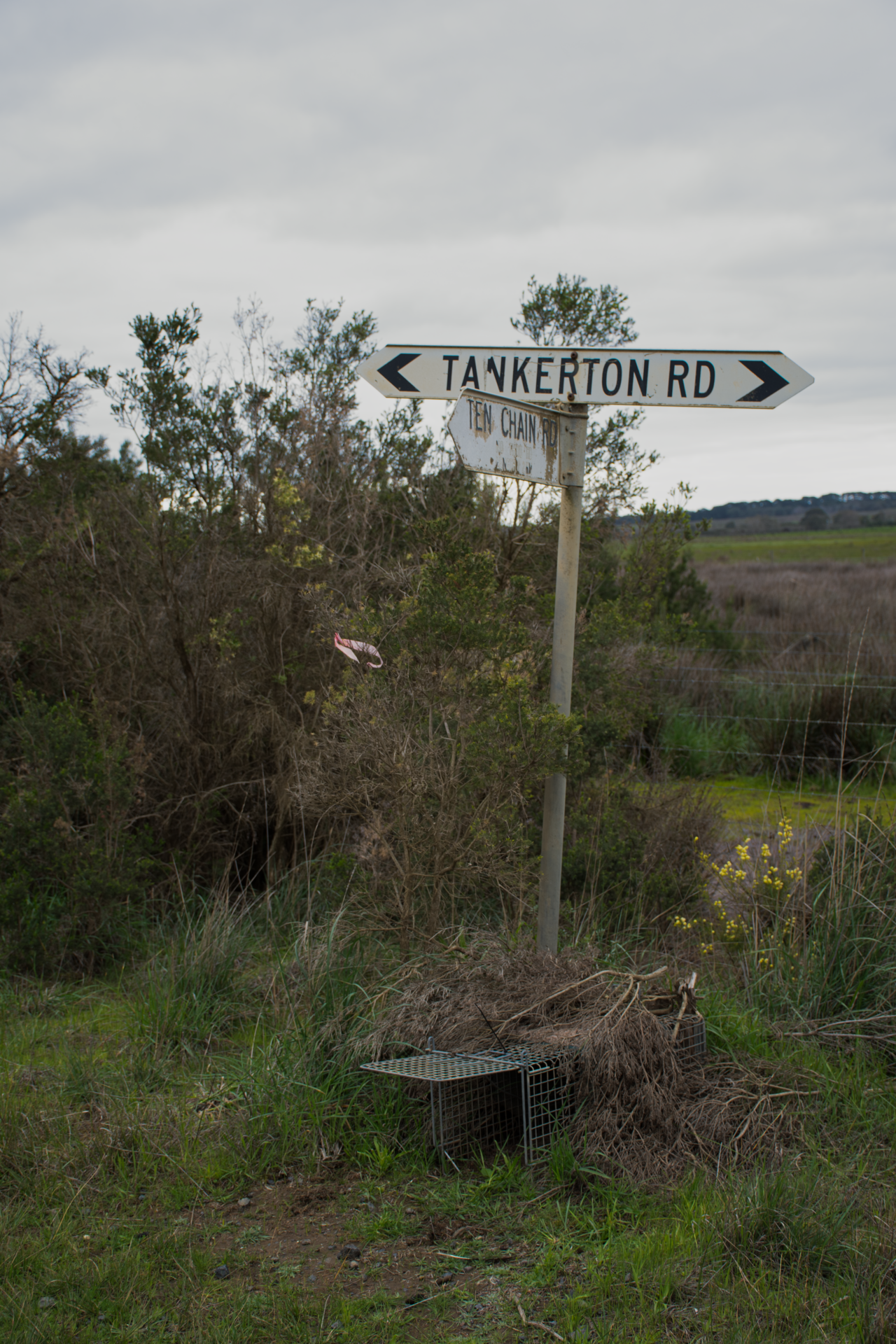
The traces of the feral cat management project are easy to spot across the island in the form of pink tape strips, signalling camouflaged steel traps hidden in the brush around them. Photo by Ashleigh Wyss.
French Island Landcare is mounting a huge effort into suppressing rabbits by destroying warrens and releasing the Khaleesi virus, but there is never a single simple solution.
The irony is not lost on anyone on French Island. Conservation, which aims to protect, preserve and restore the natural world from the forms of human destruction that push our wild creatures to the verge of annihilation – to heal the ecological damage wreaked by colonisation – demands an extraordinary amount of human intervention.
Achieving equilibrium will always be imperfect, these are creatures being brought back to a changed world. With many of their native ranges now inhospitable they must instead be moved to the few remaining places left where they can survive. And even then, there is not enough room on the ark for every single species on the verge of being lost forever.
Importantly, coots and pots – amid the menagerie of rare native species thriving on French Island – were only found again because a community of people who pride themselves on being essentially forgotten let it happen. It is in spite of all odds that they persist.
Despite the occasional stolen vegetable, Meg says a lot of French Islanders are deeply invested in the island’s wildlife and are especially “proud of their potoroos” for surviving so long in the face of such intense adversity.
Plenty of locals volunteer their properties for traps or install their own cameras, either to support research or their own curiosity for the natural wonders they live alongside. Others who seemed aloof or reluctant to offer their own land show more subtle interest. They invest in wildlife-friendly gardens, inquire about what pesticides won’t hurt the pots, or stop Meg in the general store to ask how “their” potoroos were getting on.
Conservation, Meg says, is a “two-way street”.
Eighteen-years after first setting foot on French Island, Amy’s work is far from done. She says the reclassification of eastern barred bandicoots, while a victory, was also akin to “shoot[ing] ourselves in the foot” by way of securing future government funding to help improve the genetic diversity of French Island’s bandicoots. Their upgraded status makes them appear less threatened on paper.
The unfortunate paradox is that the island’s natural isolation, the very thing that lets bandicoots survive, is also a threat, contributing to inbreeding and increased vulnerability to disease.
“If we took our foot off the pedal now,” she says, “we could easily slip back down and have them go extinct in the world again.”
It’s close to midnight back in Bluegums, and I am still holding an ex-extinct marsupial in a bag.
I kneel in the grass, wetness soaking through my two layers of pants and a mosquito making a feast of my top lip as I search for a path in the grass to release the female that will not see her catapulted directly into a patch of blackberry.
“You make sure you have them facing a good direction,” Amy had instructed me.
“You want to give them the best possible chance you can.”
The advice made sense. The night before, I had carefully angled a potoroo towards a soft patch of grass only to witness it dive sideways toward a bramble tangle, oblivious to my intentions.
The calico is damp with dew as I peel it back until the soft grey and brown stripes on her bum emerge. I fold the cloth back further to free her ears, then, her long snout and pink nose.
The sack is completely open, she is free, but for a moment she stays exactly where she is, beady black eyes catching my headtorch.
A second of hesitation, a moment of awe, then, a blur of movement past the reach of our lights. Before my brain has even registered what direction she went, she is gone.