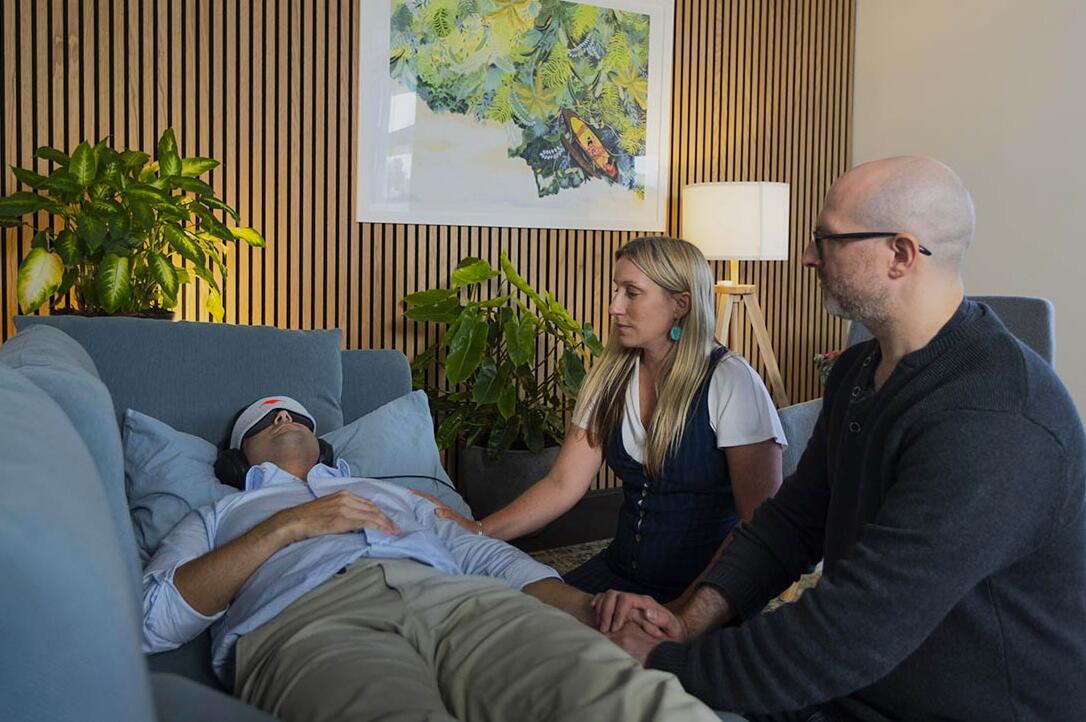
Australia’s leading psychedelic research lab is launching a clinical trial to test a new formulation of “magic mushrooms” for people suffering from major depressive disorder (MDD).
The upcoming Monash Clinical Psychedelic Lab EMBRACE trial will use the primary chemical compound found in “magic mushrooms”—psilocybin—which is responsible for the psychedelic effects.
Psychedelics are a broad class of substances that temporarily produce changes in perception, mood, and cognitive processes, according to the Alcohol and Drug Foundation.
Australia emerged as a global leader in psychedelic medicine research since 2023 when it became the first country to reclassify two previously restricted psychedelic substances to allow controlled psychiatric use—psilocybin for treatment-resistant depression, and synthetic drug MDMA for PTSD.
The Clinical Psychedelic Lab, located within the School of Clinical Sciences at Monash University, pioneered this development as Australia’s first psychedelic research laboratory.
The lab, headed by Dr Paul Liknaitzky, has led the development and implementation of several psychedelic clinical trials since its 2020 inception.
Researchers at the lab said the EMBRACE trial was in its first stages of development, and currently in the process of recruiting.
The study is seeking participants aged 18 to 85 who have been diagnosed with MDD and “don’t feel their current medication is treating their depression well enough”.
Lead co-investigator and head psychiatrist Professor Suresh Sundram said the lab was “very keen on trying to recruit eligible people” to the multi-national study.
Globally, psychedelic-assisted therapy has emerged as a promising breakthrough for treating complex mental health disorders that have not responded to conventional therapies, researchers say.
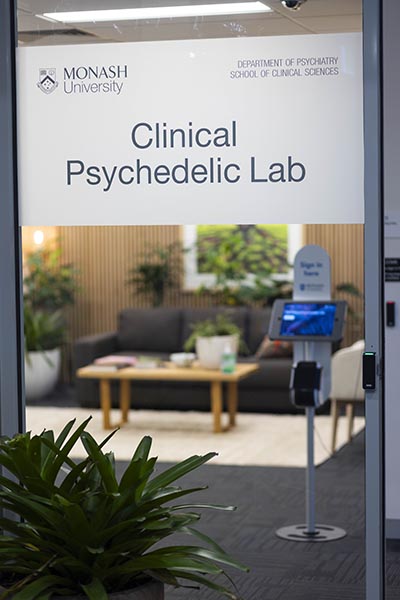
Entrance to the Clinical Psychedelic Lab at Monash University. Image: Supplied by Monash University
Psychedelic-assisted therapy involves the structured dosing of a patient with medication that is accompanied by a specialised therapy session with trained therapists before, during and after the drug is administered.
According to researchers at the lab, the goal is that the combination of specialised therapy and psychedelic medicine application helps reveal deep or early causes of emotional distress and behaviour, to provide new or better ways to address these issues.
Sundram said psychedelic research was still in the early stages of exploration, and psychedelic clinical trials were therefore more complex to organise and administer than conventional clinical trials.
“The people that need to be available to guide these clinical trials are very highly skilled,” Sundram said.
“There are very few people who have that skill-base. The capacity for most health services is not there to be able to do these studies”.
According to a 2026 report published in global medical journal The BMJ, psychedelic-assisted therapy requires extensive therapist training, high therapist-to-patient time commitments, and specialised facilities, increasing both staffing demands and operational costs compared to standard clinical trials.
These costly operational demands come as Australia’s broader medical research sector faces growing financial pressure.
While the Federal Government committed, in this year’s budget, to increase disbursements from the Medical Research Future Fund from $650 million to $1 billion per year by 2030-31, Sundram said declining medical research funding in recent years had made it increasingly difficult to secure financial support for psychedelic research.
“What this has done, of course, is made an increase in competition to try and find money to do psychedelic research,” he said.
Lab trial coordinator Emily Maguire said recent progress had been predominantly supported by industry investment and philanthropic contributions.
“A lot of our money comes from philanthropy,” Maguire said.
The Clinical Psychedelic Lab is not alone in experiencing financial pressures.
Currently, 10 out of the 14 independent medical research institutes in Victoria are reportedly at risk of closure by 2030 without additional state and federal support, according to the Association of Australian Medical Research Institutes.
Despite of the sector’s challenges, researchers remain optimistic about the future of psychedelic medicine and its potential to advance treatment for complex mental health conditions.
In April, US President Donald Trump signed a new executive order to advance the development of and improve access to psychedelic drugs for PTSD in military veterans, moving to expand US federal research into psychedelics and directing the Food and Drug Administration to accelerate psychedelic drug products that have shown promising results.
Clinical Psychedelic Lab trial coordinator Josh Allen said participation in psychedelic treatment by certain groups—including professional sportspeople and military veterans—had helped shift public perception of the use of psychedelic medicine on a wider scale.
“There’s nothing really else that compares to the kind of efficacy rates you’re seeing with psychedelics,” Allen said.
With a background in neuroscience, Allen said evidence of the positive neurological effects of psychedelics was driving his optimism in the field.
“By researching the underlying mechanisms that are responsible for these effects, we can develop a new generation of drugs that might be more suited to specific patient needs,” he said.