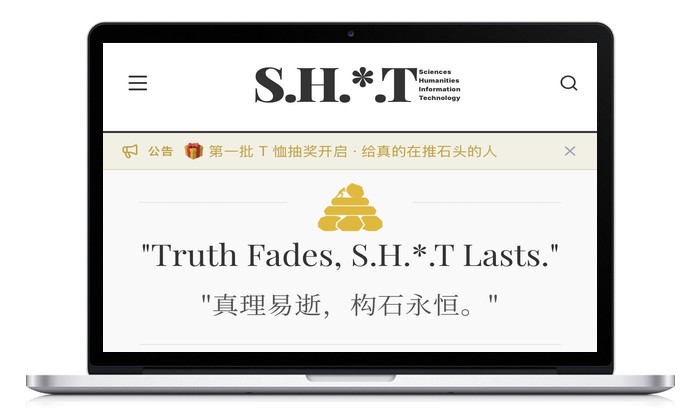
Desperate Chinese amateur scholars have launched their own academic journal to break into the competitive publishing industry.
SHIT—short for Science, Humanities, Information Technology—is a Chinese online platform launched in February 2026 and styled as an academic journal for odd, playful and overlooked ideas.
Its works are presented with formal titles and structured arguments in articles that can be serious or satirical.
Zhejiang Normal University undergraduate Xin Fang found SHIT journal after spending a year toiling on a formal project that still could not pass review.
“I kept revising it, and I kept crying and crying,” Fang said.
After publishing with SHIT in April, he said he saw the platform as a diverse alternative to stuffy academic journals.
“It is very academically decentralised,” Fang said. “A completely open review system allows many new and strange projects to grow.”
SHIT journal’s rise is driven by its absurd use of academic style, turning everyday ridiculous questions into mock research papers.
For students, it offers relief for those who are under publication pressure, as well as academic respectability through real publishing outcomes.
Fang turned his own everyday experiences into ‘A Multifactorial Analysis of Douyin Users’ Streak-keeping Behaviour, Ambiguous Feelings and the Actor’s Single Status’, a mock paper about people who keep daily Douyin (Chinese TikTok) connections alive.

Authors say the journal offers a welcome alternative to the grind of applying for funding and trying to break into the competitive publishing industry. Image: Junfei Du.
It gave him no academic advantage, but Fang “wrote only for feeling good”.
“It was completely satisfying,” he said.
According to its website, SHIT’s mission is to challenge academic hierarchy by arguing that the right to ask questions and interpret ideas should not be monopolised by a small academic elite, and that “discussion should not be reduced to standardised answers”.
The platform’s founder, who goes only by “Snail” online, did not respond to requests for comment.
Snail has posted that SHIT’s purpose is to encourage “cross-field idea recombination” by opening academic discussion to wider public participation.
Snail has also framed the journal as a generational statement, stating older academics often failed to understand young people’s absurdity, while young voices needed attention because they were “the ones shaping the future”.
Economics PhD candidate Jiacheng Zheng, who has co-authored articles for the Journal of Chinese Economic and Business Studies and the Conference on Neural Information Processing Systems, published on SHIT after a romantic disappointment, turning the experience into a mock economics paper about information asymmetry and unequal emotional exchange.
For Zheng, SHIT allowed a kind of honesty that formal academic journals rarely accepted.
His own paper made clear that it was “writing from my own experience instead of pretending to speak for everyone”.
“Formal academic writing often removes the ‘I,’” Zheng said.
“SHIT lets me put myself back into the paper.”
But he said formal academic publishing still had a role to play.
“The formal journal review process is slow and sometimes unfair,” he said. “It still helps filter out noise.”
University of Melbourne PhD candidate Summer Cui said SHIT should be taken seriously as a response to academic pressure.
“It’s not really a joke,” Cui said.
“People realise something. While those things cannot be accepted by journals, they need to find a place.”
Cui said many young students and researchers faced pressure to publish before they were ready, especially in academic systems where publication was tied to graduation.
“This kind of anxiety is killing people,” Cui said.
Like Zheng, Cui acknowledged that the formal journal system was often slow.
“It usually takes one year to two years,” she said. “That’s very normal.”
In her own experience, an 8000-word paper once received about 5000 words of reviewer comments, forcing her to rewrite most of it.
Cui said SHIT offered speed and visibility that formal journals could not, as well as “a healthy way to unleash anxiety”, giving space to ideas that struggled to fit formal academic systems.
She said the boundary between serious and unserious knowledge was shaped by many factors.
“It’s also about genre, about language, about a way of seeing what is true,” she said.
Cui said universities could learn from SHIT’s popularity.
“The uni doesn’t really have that kind of forum,” she said.
“In a serious place, allow a place to allow people to do something stupid.”