The University of Melbourne has received more than $43 million from the Australian and United States defence departments, plus at least $7.1 million from defence-related companies, to support “current research projects”, its new research transparency declarations reveal.
No detail is provided about the nature of the research collaborations with the Australian and US defence departments, while the declarations on corporate affiliations include project titles, summaries and timeframes. Of the military deals, it states only that it received $27.8 million from Australia, and $15.4 million from the US for projects “in a wide range of areas” over multiple years.
The disclosures of defence-related research projects are a consequence of a deal brokered between the university administration and pro-Palestine student protesters in May to end months of escalating actions on campus. These included a month-long Gaza solidarity encampment on the South Lawn at the heart of the university’s historic Parkville campus, and a nine-day occupation of the landmark Arts West building.
The lack of detail might be explained by a wide-ranging caveat included in the disclosures, stating the transparency was subject to “confidentiality and national security restrictions and [would] consider the need to ensure the safety of our researchers”.
Asked if the information published by the university was in line with their expectations, one of the protest organisers, Hala, who did not want to use her last name, said she was “concerned” and “doubtful” that the university had disclosed “the full extent of current research projects with Lockheed Martin, for example”.
She also criticised the way the university was presenting the release of information “trying to reframe the disclosure as coming from consultation with the community as a sign of good faith and conscience … however, this is disingenuous and ignores the reality that we forced this out of them”.
In terms of the substance, the master of international relations student said she hoped more detail would emerge in future disclosures.
“I would be concerned that the next release will just move on to the next set of research projects”.

“Gaza Solidarity Encampment” tents covering the South Lawn at the University of Melbourne in May. Photo: James Costa
Dr Margaret Beavis OAM, a public health specialist who tutors at the university and is vice president of the Medical Association for the Prevention of War (MAPW), said she was “deeply sceptical about anything [the university was] releasing”, a view informed by her continued anti-weapons advocacy and engagement with the university since 2016.
Beavis said that in 2018, in a meeting between MAPW and university executives, the university said there were at least 10 PhD and postdoctoral positions funded by Lockheed Martin. While some may have completed, she said it would be surprising if the $64,773 project now declared with Lockheed Martin was the extent of the relationship.
She had not looked at the specifics of the new declarations yet, but would be scrutinising them because the university had historically not been upfront about weapons ties.
The university declarations also did not specify if the projects with the Australian and US governments included collaborations with companies in the defence industry, nor if the listed $7.1 million from defence companies was separate to, or inclusive of, the government projects.
Responding to a list of questions from The Citizen, the university declined to provide any detail, instead it referred to previously published statements on its ‘conflict in the Middle East and activism on campus’ website.
The university has declared that it currently has nine research projects in collaboration with defence companies Boeing, General Electric, Lockheed Martin, Mitsubishi Heavy Industries and Nova Systems Australia.
These range from aircraft parts recycling to “reinforcement learning and feedback control policies for unmanned vehicles”.
Three of the nine industry-linked projects had their funding details listed as “confidential” due to “commercial restrictions preventing the university from disclosing information”.
In May, Unimelb for Palestine – the self-described non-affiliated, grassroots group of students, alumni and staff which lead the campus protests – published its own “expose” of what it alleges are the university’s research ties to weapons and defence-related companies. Protestor Hala was the lead researcher of that document.
The university did not respond to questions about the allegations in the Unimelb for Palestine “expose”.
Hala claims that the university’s declared relationships “are not the only research projects,” and that her group’s expose listed “13 companies linked to the genocide, but there are more, up to 17”.
The Israeli and US Governments strongly deny that what is occurring in Gaza is genocide. More than 38,200 people have been killed by Israel in the nine months of bombardment and offensives in Gaza since the Oct.7 attacks in southern Israel, when Hamas militants killed 1200 people and took roughly 250 people hostage.
“The difference between my research and theirs is I note both past and current projects, where they only note current,” Hala said.
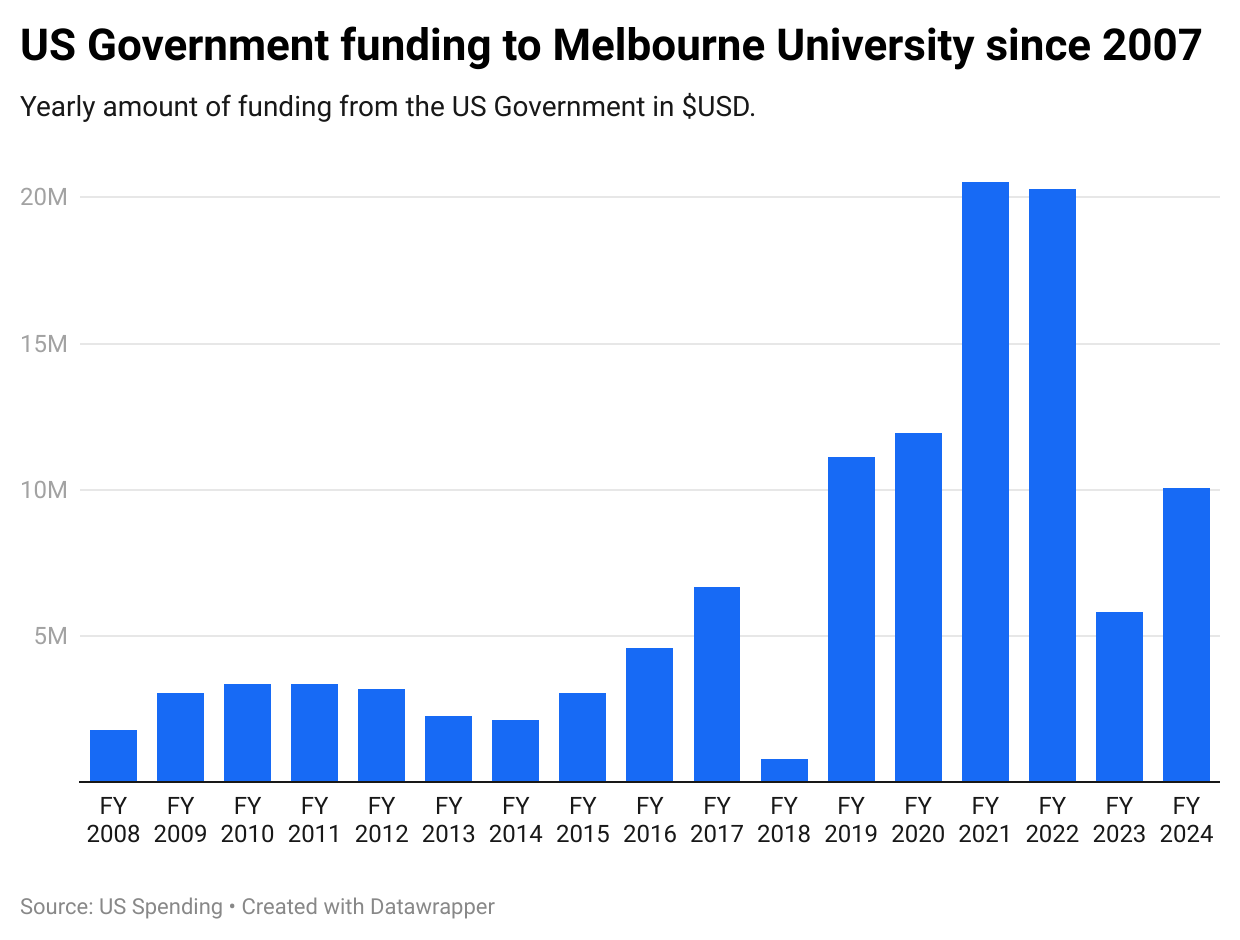
According to the government database USA Spending, 39 percent – or $US47.1 million – of a total $US120.8 million that the university received from the US government and its agencies since 2007 came from the US Department of Defence.
In addition to the defence and corporate contracts, two more projects are “acknowledged” in declarations by the university under a subheading of ‘Other Information’.
One of these is with Rosebank Engineering for $302,816. The company describes itself as a “Australian sovereign defence and advanced manufacturing company”.
The other relates to a university project with Lockheed Martin in collaboration with Melbourne-based Phasor Innovations, which says it “[works] closely with university and industry partners to develop innovative solutions for challenging defence and civilian applications”.
On a defence directory website, Phasor Innovations’ address is listed as Level 2, 700 Swanston Street, the same level as the co-working space at Melbourne Connect, the “innovation precinct” opened on the old Royal Women’s Hospital site on Swanston Street in 2021. The Connect website describes the precinct as “powered” by the university, in partnership with “a consortium led by Lendlease” and “embodies a dynamic collaboration between leading organisations and interdisciplinary institutions”.
The building houses the faculty of engineering and information technology’s school of electrical, mechanical and infrastructure engineering, as well as the school of computing and information systems.
On its website, the university states that in preparing its transparency report it identified “relevant companies in the defence and national security sectors” by referencing the Stockholm International Peace Research Institute (SIPRI) database and the Defence Connect Australian Defence Industry report.
But neither of these databases appear to be comprehensive. The SIPRI database only lists the top 100 “arms-producing and military services companies in the world”, while the link to the Defence Connect report redirects to a news article that lists the top 20 companies with “the greatest footprint in Australia’s defence industry”.
“I think they’re not bothered to present the ties thoroughly,” Hala said, “they’re just trying to appease our demands, thinking this is enough and that we won’t look into this further”.
The university, she said, was “definitely hiding projects through the caveat of ‘national security’”.
The university did not provide The Citizen with the full Defence Connect report, nor did it directly answer questions about whether its lists of defence-related companies identifies smaller defence businesses.
Neither Phasor Innovations or Rosebank Engineering appear on either of the databases linked by the university, though both their websites highlight defence-related work.
In publishing the new declarations, the university also appears to have gone to some trouble to water down some of the messaging around its defence industry and government relationships.
Shortly after the launch of the newly disclosed material, a banner image used on the ‘Current Research Projects’ website depicting the testing of a military drone with a fake payload was removed and replaced with a sprig of wattle.
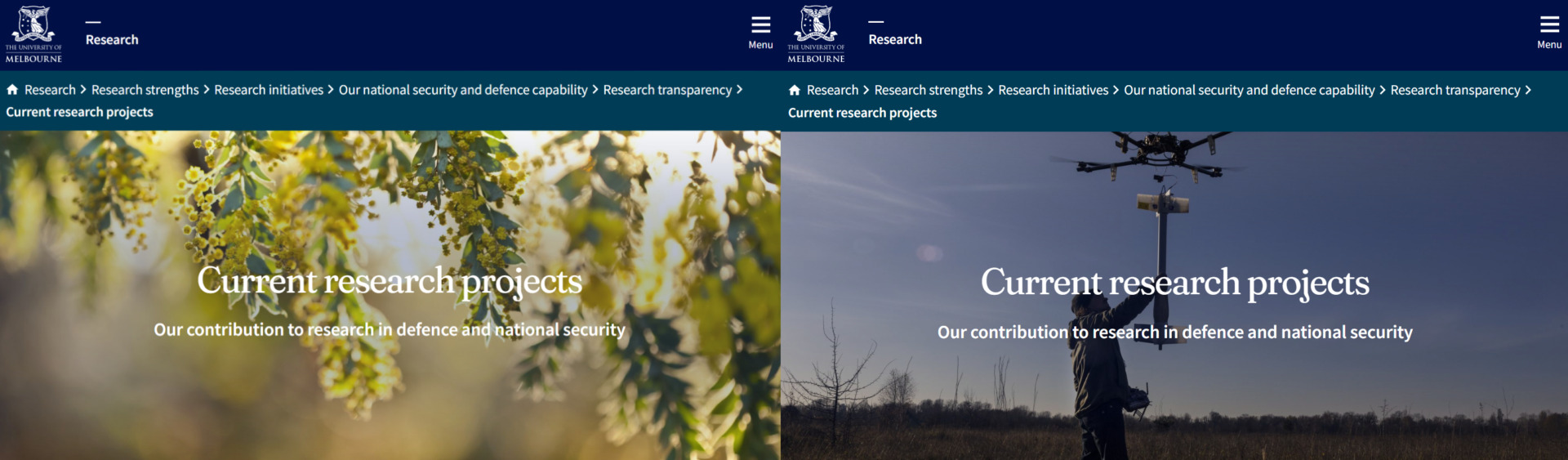
Screenshots of the ‘current research projects’ site, current version (left), old version (right).
A smaller version of the same drone image was also used on the ‘Research Transparency’ site but disappeared shortly after The Citizen contacted the university for comment. (The Citizen retained archived copies of both.)
The deal with the university for additional disclosure of research ties was claimed as a partial victory by pro-Palestine protesters back in May, and underwrote their agreement to pack up camp and leave their sit-in at the Arts West building.
At that time, vice-chancellor Duncan Maskell said in an all-staff email that the university had “achieved a peaceful resolution to the occupation” and that “in an effort to provide greater transparency and remove ambiguity about research being conducted at the university, [it] is committing to additional disclosure of its research grant arrangements…”.
Twenty-one students involved in the protests are presently facing misconduct hearings brought by the university, which may result in their suspension or expulsion.
Claims that surveillance and tracking technology has been used by the university to gather evidence for the misconduct hearings has prompted a preliminary investigation by the Office of Victorian Information Commissioner due to the potential breach of privacy laws by the university.
Would you like to disclose any additional information about the university’s research ties? Send a secure email to [email protected]