When was the last time you were pissed off?
Maybe when you cut your finger. When your partner doesn’t text back. When the Wi-Fi drops in the middle of a Netflix episode. Anger, we tell ourselves, is uncontrollable.
But Phan Thị Kim Phúc knows exactly how controllable it can be.
It’s almost midnight in Melbourne when I hear Kim’s voice through my laptop. She asks where I am, makes jokes, tells me she loves my name, laughs easily and constantly for the next hour. Just like that, my nervousness melts away.
Most people know Kim as the terrified girl running naked after a napalm attack in the 1972 award-winning photograph that became one of the most powerful representations of the Vietnam War.
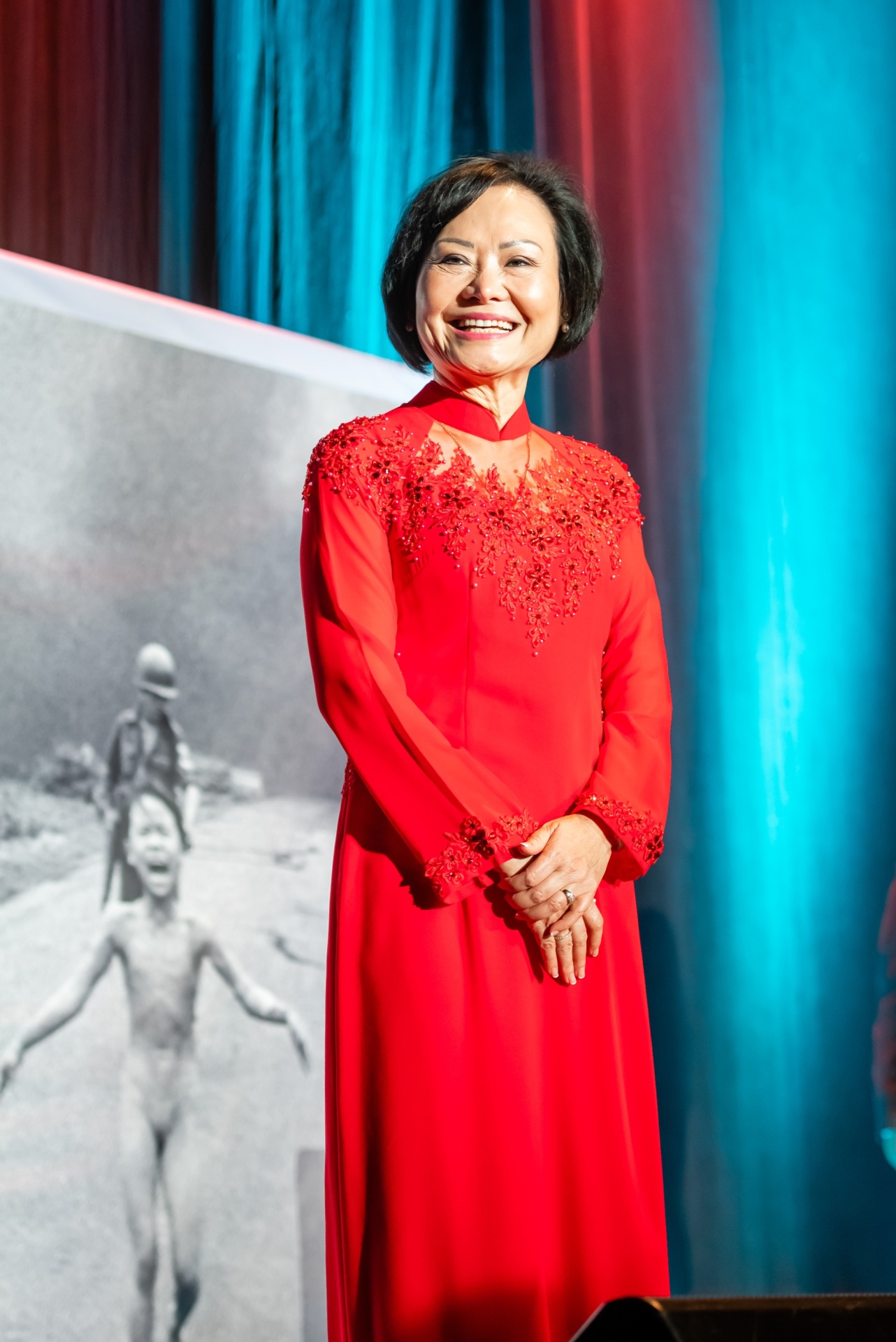
Phan Thị Kim Phúc standing alongside ‘The Terror of War’, the image that has defined much of her life. Photo: Stephanie Brown, @stefbrownphoto.
Today she is 63, UNESCO Goodwill Ambassador for the Culture of Peace, founder of The KIM Foundation International which supports child victims of war, a grandmother, and a woman who prays every morning.
Between that photograph and Kim’s life today were decades shaped by pain, sacrifice and—eventually—healing. Millions of people survive terrible things. Few choose to forgive. Fewer spend 30 years showing others how.
I was born in Tây Ninh, where Kim’s story began. The road where it happened, Highway 1 (now called Quốc Lộ 22), still runs long and flat. I have travelled it hundreds of times to visit my family. Kim ran it once, at nine years old, with her skin on fire.
She takes me back and describes her whimsical childhood before that day. She climbed trees, pulled pranks, once put salt in her uncle’s water just to watch him chase her around. Not so different from my own memories as a kid, decades later.
Kim’s childhood ended on 8 June 1972.
South Vietnamese planes accidentally dropped napalm on Trảng Bàng, a town nearby, sending soldiers and children running through smoke and fire. Kim’s three-year-old cousin, Danh, could not keep up. Kim slowed down, of course. She was not going to leave him.
That is why she was still on the road when the bombs fell.
“Boom. Boom. Boom. Boom,” she describes it.
She remembers looking down at her burning arm and thinking “I will be ugly … I’m not normal anymore”. She fainted shortly after.
Kim would not wake for days, and would not know that the photograph captured of her in that moment would define the rest of her life.
The burns covered 30 per cent of her body. The first hospital rejected her, the second expected her to die within days. Her mother found her in a morgue three days later, barely breathing, already given up on.
She did not die.
But surviving the bomb, she tells me 50 years later, was not the hardest part. Surviving the photograph was.
“I hated that picture so much,” Kim says.
She says the Vietnamese government turned the image into a propaganda tool, cutting off her education, controlling her movement, stripping away the future she once dreamed about.
“The more that picture got famous,” she tells me, “the worse it cost my private life.”
By her twenties, the same age as I am now, Kim wanted to take her own life. The bomb had burned her body. But hatred almost destroyed her.
“Hatred is like cancer,” she says. “More dangerous than the Napalm bomb that burned me.”
So, what changed?
“When I was nine, four bombs dropped, my picture taken, I had no choice at all,” she tells me. “But now, since I have freedom, I have my choice to make my life much better than that.”
That choice began in 1982, when she found faith. Not religion, she emphasises, but relationships.
“I believe that the relationship between me and God is really changing my life,” Kim says.
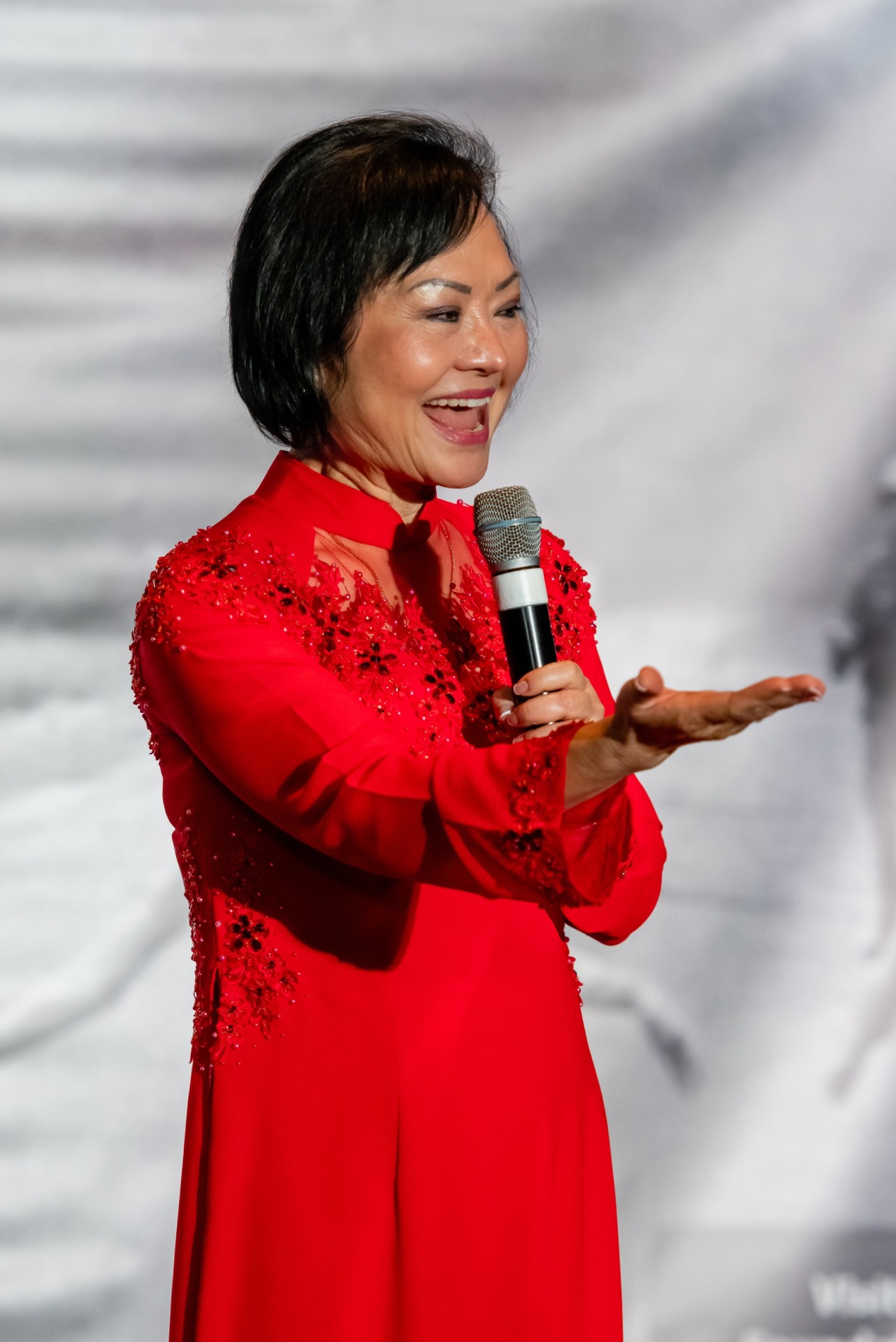
Kim now shares her story as a UNESCO Goodwill Ambassador for the Culture of Peace. Photo: Stephanie Brown, @stefbrownphoto
Through that relationship, she was taught something she had never found on her own: the desire to forgive.
But forgiveness did not happen overnight. It meant letting go of all the bitterness, resentment, insecurities, and anger that she had carried for years. She compares it to playing piano: “You want to be the best pianist? You have to practice, practice, practice.”
So, she did, through what she called “the three D’s”: desire, determination, and discipline.
Kim prayed for the pilot who dropped the bomb. For the government that rejected everything she offered. Day by day, the photograph she once called a curse became a blessing. Soon, she defected to Canada and built the life she had always deserved.
“My heart was broken,” she tells me. “One million pieces. And now my heart is healed.”
Halfway through our interview, Kim laughs and checks her phone. It is a message from Nathan Parkinson, Administrative Assistant for The KIM Foundation International, checking on her.
Nathan has seen Kim’s healing up close. Their families have known each other for almost 30 years. To a young Nathan, Kim was simply the kind lady whose house he visited for lunch.
“I never understood the weight of her story or what it was all about as a kid,” he later tells me.
Seven and a half years into working alongside Kim, Nathan has witnessed forgiveness become easier as she practises daily. Not just through words, but a discipline she lives.
“I’ve many times compared her life to my own,” he says. “And I think what a weakling I am.” He pauses, then laughs softly. “If she could forgive, maybe I could too.”
It is nearly 2am. Kim reminds me to go to sleep. I ask her the question I have been saving all evening.
If that nine-year-old girl running down the road could see you today—the mother, the grandmother, the activist—how do you think she would feel?
Kim smiles.
“When you see that little girl in the picture,” she says, “don’t only see her the way she was then— running, crying, suffering and fear—but look at her now.”
She asks me to carry her message onward. To tell people that love, hope and forgiveness are not weaknesses. They are the only things strong enough to heal a broken heart.
“If that little girl in the picture can do it,” she says, “so everyone can do it, too.”
The next time you decide to hate or get angry at something or someone—and you will, I will, we all will—remember the girl who had every reason to burn the world down and didn’t.