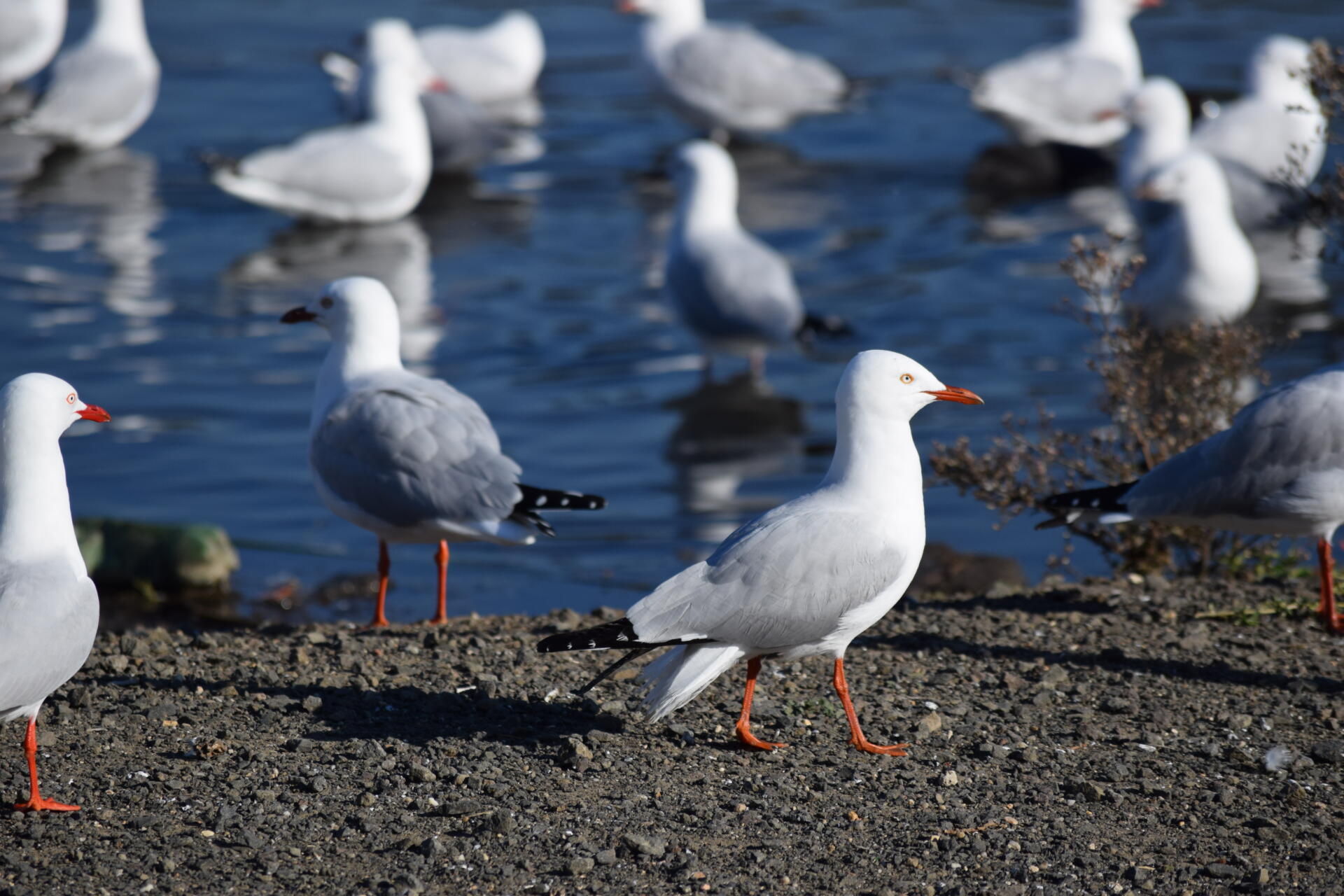
A nest sits next to an air-conditioning unit atop the gravel-covered roof of a Dandenong warehouse. Inside, three speckled, stone-coloured eggs rest against a tangle of twigs and bottle lids.
A man in his 60s reaches in and pulls them out one by one. They’re warm from the morning sun, the bird still alive inside.
He places them in a plastic bag; he’ll euthanise them further away. The nest follows. They’ll go into biohazard or commercial waste.
Tomorrow, or the day after, the birds will return and build a new nest. He’ll remove that one, too.
This is typical. His phone rings constantly during breeding season—spring through early summer. Property managers, body corporate representatives, warehouse owners, all wanting the same thing: Make the birds disappear.
David Faulkner has been a pest control agent in Melbourne since the 1990s—back when pest control meant rats and termites, or the occasional possum in the ceiling.
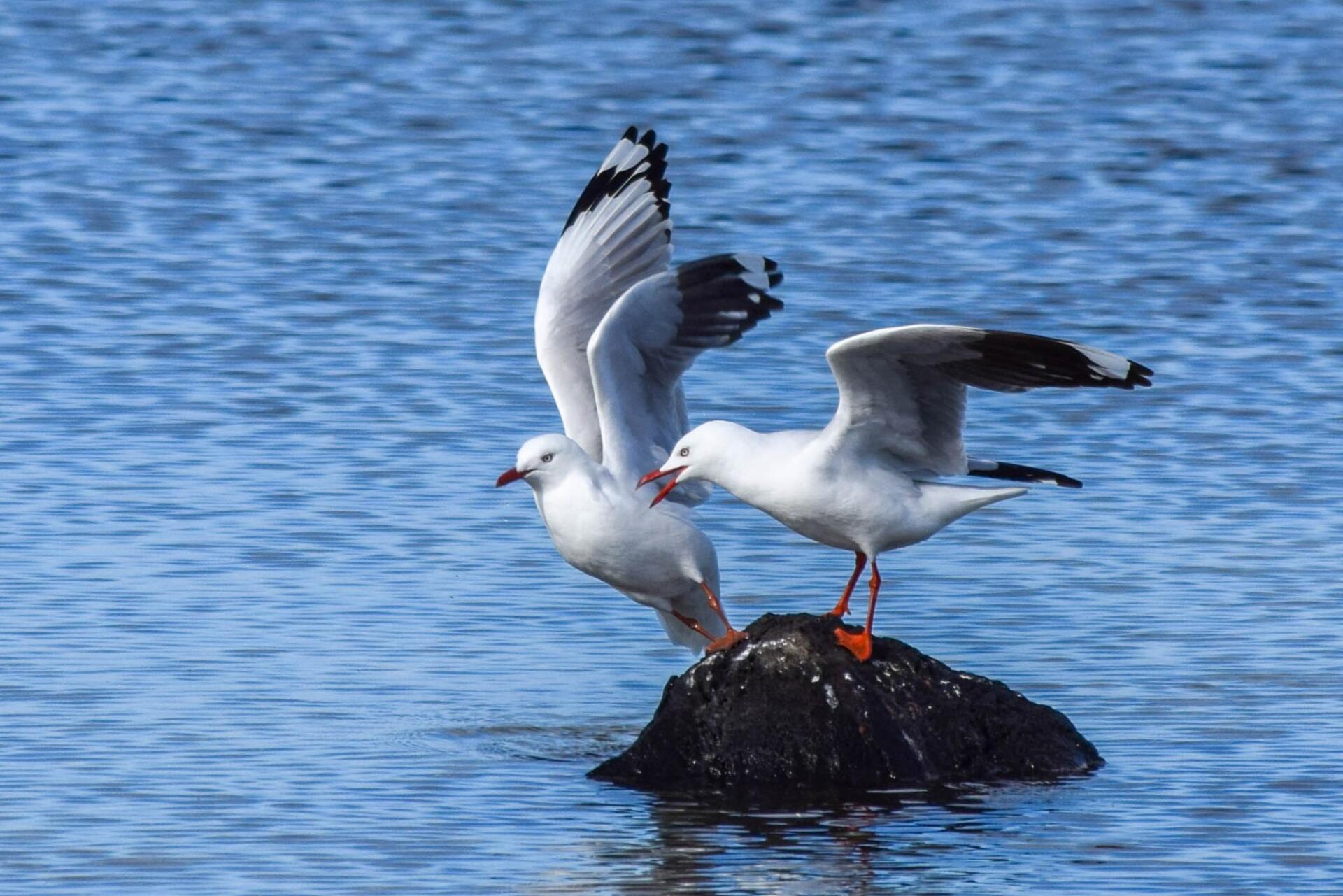
Working with silver gulls (Larus novaehollandiae) for the past 18 years, David’s methods are less playful: netting, lasers and nest removal. After almost two decades, he speaks about gulls with the weary expertise of someone who knows the birds are not the invaders.
“Hello, Dave speaking”. The word Dave lingers; his diphthongs stretched into a leisurely Dah-eev that climbs in pitch like a wave. The final g clipped off; he finishes with a friendly upward inflection. An invite to a yarn.
His voice carries loudly through the phoneline. He answers an unknown number with the confidence of a man who’s been working for himself for years.
David speaks with the easy humour of someone long past taking his job too seriously. There’s a rhythm to his talk, a cadence of someone who has thought about birds longer than anyone else has bothered to.
Beneath the jokes sits a quiet admiration for them: their stubbornness, their ingenuity, their refusal to yield. How stupid they make us look.
***
A sunny September day draws groups of Melburnians into city parks to soak in the first real sunshine in months. They flock in clusters to lawns and benches, spreading rugs, opening containers of food, claiming a spot in the crowded green.
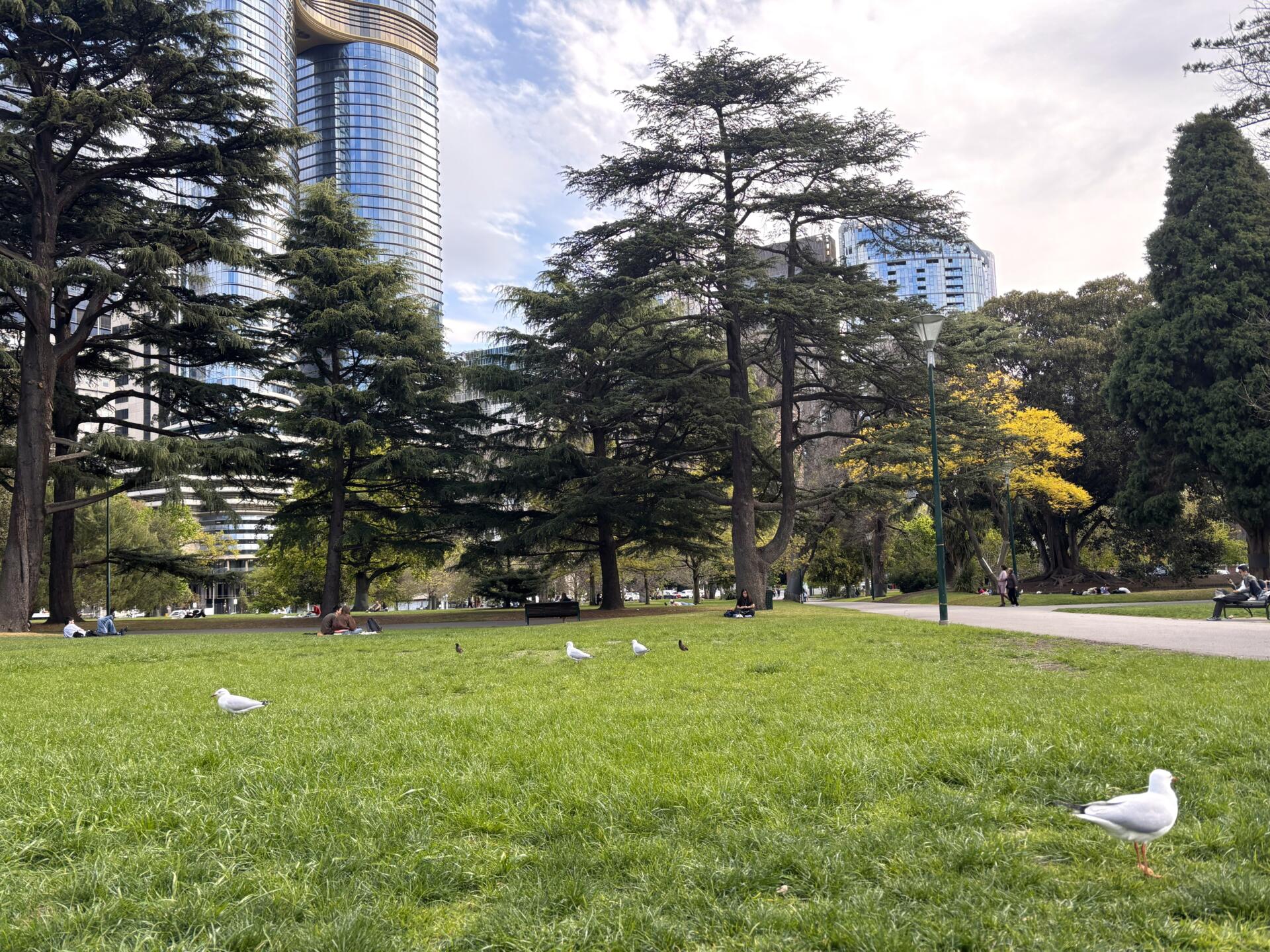
Silver gulls in Carlton Gardens. Photo by Luisa Bonazzoli.
In Carlton Gardens, a young boy in a blue hat rests his basketball on a bench and eyes off his target. He stretches out his green jumper at the sleeves, arms wide, and charges towards them, sirens sounding as he runs.
“Wee-woo, wee-woo!” he shouts. The birds explode upward.
“Wee-woo, wee-woo, pest control!” he continues, weaving between groups of friends soaking in the spring sun.
His parents call him back after a few minutes. The seagulls are gone.
“Thank you!” three girls call out after the boy, their picnic intact.
***
Silver gulls were coastal creatures, nesting on offshore islands and rocky cliffs, feeding on fish and marine invertebrates. They held a practical relationship with coastal Indigenous communities, acting as scavengers and opportunists claiming discarded catch.
They existed on beaches and boats, not bins and buildings.
Then commercial fishing came along in the 1900s, and natural marine food sources declined. As consumption took away the gulls’ natural diet, our rubbish replaced it.
“I think [why they moved inland] relates back to years ago,” David explains.
“There was a lot of open tips and that attracted the seagulls and then they just never left.”
Since the 1950s, the population of silver gulls has surged due to the increased availability of food from growing human waste. As rubbish tips grow, so does the number of gulls. A 1993 study from NSW National Parks and Wildlife recorded 6000 silver gulls leaving a landfill site near Wollongong in just a single hour.
As Melbourne’s Victorian architecture gave way to modern development, the new flat-roofed warehouses and commercial buildings provided perfect nesting grounds.
David’s work takes him to warehouses in Dandenong, shopping centres in Frankston, and apartment blocks across Port Melbourne—always the same architecture.
“Domestic houses with a pitch roof tend to not suit seagulls for nesting and roosting,” he says.
Silver gulls survey a warehouse rooftop and choose strategically. They tuck into corners where waste pipes exit through the roof, take advantage of ridges that shelter them from wind, each piece of human infrastructure providing shelter and anchorage.
“They’ll just get anything that can get them a little bit of protection to get up against their nests,” David says.
***
Stand on any corner in Footscray near the markets and watch them work. They perch on awning edges, heads cocked, tracking movement below. When someone drops a chip packet, three gulls converge before the rubbish hits the ground.
Peak hour at Southern Cross Station, throngs of people arrive and depart in a blur of movement, yet on the square below, the gulls have already claimed their territory. A fleet of white sentinels oriented toward the food court entrance.
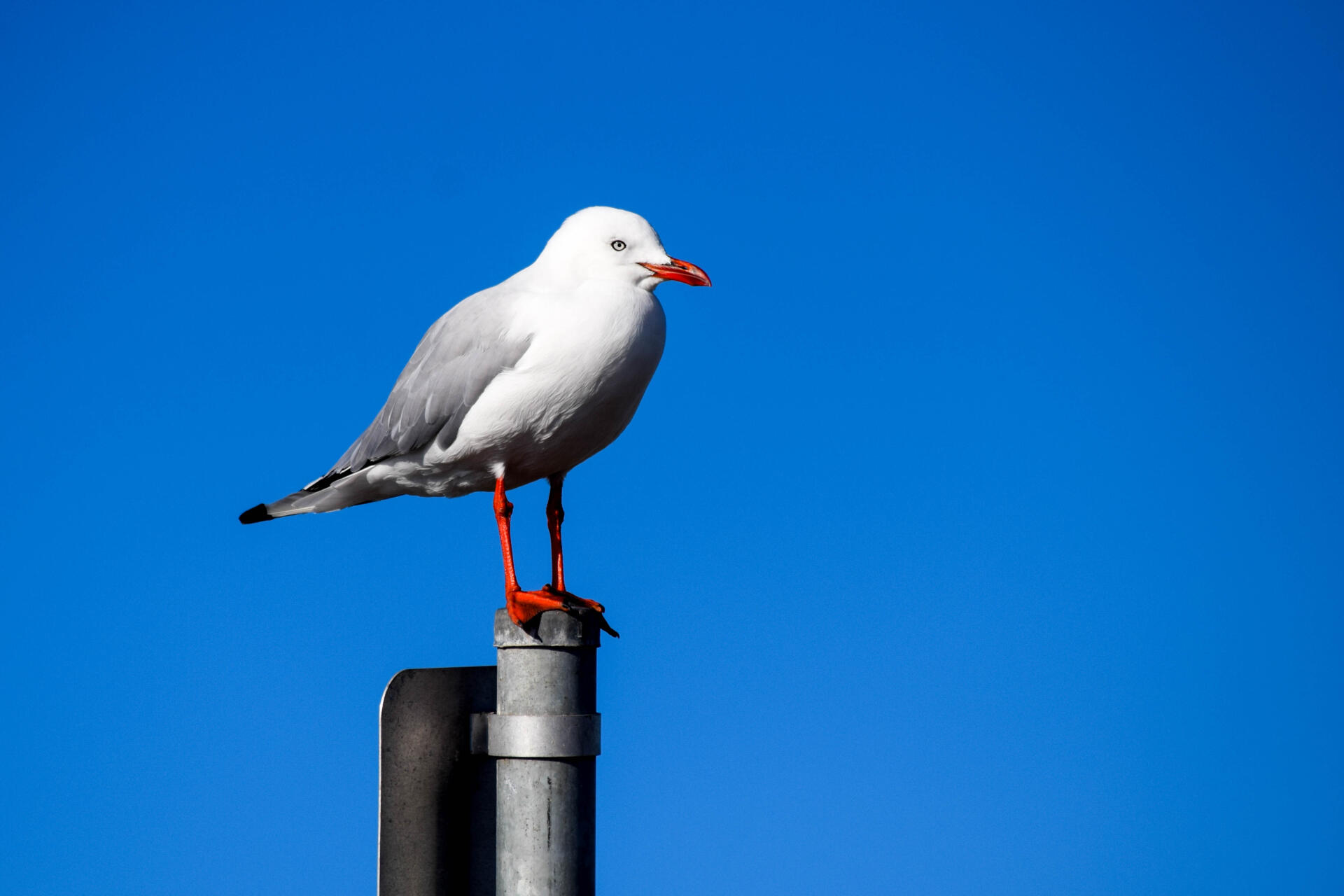
At St Kilda beach, they’ve learnt the rhythm of weekends, arriving en masse Saturday morning when families spread picnic blankets, disappearing on Monday when the sand empties.
Along the Yarra, they follow joggers eating breakfast bars, keeping pace overhead, waiting for a moment of distraction. They’ve mapped the city by its food sources, drawn invisible lines connecting every McDonald’s, every primary school, every open bin.
Wurundjeri Woi-wurrung Country has become a constellation of feeding opportunities, and they know every point.
Displacement is not unique on this continent. Everywhere, animals adapt to human-shaped landscapes: pigeons nesting on skyscrapers, foxes prowling city streets, bats searching for homely eucalypts in a maze of introduced trees.
It’s survival in the face of colonisation.
The same roofs that draw the gulls now crowd out the residents that called them home. Beneath the cranes and scaffolds, old boarding houses are knocked down, public housing towers stand fenced-off for redevelopment, and those without a foothold drift further from the centre. Losing a home has a familiar pattern.
“Once birds are born in a location they tend to come back to the same location and have their babies,” David explains.
“Once a population builds up to a point on one roof, there’s not enough room here for [them], [they] go to the next roof and then the next roof.” Each generation claiming the building next door.
Every technological advance, every flat warehouse, every warehouse district where land was cheap and regulations loose. Perfect for manufacturers seeking affordable space. Perfect for gulls seeking flat roofs. Australia’s urban population surged in the past 100 years, and just like the gulls, we moved inland.
Seagulls now comprise thirty to forty per cent of David’s business. But he can’t touch them. Silver gulls are a native Australian species. They are protected. And David wants to protect them.
He holds a licence to manage the birds. He can remove the nests and eggs. Some pest control experts paint the eggs in paraffin oil to block the pores in the eggshell, cutting off oxygen, humanely ceasing their development.
The adult birds continue to incubate the non-viable eggs. They won’t breed again that season. Instead, they wait for eggs that will never hatch.
The netting David uses to block the gulls from landing is high-density polyethylene with five-by-five mm mesh. He uses it not because of the quality, but because it’s harder for the gulls to get their claws or wings caught.
“It’s very rare, but it does happen, so that’s why we’re looking now with some more humane things like lasers,” he says.
The laser systems are the latest evolution in “exclusion, not entrapment”. Mounted on rooftops, they scan buildings in programmed patterns, projecting green dots that sweep across flat surfaces like searchlights.
“The bird sees it as a physical thing,” David explains. “It doesn’t see it as a light, it sees it as a physical beam coming towards them, they think it’s gonna hit them.”
The laser never stops. A constant chase with no resolution.
“In a very short time, you just drive the birds mad and they leave,” David says.
Until they move to another building.
“We go out to a commercial site, and we do a big, elevated netting job and they just move right next door,” he explains.
“Realistically, all you’re doing is just moving the problem from one building to the next to the next. From a business point of view for me, it’s fantastic.”
David’s work is constant and evolving, our neat, bright symbols of sustainability creating even more job opportunities for him.
“We’re going to see a lot of jobs now with solar panels on the roof and they’re just completely covered in bird droppings,” he says. “Which means then basically the solar panels are doing nothing.”
Companies spend hundreds of thousands installing sustainable energy infrastructure for the gulls to nest behind the arrays, roost on the frames, and render the panels ineffective.
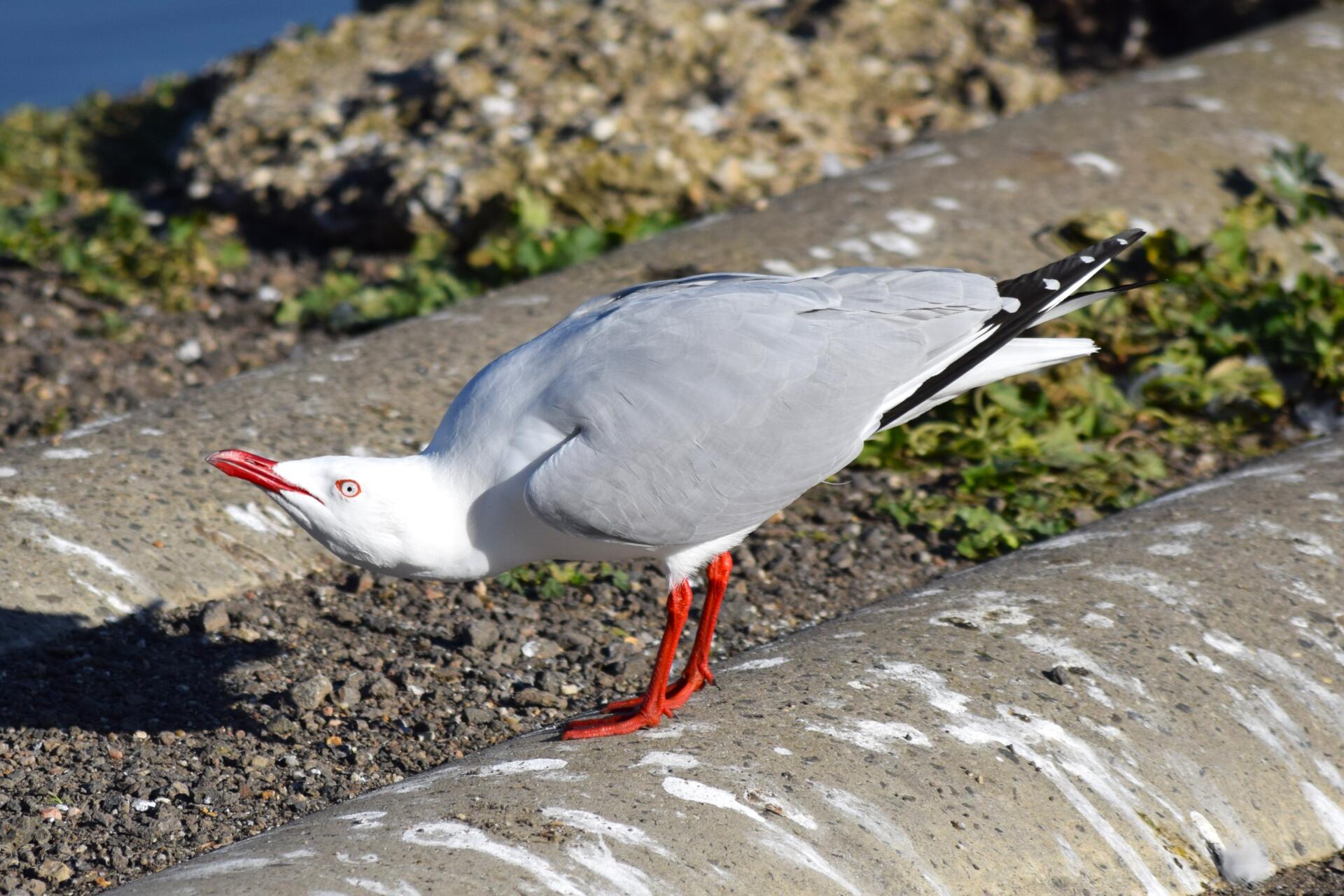
We fight over space the way the gulls do, circling, negotiating, driven by hunger and need. The cycle is the same: occupancy, vacancy, removal. The gulls adapt to the architecture; people adapt to rent. Both are told there’s no room. And still, both keep circling—over rooftops or suburb to suburb.
David thinks it’s more than engineering problems and more than a silver gull problem.
“I think it’s more human,” he says. “We are filthy people. We leave scraps everywhere.”
He calls it bird pressure: the force that draws gulls to certain buildings over others. When David assesses a job, he identifies the attraction. A food court across the road. A primary school. A McDonald’s with open bins.
“The birds are coming straight off the roof down into the bin, feeding, flying straight back,” he says. “There’s always a reason why they’re on one roof and not another.”
They feed on what we discard, thrive on our excess, mimic our resilience. Plastic lids woven into nests.
The gulls are taking over Melbourne’s suburbs. Populations exploding beyond control. We built the cities, they came to the cities, and we call it an invasion.
***
Late afternoon in Carlton Gardens. The gulls have returned. They perch on the fountain’s edge, bob between picnic blankets, eye off tossed chip packets. The boy in the blue hat is gone and now others shoo the birds away, throwing rocks and sticks or half-heartedly waving their hands.
Somewhere in Frankston, David is stretching netting over another warehouse roof. The city hums, the lasers sweep, the gulls cry. Tomorrow, the building next door will call. The week after, the building after that.
The gulls settle onto the grass as the sun lowers. Beneath every roofline and power line, they peck at scattered crumbs and prepare for the evening. Nearby, people pack up picnic blankets and head towards trams. One species building, another adjusting.
We pretend the ground is ours. The gulls know better. They arrive, rebuild, return. They know that nothing ever stays claimed for long.