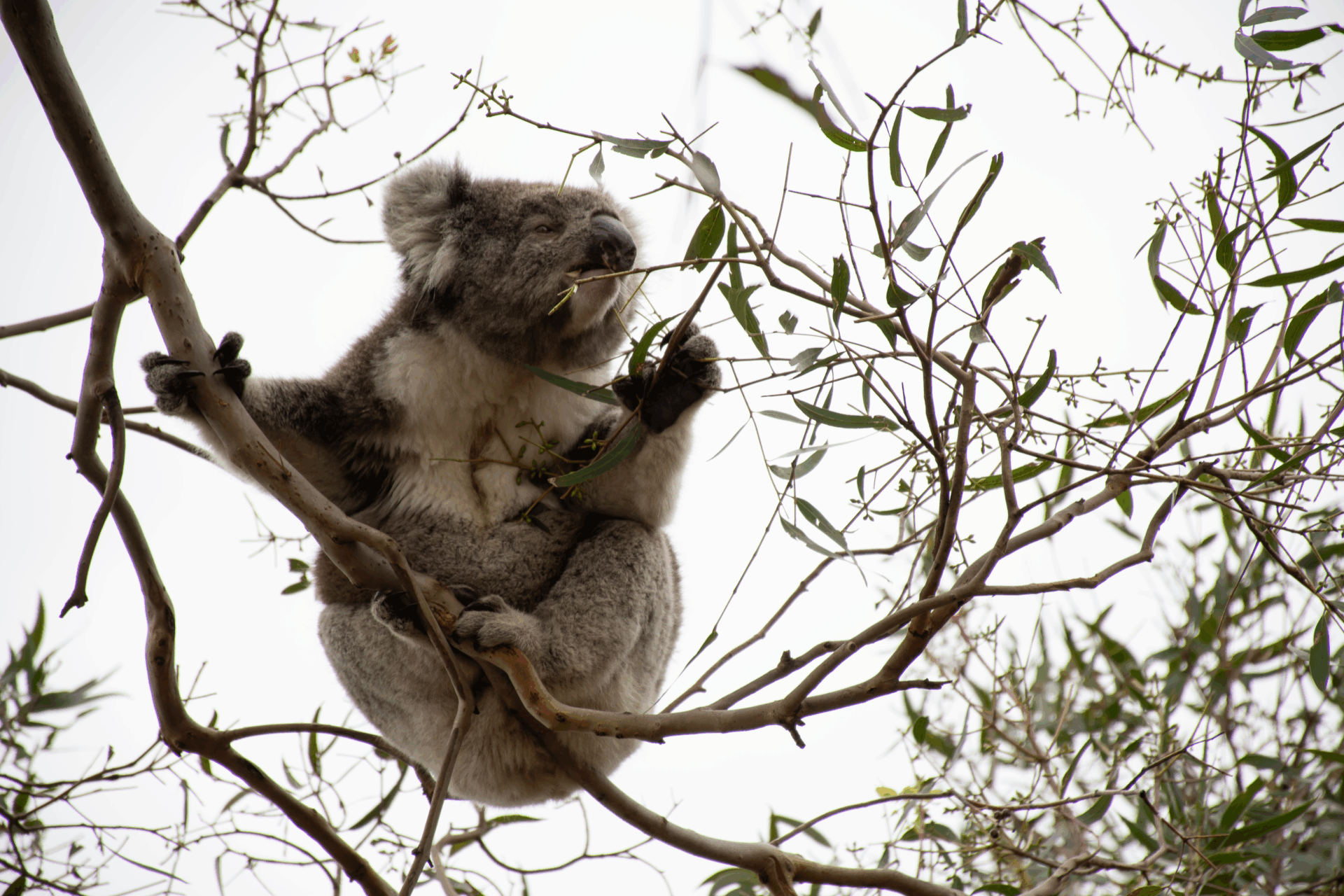
On a quiet back road on French Island, a single gum tree holds five koalas. One saunters lazily across the upper branches, three others doze while curled tight against the wind, and the last one munches on eucalyptus leaves, unperturbed despite almost losing its grip. At first glance, it is postcard-perfect and would delight tourists and nature lovers. The bigger picture tells a different story altogether.
Usually solitary, the koalas are huddled together on one of the few trees still living beside open pasture. The trees branches are virtually bare of leaves.
Across the isolated island in Victoria’s Western Port Bay, koala habitat is collapsing under the strain of overpopulation and recent drought, with locals warning that the island’s vegetation is under severe pressure.
Scott Coutts, who worked as a park ranger on the island for over 35 years and now operates wildlife tours there, calls the situation critical after having discovered multiple dead or starving koalas and their joeys over recent months.
“A lot of their preferred habitat, particularly on private property, is decimated,” says Coutts.
“Trees are dying and koalas in those dead trees are looking for food but they are starving to death.”
It’s a scenario predicted in the 2022 Victorian Koala Management Strategy, which indicates that in severe and prolonged cases where populations have swelled to unsustainable numbers, overbrowsing leads to tree defoliation and death and thus starvation.
On the island, the welfare of the koalas is a source of distress for residents who are calling for urgent action to address what they say may deteriorate into an environmental crisis.
Koalas’ preferred food on the island is manna and swamp gum, according to locals. The shortage of eucalypts has meant it has become commonplace to see koalas in oak trees or eating pine needles.
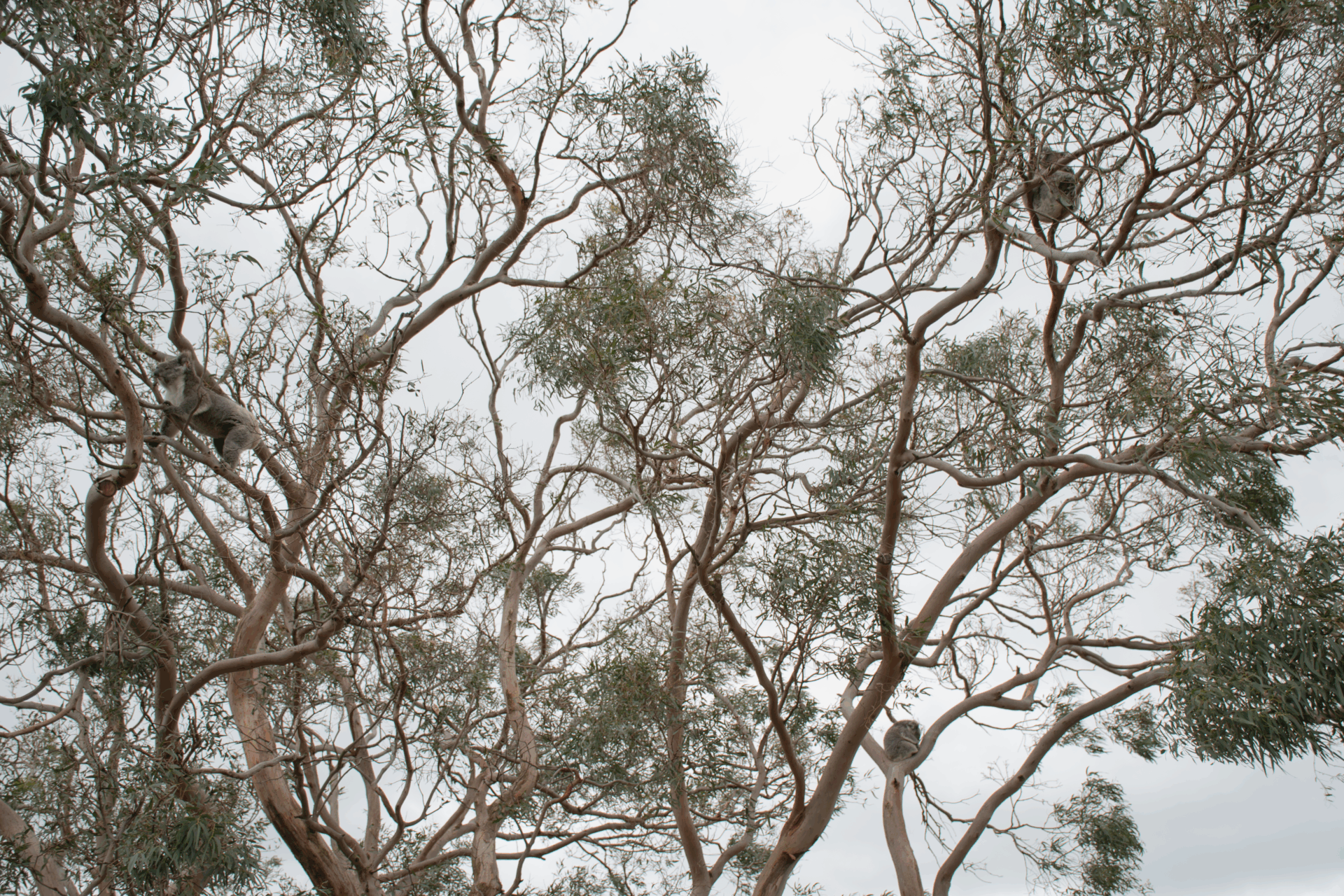
A group of koalas cluster together in a gum tree on Clump Road. Photo by Ashleigh Wyss.
“[They have] eaten themselves out of house and home,” says local Phil Bock, who runs the French Island Eco Inn.
Bock, who routinely hosts ecological conservation teams, says he hopes the community can secure philanthropic funding to plant more trees across the national park that covers two thirds of French Island.
“[M]ore koala-suitable trees need to be planted to help sustain a healthy population,” he says, warning that while that may sound straightforward, the reality is both costly and time consuming.
Residents who have attempted replanting in the past have found that koalas have ripped new plantings straight from the ground and bypassed tree guards, Coutts says.
“It should have started 20 years ago. There are sections of the national park that have no vegetation on them except for grasslands, and they can be planted with corridors of trees to alleviate the problem – but that’s not going to happen overnight.”
Wildlife expert Desley Whisson describes these as signs of a “bad situation”.
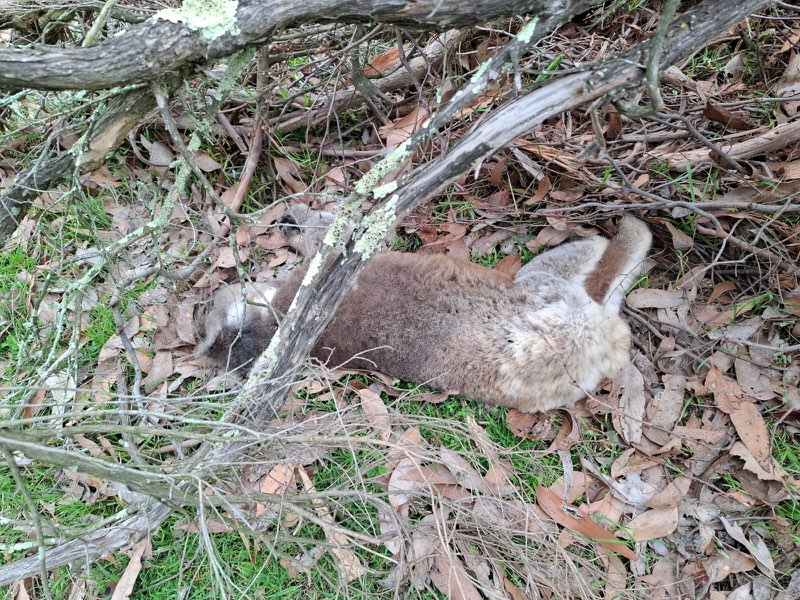
According to Coutts, the sight of dead koalas has become an increasing occurrence over recent months. Photo supplied by Scott Coutts.
“The key to managing overabundance is prediction and intervention well in advance of the problem occurring. And the problem is, our government is not geared up to act that way,” says Whisson, an associate professor in wildlife and conservation biology at Deakin University.
In 2013, Whisson was working in Cape Otway when significant overbrowsing resulted in mass deaths of trees, followed by koalas dying from starvation or euthanasia on welfare grounds.
Having completely stripped the tree canopy of eucalyptus leaves, Whisson says she witnessed koalas “strip bark… eat bracken, eat dirt, anything to put in their stomachs”.
“It’s absolutely devastating to witness,” she says.
“It’s not just watching koalas die, it’s watching forests die. The birds disappear, the other animals that inhabit the forest are no longer there. And you know that that’s going to have long-term impacts.”
In the 1880s, juvenile koalas were introduced to the isolated, predator-free French Island to help conserve the marsupials after logging and hunting for the fur trade devastated their mainland population in Victoria and rendered them close to extinction in South Australia.
While koalas are classified as endangered in New South Wales, Queensland and the Australian Capital Territory, the species remains abundant in both Victoria and South Australia to the point of overpopulation in some locations. In Victoria, koalas live in increasingly fragmented and degraded habitats due to ongoing challenges exacerbated by urbanisation.
Free of the disease and chlamydia that plague koalas elsewhere, French Island’s consistently abundant population has been used as a pool for translocation programs to replenish numbers across Victoria. Most Victorian and South Australian koalas are descended from animals originally translocated from French Island.
For decades, despite relocation and sterilisation programs, over-browsing of trees by koalas and tree mortality have remained major issues, with the Victorian Koala Management Strategy listing French island only three years ago as an example of a population “requiring extensive management”.
The Department of Energy Environment and Climate Action (DEECA) and Parks Victoria share responsibility for koala management on the island, deploying translocation programs, fertility control, and health assessment programs involving capture, veterinary assistance and when necessary, euthanasia.
Residents say the most recent sterilisation project only targeted around 250 females, falling well short of what was needed to stabilise the island’s exploding population.
A spokesperson for Parks Victoria says they have monitored the island’s koala population since 2008, including “ongoing fertility control and translocation to deliver the best outcomes for the koala population”.
Coutts contradicts this and says there has not been a koala translocation in 10 years, and locals estimate the 170 square kilometre island’s population has doubled in a decade and is now between 10,000 and 12,000.
Some local residents believe the crisis cannot be solved without lethal control.
Long time resident Keith Airs, who has seen thousands of dead trees, argues it is the only realistic option.
“One of the best things you could do is get rid of all the teddies – the koalas” he says.
“It only costs 20 cents… that’s the price of a 22 caliber bullet.”
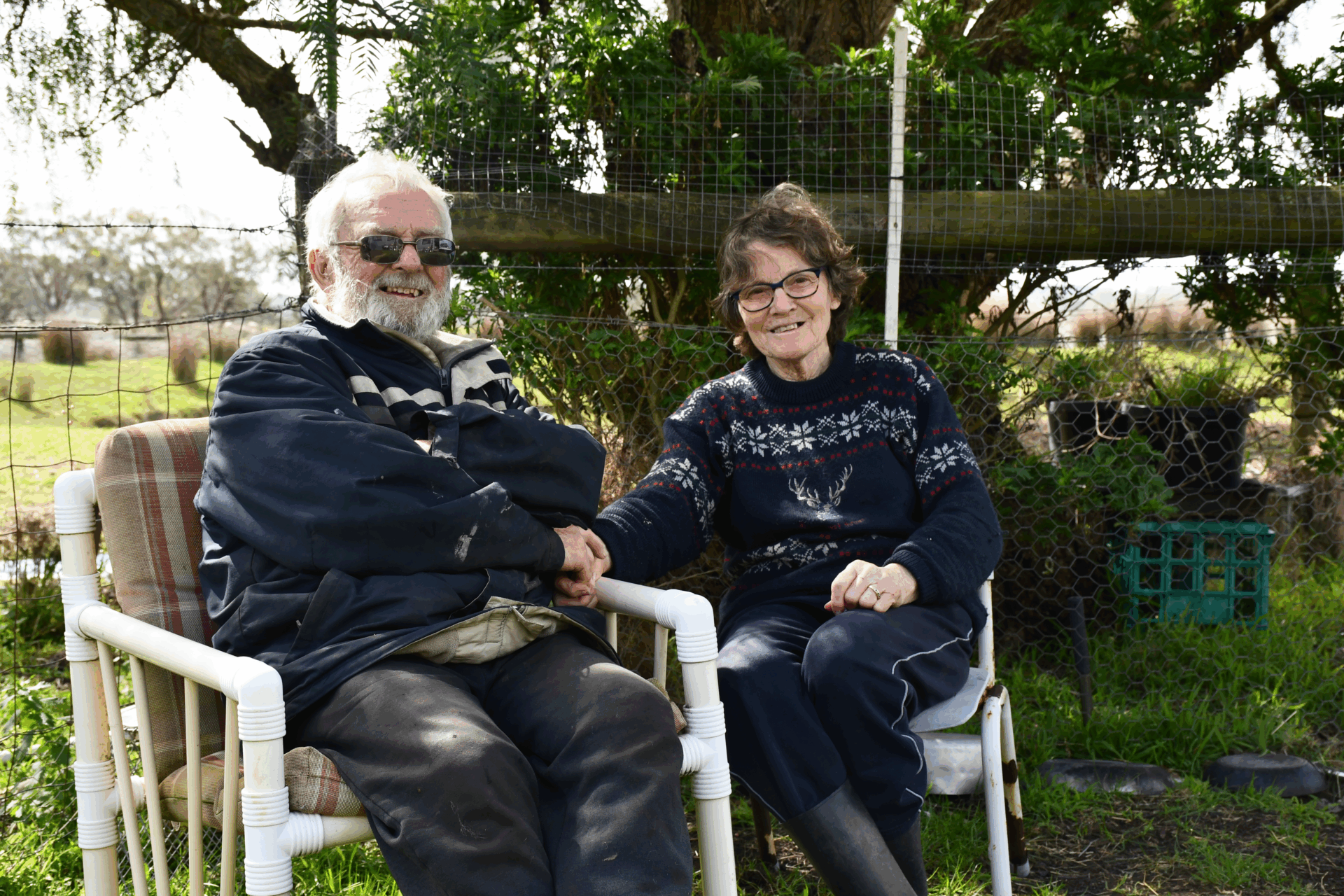
Keith Airs, a veteran and CFA volunteer, and his wife Lois, have lived on French Island for decades. Photo by Ashleigh Wyss.
Culling of koalas is generally prohibited in Victoria except in extreme circumstances, such as welfare emergencies or bushfires.
While vet-led euthanasia has taken place in previous capture and sterilisation programs on French Island, large-scale population control has not.
Earlier this year, 700 koalas were killed in an aerial shooting in Budj Bim national park after fires decimated much of their food source, a decision which attracted national outrage but was defended by authorities as a humane response.
Deakin’s Desley Whisson says culls are sometimes the most compassionate answer because translocation becomes increasingly problematic if koalas are already suffering from starvation.