Julia Wang is an 18-year-old emerging artist from Melbourne. She has always wanted to be a painter, and is already achieving early success.
Her painting In an Ancient Forest of Hundred-Year-Old Trees, You Are an Unrooted Sprout is hanging in the National Gallery of Victoria Ian Potter Centre as a part of Top Arts 2024 (an exhibition of the best work by students enrolled in VCE visual arts subjects).
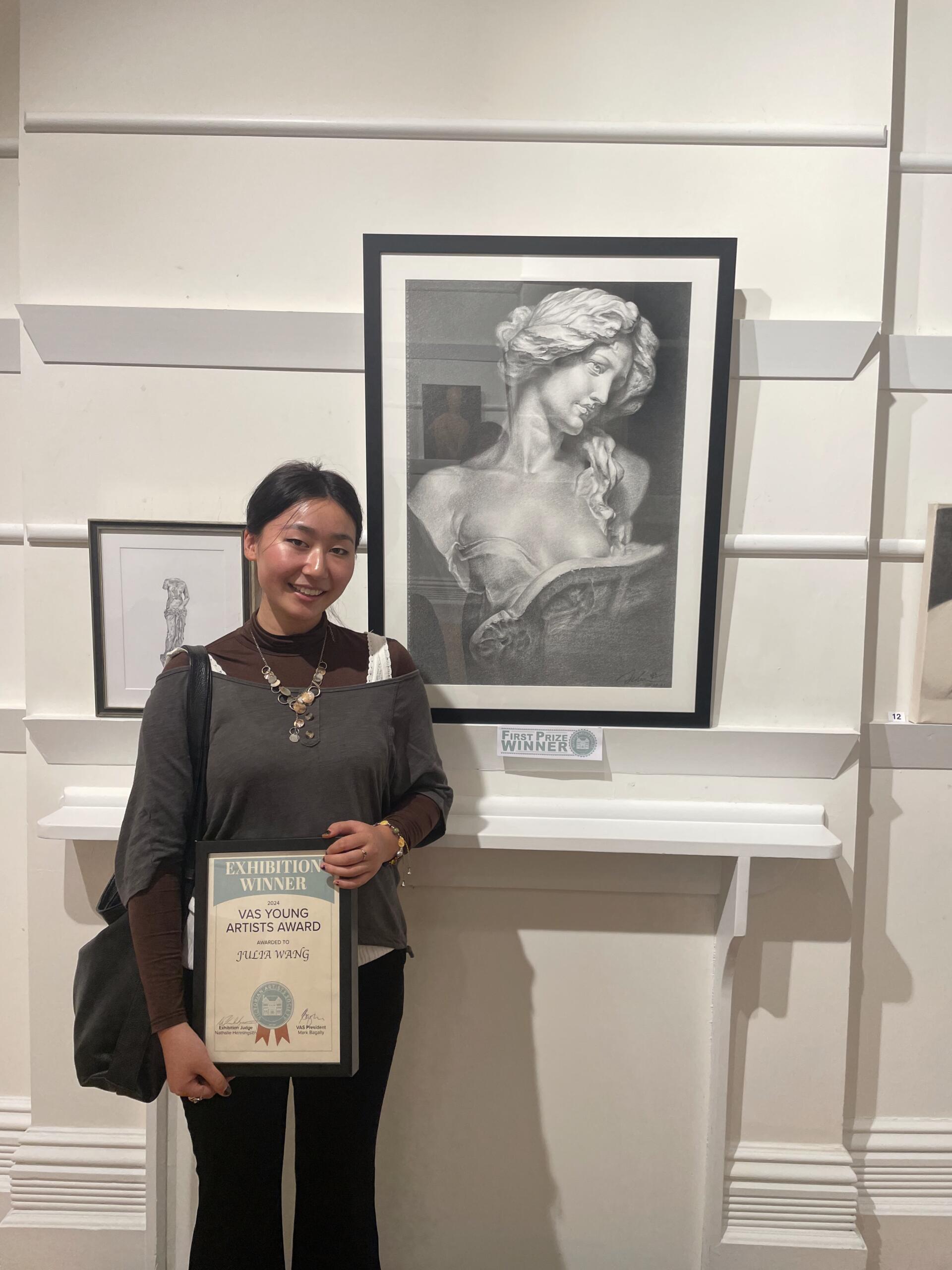
Julia Wang stands next to the drawing that won her first prize in the Victorian Artists Society Young Artists Award in 2024. Photo: Charlotte Walkling
In April, her drawing The Beauty in their Eyes won first prize in the prestigious Victorian Artists Society Young Artists Award and hung in the society’s Young Artist Select Exhibition.
But despite this recognition, she is keenly aware that a future pursuing art is likely to mean lifelong financial insecurity.
The “mental strain” of this is intensified by the cost-of-living crisis, Wang says, and means she’s still living at home, and planning a gap year in London studying fashion communications.
“Having some sort of stable income has always been in the back of my mind because I come from an immigrant family, and have a single mother”, she says.
“It’s never been harder to be an artist”, says Dr Clare McCracken, who coordinates the art history, theory and contexts program in the School of Art at RMIT University.
She says while the cost-of-living crisis is broadly felt, it has a particular impact on those with limited earning potential “at the very beginning of their arts education”.
The impact is evident in declining enrolments in creative art degrees. In 2022, 34,943 students commenced a creative arts degree in Australia. In 2016, that figure was 40,121 students — a drop of 13 per cent.
“There’s less opportunities … and then there’s less sales, and then generally, like, more of a build-up in worry about the future,” says Wang.
McCracken, who is also a practising artist, curator, writer and public art researcher, agrees. Young people, she says, “have a significant debt for education that other generations didn’t endure, and they have just lived through a global pandemic which shouldn’t be underestimated.”
Those approaching mid-career also face stark choices.
Liz Gridley is a 35-year-old contemporary figurative artist specialising in oil painting, and previously worked as a graphic designer.
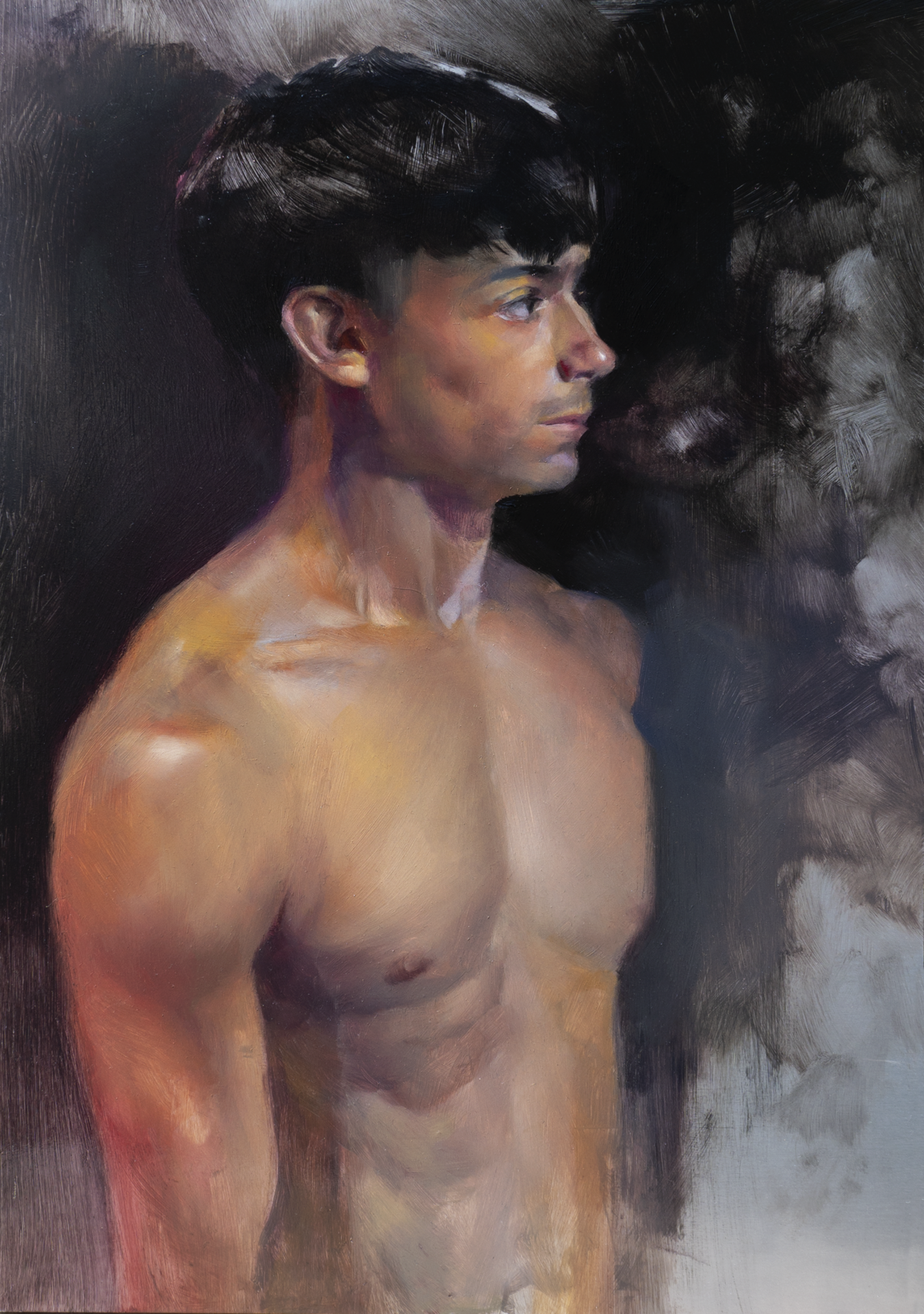
Falco – Bird of Prey, 2024 (oil on aluminium). Painting and photo: Liz Gridley
In 2016, Gridley moved to regional Victoria with her husband so that he could work as a rural doctor.
Gridley juggles practicing art in her spare bedroom, attending art classes and workshops, the “art admin” it takes to keep her practice afloat such as applying for grants and searching for opportunities, along with caring for the couple’s two-year-old daughter.
“It’s hard when you’re culturally expected to struggle,” she says.
As artists “we’re expected to live in hovels, we’re expected to spend money on nothing but our art, we’re expected to struggle. And because of that, the help is difficult to get in a lot of ways,” she says.
Financial pressures have mounted on multiple fronts, she says, as the cost of buying supplies and funding the time to create increases, while people’s ability and desire to buy art decreases.
“Last year I had a big disparity in sales because of the cost-of-living crisis. The priority of people to buy art is much lower,” she says.
“I had one sale in the first six months of last year. The year before I pretty consistently made one to two sales each month of the year, and a sale for me … can be anywhere from $200 to $2000.”
Gridley says with each bill and rent increase, she and her husband ask themselves how they will continue to survive with her working as an artist.
“I ask myself, ‘should I put this away and should I go get a full-time job for a couple of years and come back to it?’.
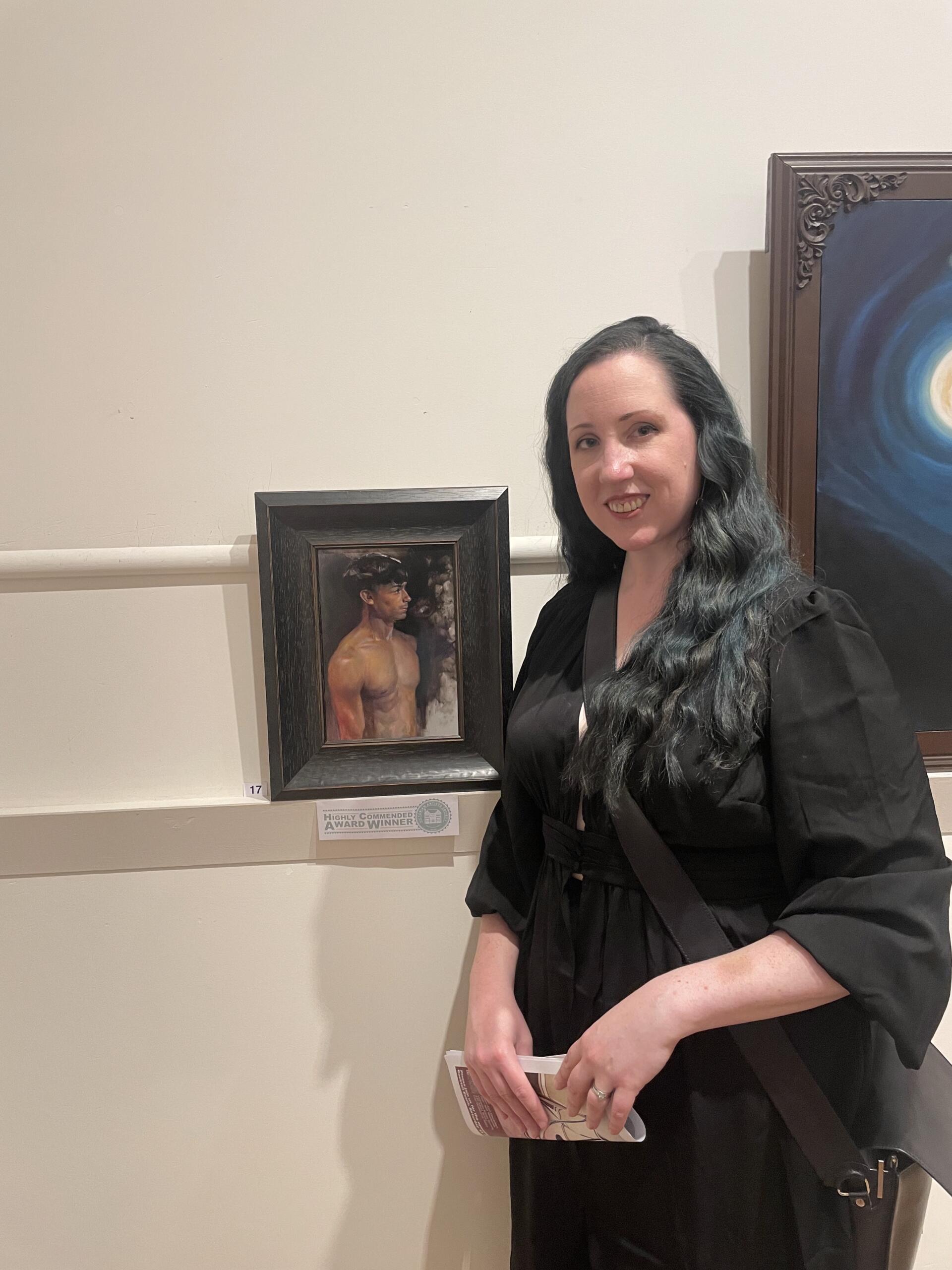
Liz Gridley stands with Falco, Bird of Prey, highly commended in the Victorian Artists Society Autumn Select Exhibition in 2024. Photo: Charlotte Walkling
“But my husband says, ‘No, this is who you are. This is what you do and you’re really good at it’.”
The mean annual income for visual artists hovered around $45,000 for over a span over 30 years from 1986 to 2016, according to a longitudinal study conducted every seven years. In 2016, artist incomes were about 21 per cent below the national average.
In 2021, the mean income for creative artists had increased to $55,000, but the gap had also grown and was now 26 per cent below the national average, the study showed.
The added financial strain from the cost-of-living crisis means we’re at risk of losing much of the arts sector’s diversity, says McCracken.
“Few well-known, full-time practising artists are of working class and lower socioeconomic background, and … few are from culturally and linguistically diverse backgrounds,” she says.
“It’s already a privileged person’s game, and it’s likely to get a lot worse and ultimately, that will have profound implications for the quality of art.”
In 2023, among visual artists participating in the longitudinal study, only 11 per cent were from a non-English speaking background, and only 21 per cent were artists with a disability.
“[Artists] do really important things like amplify untold narratives that might be missed by the mainstream,” says McCracken.
“I would argue that if we lose them, we’re at great risk of losing … really important, innovative voice[s].”
It’s a dilemma that Wang is grappling with while still a teenager and at the beginning of her art career.
Wang says she even “scared” herself into applying to do a biomedicine degree at the University of Melbourne because of the insecurity that artists face. Living her dream likely means the hardship — and cliche — of a starving artist, yet she is still considering committing to it.
“[Studying medicine] is completely off the tracks of what I wanted to pursue.”