
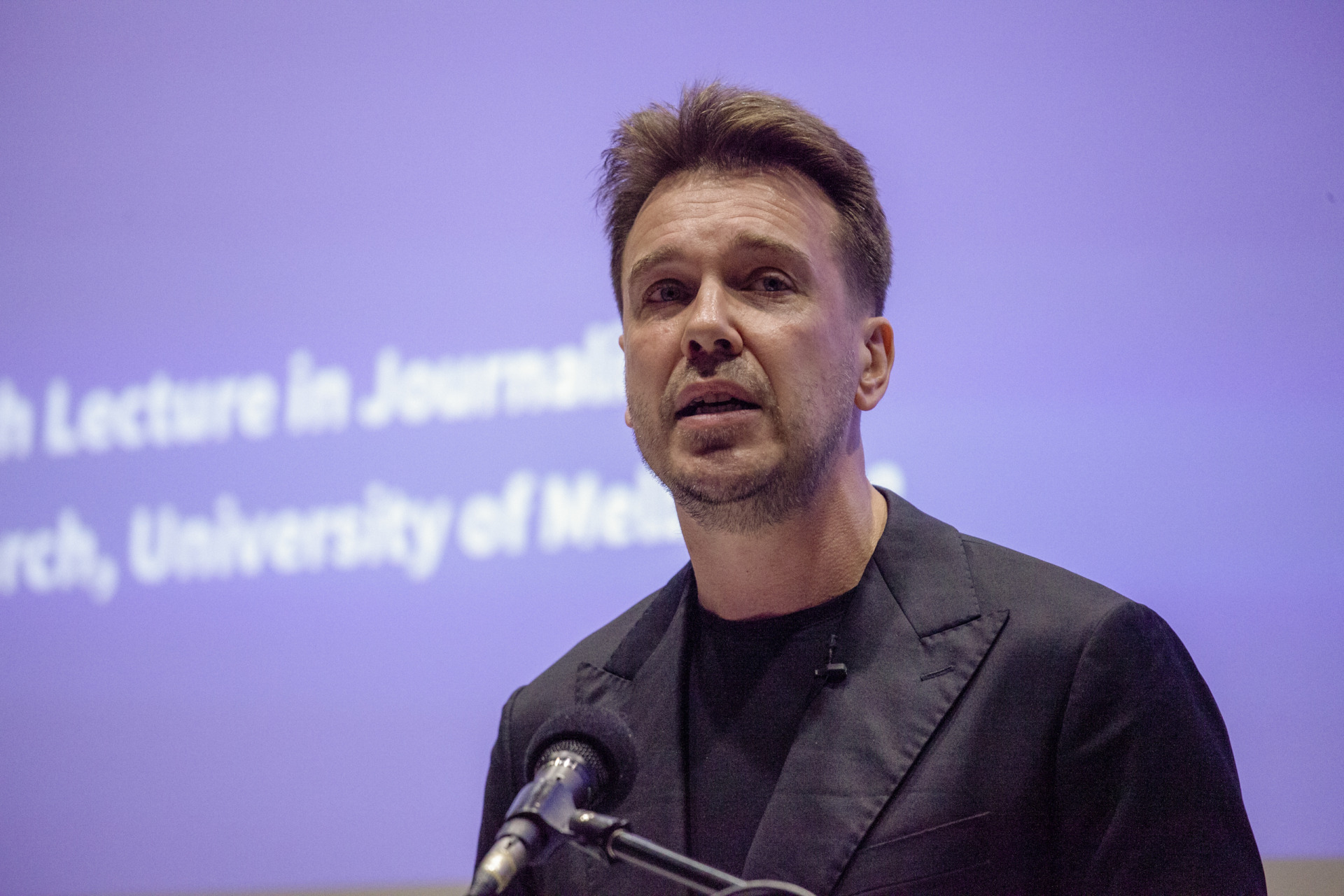
In the aftermath of Russia’s 2011 parliamentary elections, as allegations of electoral fraud triggered the biggest anti-government rallies since the collapse of the Soviet Union, President Vladimir Putin came to a seismic realisation, according to exiled Russian journalist and writer Mikhail Zygar.
It was clear to Putin that he “would never be loved” by Russia’s pro-Western, pro-democracy middle class, “those people who enjoyed life in Russia for the first time in history … [but] somehow were not thankful to Vladimir Putin”.
“They wanted democracy. They wanted real elections,” Zygar told a sold-out public lecture at the University of Melbourne on Monday night. Putin needed to look elsewhere for support, to people who were “less sophisticated, less educated, less successful – let’s call them, if I may, Russian rednecks”.
Russia’s 2014 annexation of Crimea was the turning point, he said. Putin’s domestic popularity soared, with international condemnation of the invasion supercharging Russian nationalism.
“Vladimir Putin realised that war is the unique mechanism. The best solution to all of the problems,” argued Zygar.
“The war mobilizes the nation, the war loves to call any protester traitor, and that’s the end of the story”.
Zygar was the founding editor-in-chief of TV Rain (Dozhd), Russia’s only independent television news channel, which stood out as a rare outlet for opposition voices, in stark contrast to the state-controlled press.
Having fled Russia in 2022 Zygar, a vocal critic of the Russian invasion of Ukraine, now lives in New York and teaches at Columbia University. Observing the fallout of the new Trump administration, he said “I have a great feeling of deja vu”.
Delivering the prestigious annual AN Smith lecture in journalism, in an address titled “Journalism Against Autocracy”, Zygar argued that Putin’s approach to power was rooted in a deep ideological cynicism. Born from Soviet disillusionment, Zygar said Putin’s entire worldview is shaped by the belief that liberal democracy is a facade.
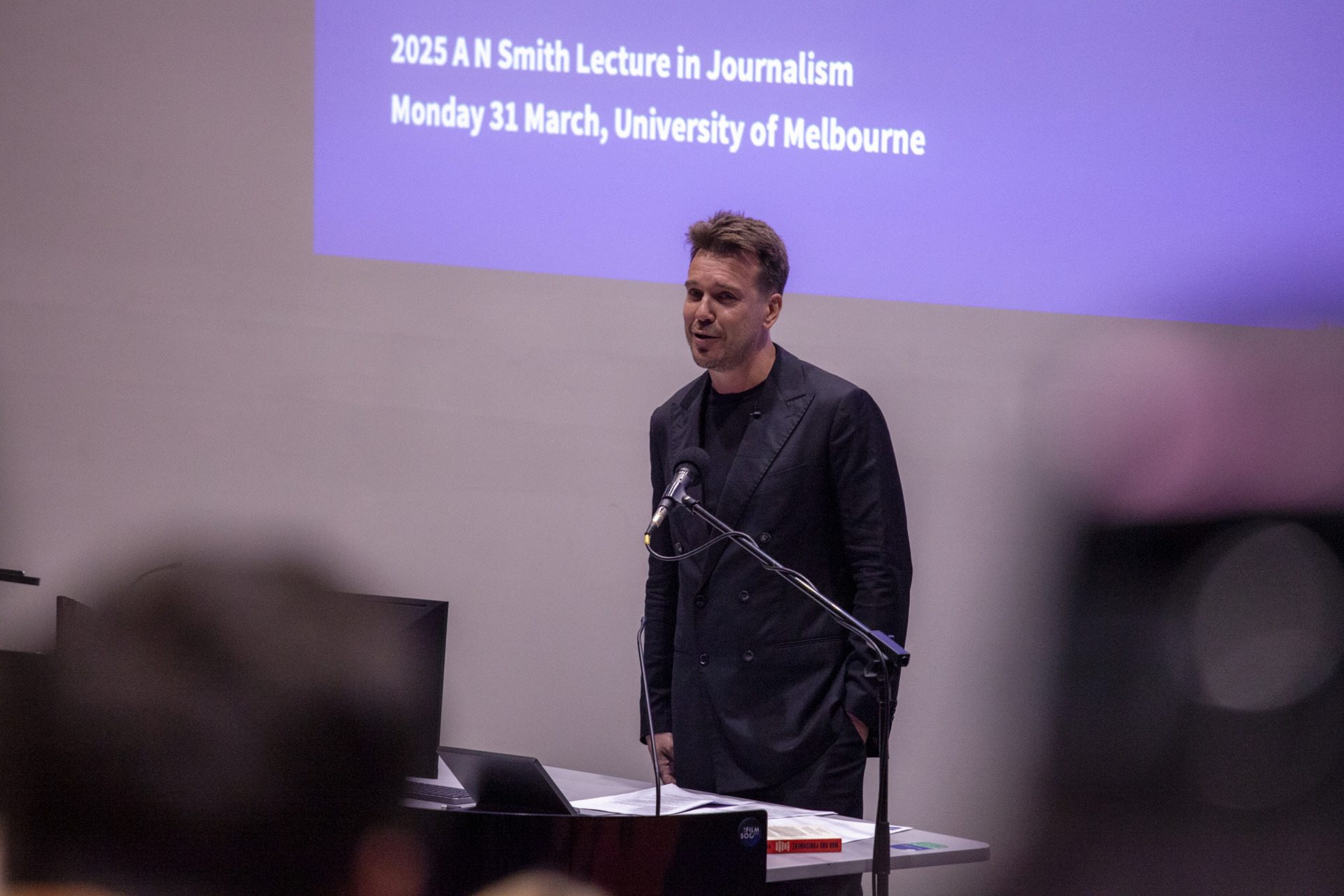
Observing the fallout of the Trump administration, “I have a great feeling of deja vu”, said Russian-born independent journalist, writer and film maker Mikhail Zygar, now living in exile in New York. Photo: Shixin Wang
“From the very beginning of his presidency, he definitely was convinced that there was no real democracy anywhere. It was all a stage.
“Everyone is corrupt. There are no saints. It’s only a matter of price, and there is no freedom of speech because the owners decide everything,”.
Zygar said Putin, alongside the Kremlin-controlled, conspiratorial news network RT, promoted the idea that the United States was destined to reenact the Soviet Union’s collapse as its citizens lost faith in democracy, just as Soviet citizens abandoned belief in communism.
That belief, Zygar warned, would only gain traction if American leaders began to adopt the same ideology of cynicism that fuels the Kremlin.
Having started his career as a journalist in Moscow as Putin first came to power 25 years ago, Zygar described his experience working in newsrooms as oligarch owners, political pressure and state propaganda progressively erased space for independent journalism.
Zygar’s first job was at Kommersant, a major Russian newspaper owned by Boris Berezovsky, the oligarch who helped bring Putin to power and was himself later forced into exile and died under suspicious circumstances in 2013. Later, at Newsweek Russia, Zygar witnessed another outlet collapse due to “economic reconsiderations” after its German publisher struck a deal with the Kremlin to protect more profitable commercial ventures.
Then in 2014 TV Rain, the independent channel launched in 2010 and which Zygar helped build, was disconnected when Kremlin officials called satellite and cable operators, telling them to “switch off our signal”, Zygar recalled. Many TV operators privately apologised to TV Rain, but feared state retaliation.
“They were telling us that they loved our TV channel and their audience, their clients need us … They cannot do anything, because otherwise their real business will be hurt,” he said.
“There was no draconian dictatorial law. Again, it was just capitalism.”
TV Rain continued to fight to stay on the air until it was designated as a “foreign agent”, forced off the airways in 2021, and its surviving online broadcast banned as “undesirable” in 2022.
Since Russia’s full scale invasion of Ukraine in February 2022, the Kremlin has waged an unprecedented crackdown on press freedom.
From the first week of the war, Russia’s communications regulator, Roskomnadzor, implemented widespread censorship laws. Publicly opposing the invasion, or even referring to what the Kremlin branded as a “special military operation” as a “war” or “invasion” was made a criminal act, punishable by up to 15 years in prison.
At least 25 journalists have been imprisoned, with hundreds more forced into exile and 22 media outlets banned as “undesirable”, a designation that makes it a criminal offence to work with, distribute, or donate to them. Those found guilty can face up to six years in prison, according to the Committee to Protect Journalists.
Zygar fled Russia in the first week of the invasion and was later sentenced in absentia to eight and a half years in prison for spreading “fake news” about the Russian military by reporting on the invasion.
Highlighting concern over the erosion of independent press protections in the US under Donald Trump, he drew parallels to Kremlin media repression tactics.
Zygar identified declining access for journalists to areas like the White House press pool, the firing of outspoken anti-Trump critics, the growing power of billionaire media owners, and practices of self censorship as eerily familiar warning signs for the future of the US press.
“One of my colleagues asked me, ‘how do we know when the moment comes and it becomes too dangerous for us? How will we recognize that day when we have to leave, as you escaped from Russia?’,” he said.
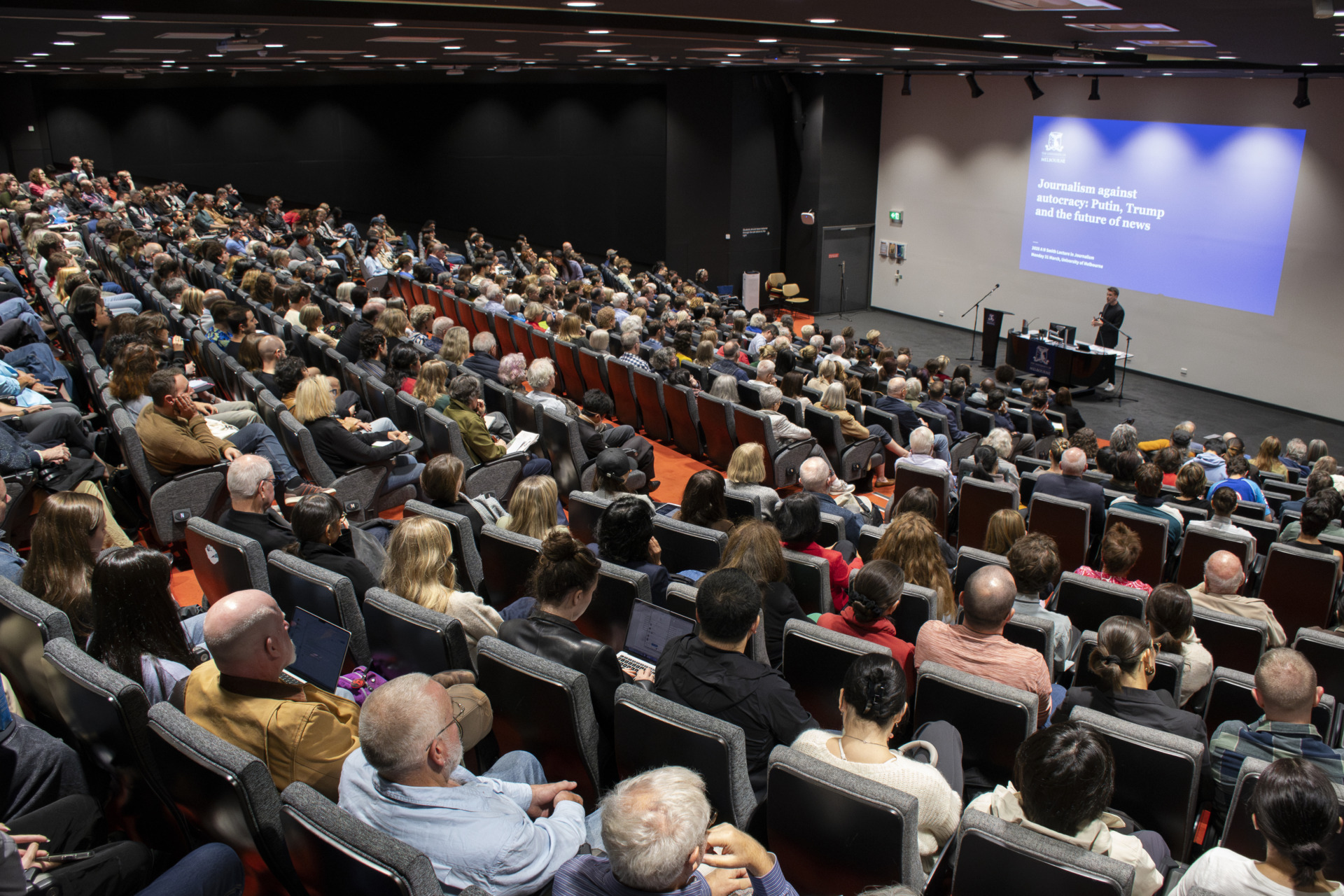
A full house for Mikhail Zygar delivering the 2025 AN Smith lecture in journalism hosted by the Centre for Advancing Journalism, University of Melbourne. Photo: Liam Cochrane
“And that’s the moment when I stopped laughing.”
Long before his exile, Zygar recounted how he fought his own, quieter “wars” with editors, oligarch owners, his colleagues, and himself.
As a young man, he threw himself into a dangerous career as a war correspondent, not only in the pursuit of journalism, but as a “perfect shield” to mask his identity.
“I wanted to prove I was strong, masculine,” he said. “Most of all, I didn’t want anyone to know I was gay.”
It wasn’t until the Kremlin’s populist culture war turned to weaponizing “traditional values” to both demonise and criminalise LGBTQ+ people that Zygar came out publicly. It was, he said, another turning point
“I’d been preaching freedom, but I wasn’t free myself.”
Zygar insisted that independent journalism in the face of authoritarianism was not futile. Even if the fight waged by his colleagues was ultimately defeated, it was never meaningless.
“I believe that the morning after is possible. That probably our war was not in vain,” he said.
“We were trying hard to promote our values. We were trying hard for those generations who were in our audience.
“I believe that we helped a lot of people, a lot of younger people in Russia, to start believing in some kind of idealist democratic values.”
An audio recording of Mikhail Zygar’s 2025 AN Smith lecture on journalism will be broadcast shortly on ABC RN’s Big Ideas.


