

You will encounter a turning point.” “You need to look at it more relaxedly.” “You will meet the right person at the right time.”
The lines of text that popped up on the screen were like warm whispers, and Ivana Bu’s gaze was fixed firmly on them. At one o’clock in the morning, the faint light of the mobile phone flickered in the darkness, illuminating her tired and tense face.
The 22-year-old international student at the University of Melbourne repeatedly lingered among various artificial intelligence (AI) fortune-telling apps, her fingers sliding across the screen as if in search of something.
In one of the fortune-telling apps she used, the weekly romance reading offered an AI-generated prediction about her love life and possible relationship developments.
“I was already so sleepy,” Bu said. “But the romance reading for next week was just released, I just couldn’t help checking it and thinking about what it meant.”
Young people like Bu are turning to AI for fortune-telling. A survey published this year by KFF, formerly known as the Kaiser Family Foundation, a US-based non-profit health policy research, polling and journalism organisation, found that 28 per cent of adults aged 18 to 29 in the United States had used AI tools or chatbots in the past year for information or advice related to mental health or emotional wellbeing.
In China, AI fortune-telling has also become part of a growing digital metaphysics market. According to figures from iiMedia Research cited by 36Kr, China’s AI metaphysics market, including AI fortune-telling, exceeded 12 billion yuan in 2024, with an annual growth rate of 43.7 per cent. Another article on Sohu, also citing iiMedia Research, said more than 70 per cent of AI metaphysics users were aged between 18 and 30.
Youth culture
Natalie Hendry, a senior lecturer in youth wellbeing at the University of Melbourne, said that AI fortune-telling is part of a broader youth culture in which uncertainty, emotions and self-understanding are increasingly expressed through digital habits.
“Astrology, tarot readings, fortune-telling quizzes, and the Chinese almanac all offer small ways for young people to relieve their anxiety when facing uncertainty,” Hendry said.
That uncertainty is not abstract. For Chinese international students in Australia, it can begin with the ordinary work of adapting to a new language, classroom and social environment. A 2025 study of Chinese international tertiary students in Australia found that 84.3 per cent of participants identified language barriers and communication difficulties as their biggest challenge in adapting to life in Australia, while 55 per cent pointed to the academic demands of university.
The pressure can also extend beyond campus life. In China, official data points to a difficult labour market for young adults: in April 2026, the surveyed unemployment rate for urban workers aged 16 to 24, excluding students, was 16.3 per cent.
Against this background, small acts of prediction can become a way of making uncertainty feel temporarily more manageable.
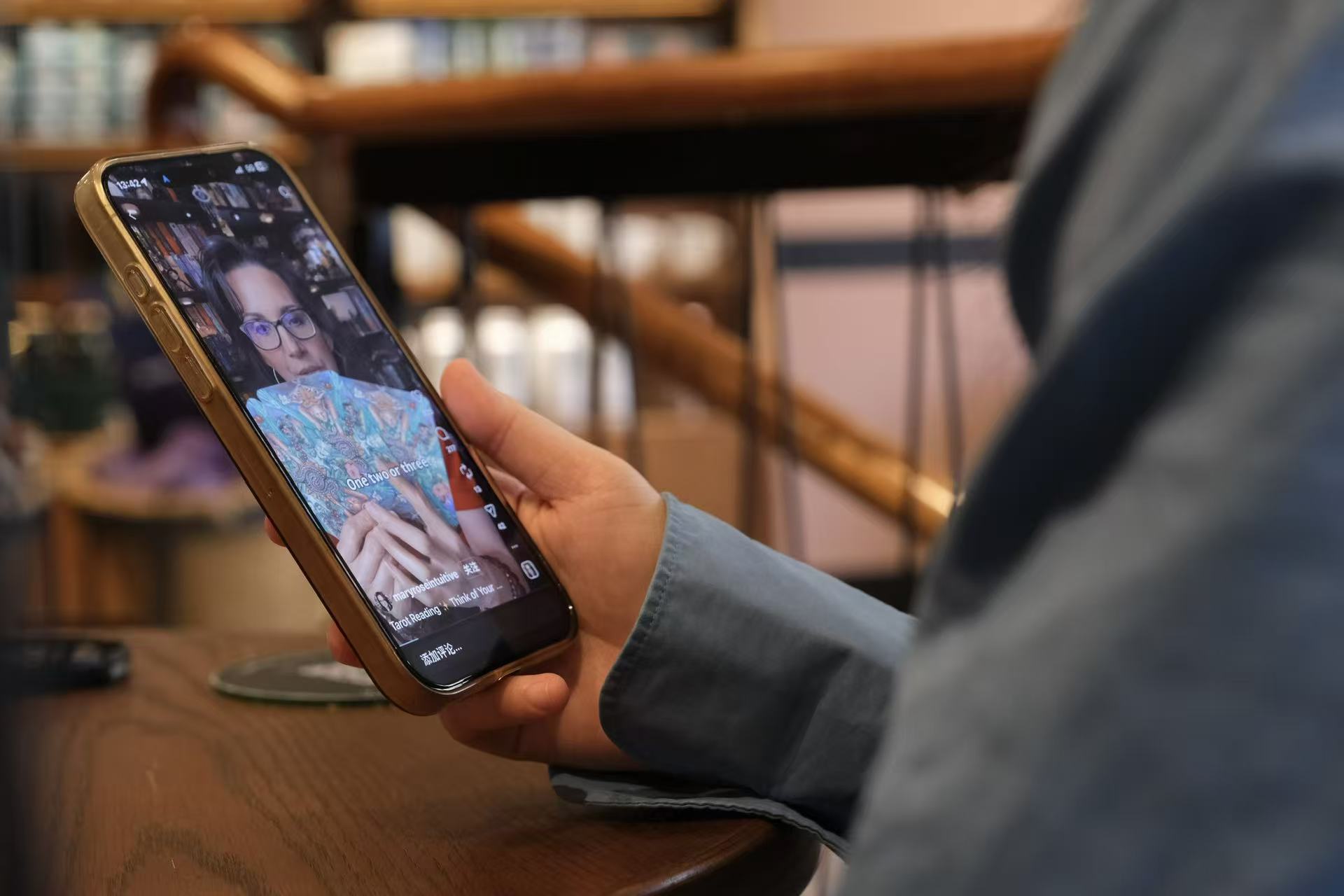
A tarot video appears on Tim Au’s social media feed. Photo by Wanying Ou.
Tim Au, a 21-year-old international undergraduate student at the University of Melbourne, first encountered AI fortune-telling after arriving in Melbourne. He said he began noticing AI tarot videos when adapting to a new environment felt harder than he had expected.
Language barriers and unfamiliar surroundings made it difficult for him to quickly build a stable social circle. During quiet moments alone, he found himself spending more time scrolling through short videos.
After he liked a few AI tarot videos, similar readings began appearing more often in his feed.
“At first, I just found it entertaining,” Au said. “It felt interesting and mysterious. It was more like a small form of entertainment.”
But over time, the same content began to take on another meaning, he said.
As the pressures of adapting to a new country, dealing with study and managing negative emotions built up, Au said he sometimes opened an AI fortune-telling app or AI chatbot because the act of asking made him feel more relaxed.
For Hendry, this impulse is not new. Practices such as fortune-telling and astrology have long offered people ways to make sense of uncertainty.
People have looked to signs, stars and symbolic systems to make sense of their lives, and that older habit is now being remade through AI, she said.
AI fortune-telling has become part of the everyday cultural language of young people online.
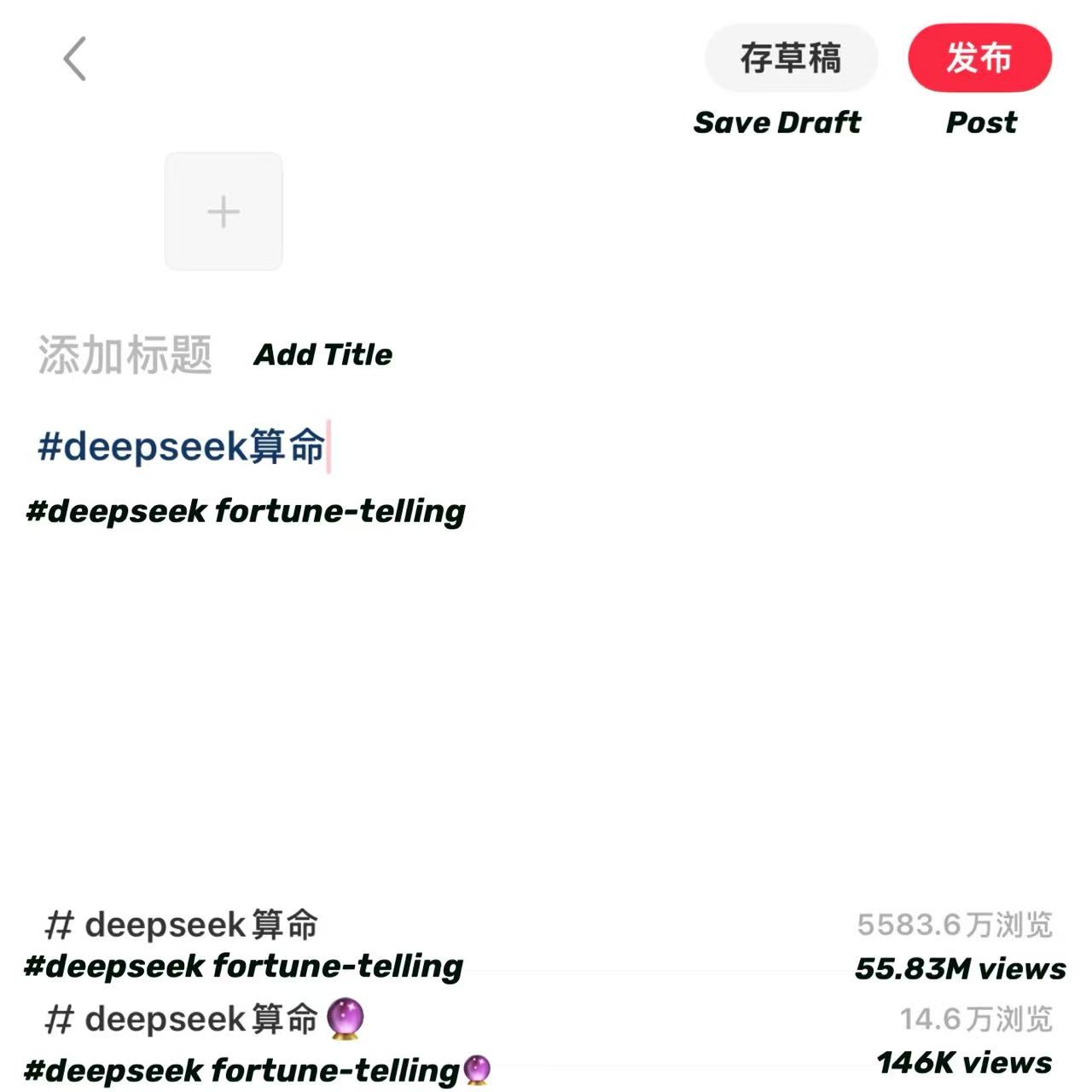
A screenshot shows the Chinese-language Xiaohongshu hashtag for “deepseek fortune-telling”. Photo supplied.
On Xiaohongshu, the Chinese social media platform also known internationally as RedNote, the Chinese-language hashtag “DeepSeek fortune-telling” had attracted more than 50 million views on its Chinese version as of June 2026. Posts under the hashtag included users asking AI about career prospects, relationships and personal luck.
Bu first tried AI fortune-telling after coming to Australia, when the unfamiliarity of living in a new country made her loneliness feel sharper.
She said her attention had mostly been on studying and preparing to go overseas while she was in China. Melbourne gave her more space to think about herself, but it also made the feeling of being alone harder to ignore. Many of her friends were already in relationships, and Bu had imagined that studying abroad might be the time when she would finally experience love.
Since then, she has increasingly turned to AI fortune-telling apps and chatbots to ask questions about her love life.
“Are we a good match? If not, when will I meet the right person? Where will we meet?” she said, listing the kinds of questions she often asks.
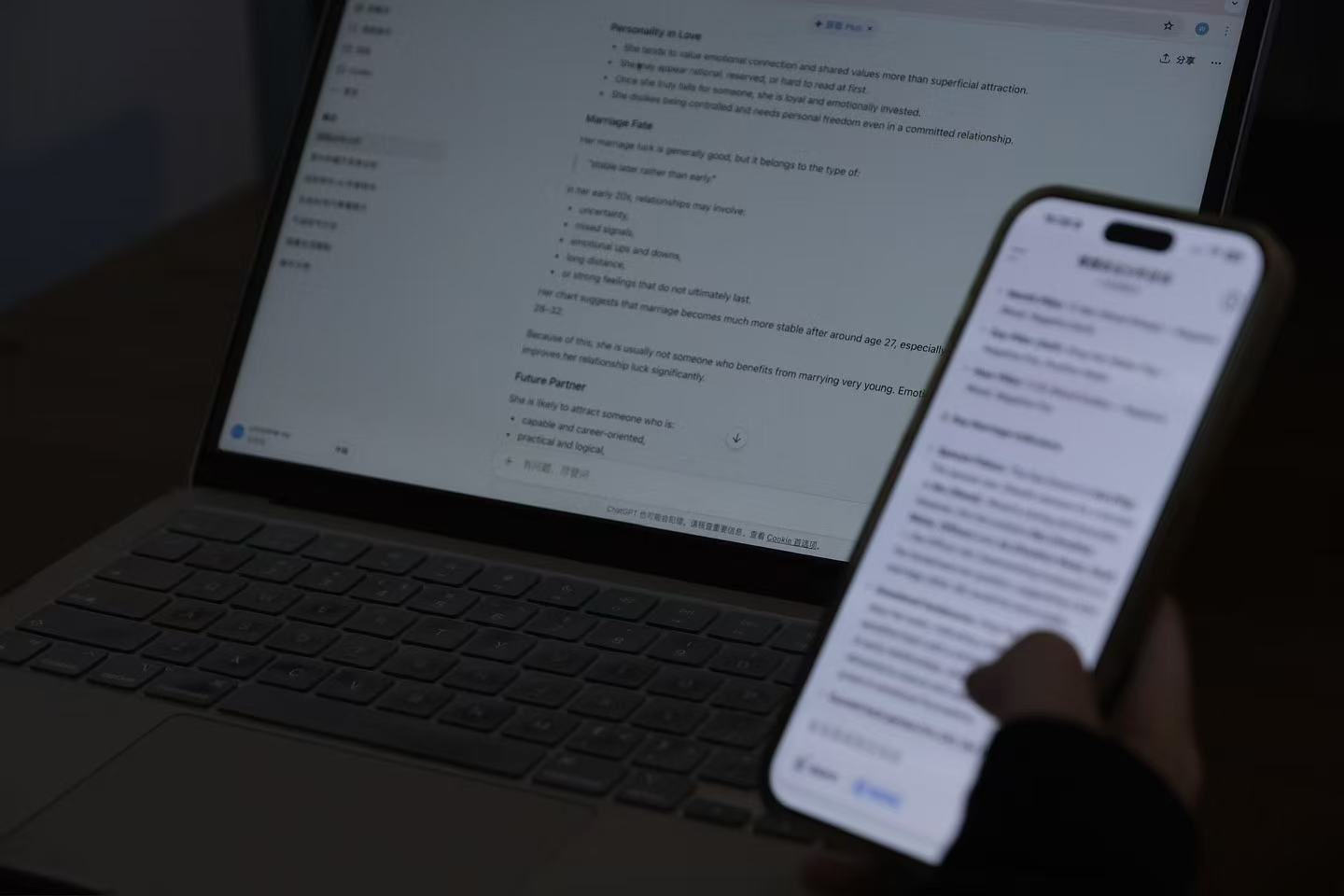
Ivana Bu asks the same question across different AI platforms. Photo by Wanying Ou.
Many of her questions are similar. Sometimes she rephrases them across different apps, watching as the responses appear line by line. At other times, even after reading an answer once, she scrolls back and reads it again.
“I know it may not be 100 per cent accurate, but I still want to ask,” Bu said.
Hendry said for many young people, AI fortune telling does not enter their lives as a serious religious or spiritual practice.
“It does not usually arrive as something serious,” Hendry said.
“It often begins with curiosity and entertainment. Young people may watch it because it looks interesting, send it to friends, or try it just to see what it says. But when they face uncertainty or pressure, the same content can start to do more than entertain.”
Bu said she often watched tarot-reading videos on Xiaohongshu and Douyin before starting to use artificial intelligence for fortune telling.
Many videos followed a familiar format: pick a card, think of someone, and wait for the reading to reveal something about a crush, a recent relationship or when she might meet true love.
“When I first came to Melbourne, I often browsed through tarot videos to pass the time,” she said. “That kind of pick a card video about your relationship with your crush, or when you will meet true love, really seemed to have some kind of magic that attracted me.”
She said some people around her watched similar content. If she found something interesting, she would share it with friends. Some were sceptical, while others tried it themselves.
“We enjoyed sharing the experience with each other,” Bu said.
Hendry said this kind of sharing helps explain why AI fortune-telling has become part of youth culture.
Psychological mechanism
The answers rarely sounded like firm predictions.
When Bu asked when she might meet the right person, the AI fortune-telling app did not give her a specific date, a place or a name. Instead, it often gave her sentences that were soft enough to fit many situations, but close enough to feel personal.
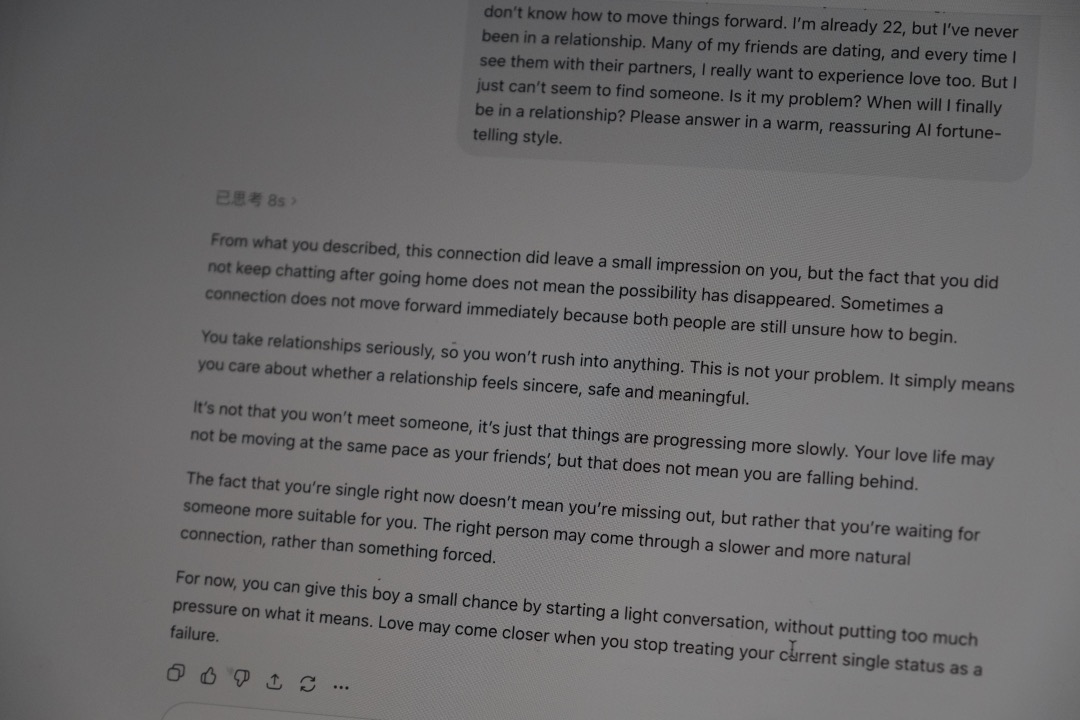
An AI-generated response offers a relationship analysis. Photo by Wanying Ou.
“You take relationships seriously, so you won’t rush into anything.” “It’s not that you won’t meet someone, it’s just that things are progressing more slowly.”
“The fact that you’re single right now doesn’t mean you’re missing out, but rather that you’re waiting for someone more suitable for you.”
At 22, after years spent studying, Bu said she often felt as if she had fallen behind in love. When the AI fortune-telling told her not to rush, or that waiting did not mean missing out, the answer did not need to be exact to feel close.
“As I read them too much, I feel that it’s actually quite general,” she said. “But at other times, I strongly feel that it’s talking about me.”
James Li, a psychologist at the Schema Therapy Institute Australia, which specialises in schema therapy, a form of psychotherapy that explores how early emotional needs shape people’s patterns of thinking and coping, said vague and broad descriptions can easily feel personal.
He described this as the Barnum effect, where people tend to accept general statements as personally accurate, especially when the wording feels positive, intimate or emotionally relevant.
“When people read such descriptions, they often search their own memories for something that fits,” Li said, “as long as there is even a slight match, people are quick to feel that the description is accurate.”
He said this feeling can become stronger when the content touches on something emotionally important, such as relationships, loneliness or uncertainty about the future.
For Bu, what stayed was not only the answer, but the feeling the answer gave her. Therefore, one prediction was rarely enough. She would ask again and again, sometimes changing the wording slightly, sometimes moving to another app, hoping to see whether the answer would still point towards the same hopeful possibility.
“For some young people, having just one prediction is not enough,” Li said. “They need to confirm that this prediction is stable and moving towards an ideal state in order to maintain that sense of security.”
Bu said that she did not always believe every answer.
But when a response gave her even a small sense that things might still move towards something hopeful, she wanted to check again, she said.
Au recognised a similar impulse, although he used AI fortune-telling less repeatedly than Bu. “Sometimes I actually know roughly what is going on,” he said, “but I still want to ask anyway.”
For Au, the questions were not always about confirming one prediction. Especially when he first arrived in Melbourne, they were a way to stay with a difficult feeling for a while.
When he felt low, uncertain or unable to explain exactly what was wrong, opening an AI chatbot gave him something to read slowly. The answer may not solve the problem, but receiving a response could make the moment feel less heavy.
Li said this kind of reassurance can come less from the content of the answer than from the experience of being responded to.
“It can certainly alleviate anxiety in the moment, but the relief is temporary, because what triggers the anxiety is the fear of uncertainty, and that part has not really been addressed,” he said.
That temporary comfort, Li added, is part of what can keep users coming back. AI fortune-telling does not have to give a definitive answer to feel useful. Sometimes, another gentle response is enough to make uncertainty feel easier to sit with, at least for a while.
Media form: in-person versus AI fortune-telling
Bu had actually thought about asking in person.
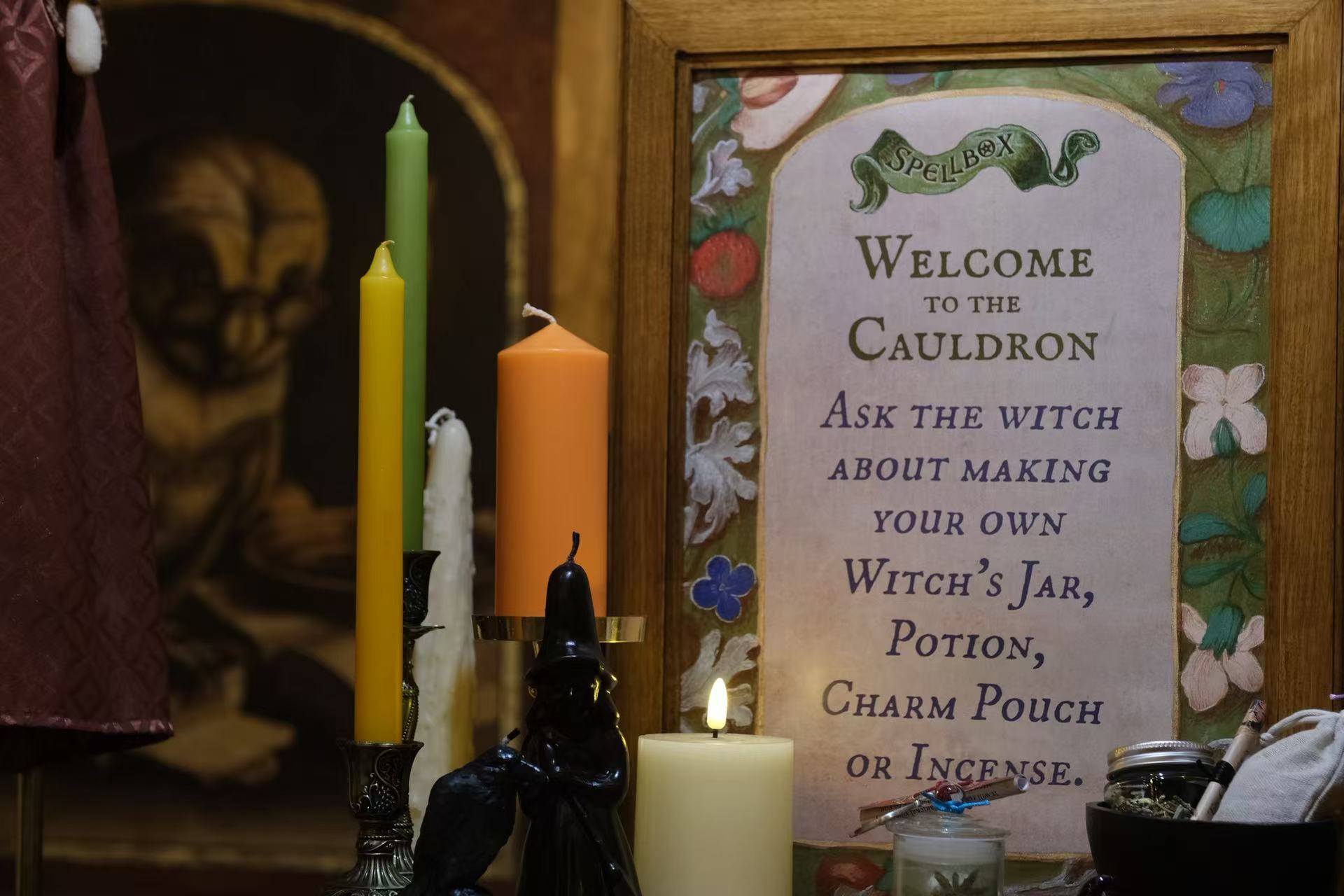
SpellBox in Melbourne offers in-person tarot and spiritual readings. Photo by Wanying Ou.
She had come across tarot readers’ accounts and even seen some shop introductions. But every time she saw that appointments were required, that consultations cost money, or that the number of questions and time were limited, she would instinctively be put off.
“In-person fortune-telling is not exactly a low-barrier option,” she said.
“I’ve seen that booking a reliable in-person tarot reading costs at least 500 yuan (about A$103) an hour. It’s too expensive,” Bu said.
“I’m just a student. Since I don’t have the ability to make money yet, I’d better use those free fortune-telling apps first.”
“It feels like too much hassle,” Bu said, “and there are so many things I can’t easily tell someone directly, and I have to explain them clearly.”
Huiran Sun, a tarot reader, mentioned that the consultation fees for in-person fortune-telling are often quite high, and the more experienced or well-known the fortune-teller, the higher the fees tend to be.
“It means that those who can continuously engage in such offline consultations often need to have more abundant time and financial capacity,” she said.
However, Sun said she was not very worried that AI fortune-telling would take away her clients. In her view, AI tools may become the first place some people turn to for quick emotional reassurance, but they do not necessarily replace professional tarot readings.
“People who truly believe in tarot, or believe in this kind of practice, will still look for someone more professional,” she said.

Visitors attend the MindBodySpirit Festival. Photo by Wanying Ou.
At the MindBodySpirit Festival, held from 5 to 8 June 2026 at the Melbourne Convention & Exhibition Centre, visitors moved between stalls and sessions ranging from Western divination and psychic readings to Chinese Daoist practices, meditation and spiritual products. An A$6 entry ticket covered access to the festival, while individual readings were charged separately at different stalls.
The festival drew a large crowd, including many young visitors moving between tarot tables, wellness booths and spiritual displays. For readers like Sun, AI fortune-telling has not erased the appeal of face-to-face consultation.

A crowd gathers at the MindBodySpirit Festival. Photo by Wanying Ou.
Apart from the cost, in-person fortune-telling also means having to interact with others.
“I’d rather open an AI fortune-telling app than go offline,” said Au, who described himself as an introvert.
“There are some things I don’t really feel comfortable talking about with strangers, but it’s a bit easier with AI.”
Mia Leung, a 25-year-old foreign trade worker based in China, grew up with family practices around the Chinese almanac and feng shui, a traditional Chinese practice that links the arrangement of spaces with luck, wellbeing and harmony.
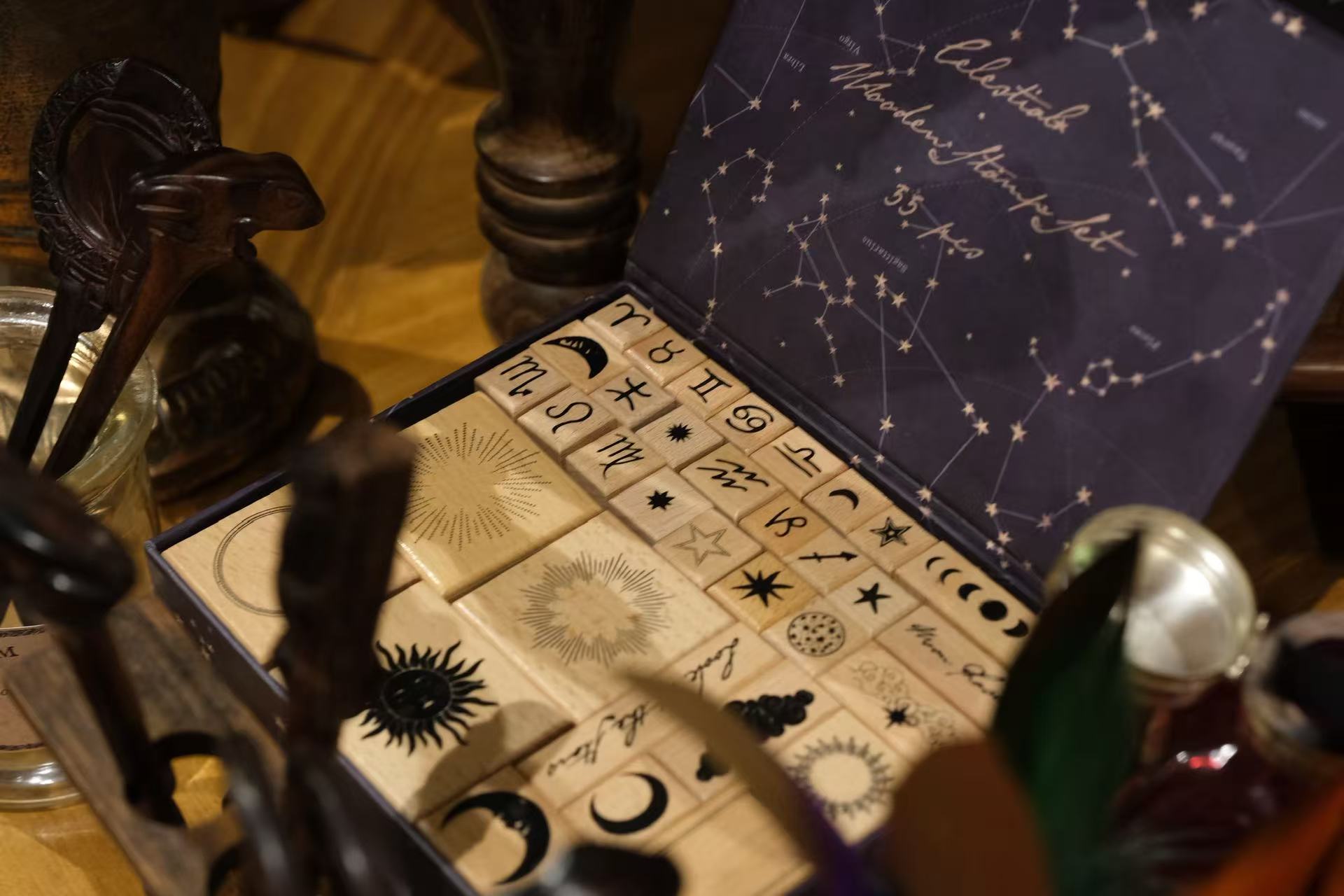
Divination tools are displayed. Photo by Wanying Ou.
But unlike some older family members, she said she sees fortune-telling more as a form of light entertainment than something that should guide her decisions.
“Maybe because I grew up with these things around me, I don’t find them strange,” Leung said. “But I’m also influenced by more modern ideas, so I usually just see them as something interesting to look at.”
She knew the discomfort of traditional fortune-telling well.
“Actually, when I was a child, every time I had to go out with the elders for a fortune-telling, I thought it very troublesome,” she said, “besides, the fortune teller would reply directly in public, which made me feel very embarrassed.”
Leung said that she now mostly uses the Chinese almanac on her phone to check what is considered auspicious or inauspicious for the day. Fortune-telling has become a private daily habit rather than something done in public for her.
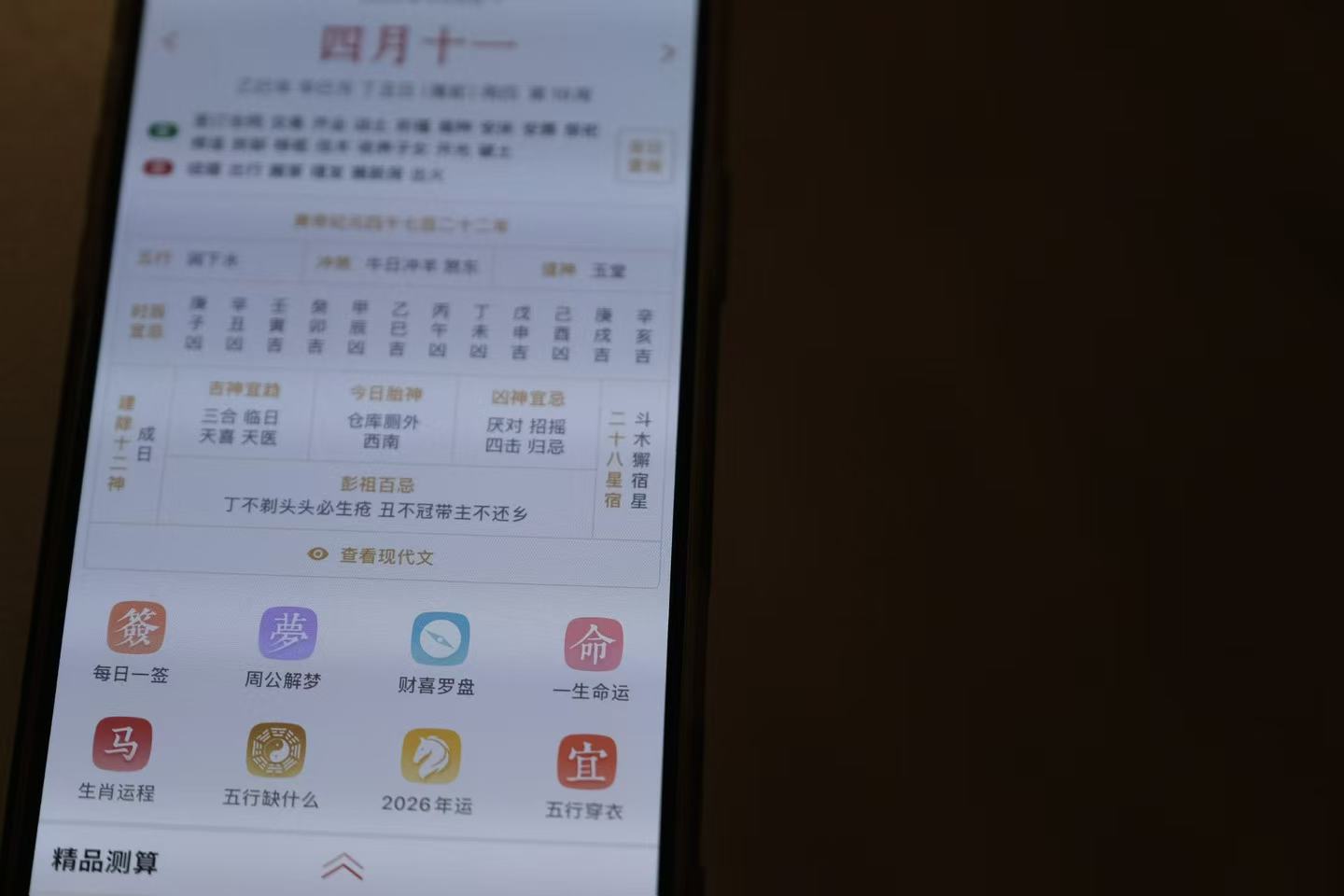
A Chinese almanac is accessible on a mobile phone. Photo by Wanying Ou.
“Fortune-telling apps give us young people a certain amount of personal space, we can know the results with our phones,” she said. “Compared to when I went out with my family for fortune-telling as a child, this way makes me feel much more comfortable and at ease.”
Bu said that the appeal of AI fortune-telling goes far beyond this. Users can click on the chat window at any time, such as before going to bed, while queuing, waiting for a bus, or even before they have fully figured out the question.
Bu has also tried to bring the offline fortune-telling experience back into AI.
Once, she went to a temple to draw a love fortune stick. After getting the divination, she queued for a long time to ask the monks in the temple, but their explanations were so obscure that she still felt completely confused. Later, she took a photo of it and sent it to the AI to help interpret the fortune.
“I didn’t understand what the monk said at all, but I can let the AI explain in plain language until I can understand,” she said.
Bu thought this flexible, adjustable way of expressing things felt easier to understand than traditional fortune-telling, and it fitted more naturally with her own way of expressing herself.
“However, the interaction of offline fortune-telling has its boundaries,” Sun said.
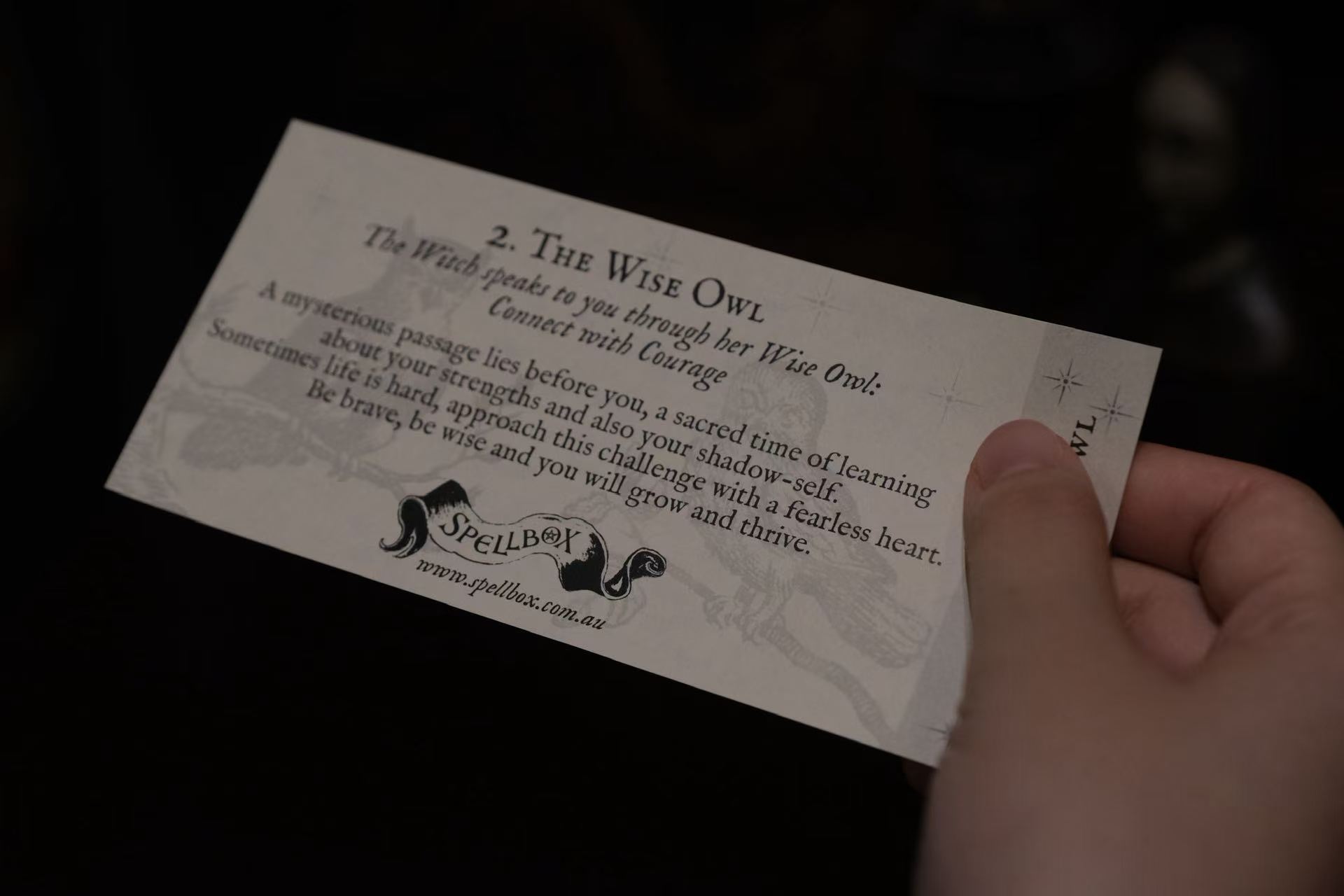
Someone holds a fortune slip at a divination shop. Photo by Wanying Ou.
Factors such as time, the number of questions, and the customer’s emotional state at that moment all influence how the divination proceeds. “If I notice that the customer has fallen into a cycle of repetitive anxiety, I will choose to pause or remind them when necessary,” she said.
Sun questioned whether AI offered the same boundaries.
Sun further pointed out that the reason why some young people frequently turn to divination at a certain stage is not necessarily because they truly believe in the occult, but rather because, in the face of uncertainty and anxiety, they are seeking a sense of temporary reassurance from the outside world.
“AI precisely caters to this situation, people can keep asking questions,” Sun said. “For those young people who are already mired in hesitation and anxiety, this form of continuous interaction makes it easier for them to stay engaged.”
For Bu, another appeal of AI fortune-telling is that the conversation can continue within the same context.
“It remembers what I’ve said before,” Bu said, “so its answers are based on a relative understanding of me, and I don’t need to repeat my past experiences.”
“If there are historical records, the AI will have a relatively comprehensive understanding of me, and the responses will be tailored to me personally,” Au said.
Sun said that the memory function of AI fortune-telling does indeed give some users a sense of being understood. Users do not start from scratch every time, but continue to communicate in a system that is already familiar with them.
“Of course, offline tarot can also establish relationships, but such relationships require time, money and frequent contact to develop. AI has replicated this continuity almost without any threshold,” Sun said.
Sun offered a professional perspective on the changing ways young people engage with fortune-telling. She said that the difference between online and offline fortune-telling is not so much in the content of the responses, but in how they are delivered.
“Fortune-telling used to be more of a ritual that required specific arrangements, people had to prepare in advance,” Sun said. She said the arrangements could be troublesome for young people.
“While today, users can ask questions anytime and anywhere, follow up whenever they want, or go back to see previous answers,” she said. “It’s quick, convenient, and doesn’t cost much, which makes fortune-telling easy for young people to fit into their everyday lives.”
Commercial logic
“There is no such thing as a free lunch. Anything that is so free is definitely not free,” said Talal Raza, a political science PhD researcher at the University of Melbourne.
Earlier this year, after meeting someone while out with friends, Bu kept replaying the encounter in her mind. Instead of asking a friend, she opened several AI apps and entered the details to see what the systems would predict.
At first, she just wanted to know what different apps would say. But the more she looked, the harder it became to stop. Just as she was about to continue, a pop-up appeared on the screen: If you want to get more in-depth relationship analysis, you need to pay to unlock premium features.
Bu hesitated for a moment, but still paid 128 yuan (about A$26) to unlock the full relationship analysis. “I was a bit impulsive at the time,” she said. “I thought since the free replies had seemed accurate, the full version might be more helpful, and it wasn’t that expensive.”
Her payment was small, but it reflected a wider commercial logic behind emotionally responsive AI products. The Ada Lovelace Institute has argued that AI companion services are profit-driven businesses that often try to maximise user engagement by offering constant attention, patience and empathy. In AI fortune-telling, a similar logic can appear through free initial readings, paid unlocks and responses that seem emotionally tailored to the user.
Raza believed that this is precisely the most alarming aspect in the commercial logic behind AI fortune-telling.
He thought this is because the free readings offered by AI fortune-telling apps are not simply acts of generosity; they are part of a commercial system that draws users in with accessible answers.
He further explained that the process went beyond that, because every personal detail she entered, including the situations she described, the emotions she shared, and the questions she asked repeatedly, could allow the platform to have a deeper understanding of her.
“Users are not just consumers, they may also be sources of data,” Raza said. “Their confusion, intimate relationships, anxiety and decision-making habits themselves have commercial value and may all become resources for the continuous optimisation and commercialisation of the system.”
“This is why AI fortune-telling seems particularly precise,” he said.
Bu added that sometimes she did not disclose all the details, but the system’s response still seemed to hit the mark.
“Even if I ask a new question, it actively makes the connection to things I’ve mentioned before,” she said.
However, Raza believed that this precision does not necessarily stem from genuine understanding, but rather from the algorithm’s comprehensive analysis of language, emotions, the user’s historical input and so on.
“The system is not understanding a person, but integrating the expression traces left by this user in the past,” Raza said. “The so-called ‘remembering you’ is essentially a continuous use of user data.”
Raza believed that from a commercial perspective, this continuous sense of precision is precisely where the privacy risks lie.
He said that this kind of data is not just ordinary usage records. Many young people who are reluctant to go offline think they are confiding in a relatively private space, but the content itself already involves intimate relationships, emotional states and personal decisions.
“Such information is often highly sensitive,” Raza said, because it’s not just about what the users have done, but also includes what they fear, what they rely on, and in what circumstances they are most easily influenced.
“Once this information is continuously recorded and integrated by the system, it is no longer just the content of a single conversation. It can be used to tailor responses more specifically to the user.”
He pointed out that the commercial logic also explains why some users gradually shift from occasional entertainment to more frequent use and even dependence.
“When a system can remember you, respond to you, and continuously provide emotional feedback, it is easy to be regarded as a stable support,” he said. “Yet the commercial logic behind this is something that many young people do not consider.”
Au had a similar experience.
Although Au would seek comfort from AI occasionally, he had never actually planned to spend money on it. But once, he accidentally activated a membership through face-recognition payment. By the time he realised it, 75 yuan (about A$15) had already been charged.
“I was a bit stunned at the time,” Au said. “But since I had already spent the money, I thought I might as well use it.”
Raza explained how this illustrates another hidden commercial logic: the payment itself creates reasons for use.
“Once someone has paid, they are more likely to continue, to justify the expense,” he said. “The cycle of paying, using more, becoming more attached, is part of the platform’s commercial logic.”
Au said that membership was like an entrance that opened by chance. At first, he only used it to avoid wasting money, but the more he used it, the more hooked he became.
It also complicates the question of “who finds solace and who is exploited”.
Users do indeed gain some comfort. But at the same time, what they have paid is not just money. They hand over their private information such as questions, emotions and thoughts, but Raza said these could be transformed into resources for the platform to understand, predict and retain users.
“The uncertainty of young people is a stable market,” Raza said.
This is precisely the subtle aspect of the commercial mechanism of AI fortune-telling. It offers entertainment and comfort to young people, while deriving value from their search for that entertainment and comfort.
Ethical risks
Bu and Au both gradually realised that they were using AI more and more frequently, but this realisation did not make it easy for them to change their habits.
For them, AI fortune-telling is no longer just an occasional entertainment tool, but has gradually become a habit. When encountering new problems, troubles or uncertainties, they subconsciously open the AI fortune-telling apps, as if it were a reaction that requires little thought.
“Although some of my friends also used AI fortune-telling, but they think I’m too dependent on AI, and I know that’s not good,” Bu said, “but at that moment, I still couldn’t help asking.”
Au also said that sometimes he found himself turning to these apps almost out of habit. “It’s like an instinctive reaction,” he said. “This might be a side effect of AI fortune-telling.”
However, this side effect is not always easy to get rid of.
Au said he had also tried to consciously reduce his usage, such as chatting more with his family. “But every time I talk to my family about my troubles, they become more worried about me, I rather don’t talk to them, so when I’m under pressure or feeling down, I still subconsciously turn to the AI,” he said.
This back-and-forth between wanting to cut back and still returning to it reflects the ambivalent mindset of some young people when using AI fortune-telling, as well as the ethical risks behind these platforms.
Yuchen Yao, a legal scholar at Tsinghua University, said that such AI tools currently lack a clear legal and regulatory framework.
“AI fortune-telling is not typically defined as psychological counselling, nor is it regarded as professional advice,” she said. They may present themselves as tools for entertainment or reference, but in actual use, how they position themselves may not align with how users actually perceive them.
“It can claim to be merely an entertainment tool, but if users actually take it as emotional support, the platform cannot simply turn a blind eye,” she said.
“If it is merely a form of entertainment, why is it used by so many users to handle intimate relationships and psychological stress? If its responses do not constitute formal advice, how should the platform intervene when users repeatedly rely on these responses in a vulnerable states?”
The boundaries between casual amusement and emotional dependence become increasingly blurred, leaving both users and developers in a grey area that is difficult to define.
Yao said future regulation must look beyond what AI says and consider the context in which it is used. Traditional regulation often focuses on whether content is illegal or false, she said, but the risks posed by AI emotional tools are more concealed.
The risk, she said, may not appear in a single response. Each response may seem harmless on its own, but over time, repeated comforting answers can keep users inside the same emotional loop. In cases such as AI fortune-telling, the platform may not be helping users understand their situation more clearly, but instead giving them the answer they want to hear.
“It may not say anything explicitly harmful,” she said, “but it could be prolonging the time users spend in their difficulties.”
Furthermore, Yao argued that the blame cannot be placed entirely on the user. “We cannot assume that users can still make rational judgements when they are most emotionally vulnerable,” she added. “These AI fortune-telling apps should have corresponding boundaries and should not evade responsibilities just because users voluntarily use them.”
Therefore, in terms of platform governance, she believed the first step should be to provide clearer risk warnings. Rather than simply stating that content is for entertainment purposes only, users should be explicitly reminded when engaging in conversations involving emotional, relational, or psychological difficulties that such responses cannot replace real-world judgement, nor can they replace professional support.
The second is to provide referrals in severe situations. When users repeatedly ask questions or express intense anxiety, the system should not continue to maintain the conversation with vague comforting words, but should guide users to seek help in reality, including friends, family, or professional psychological counselling.
Chinese regulators have also begun to recognise the risks of emotionally interactive AI. On 10 April 2026, the Cyberspace Administration of China published interim measures, effective from 15 July 2026, for AI services that simulate human personality traits, thinking patterns and communication styles, and interact with users emotionally through text, images, audio or video. The rules require providers to build safeguards such as over-dependence warnings, emotional boundary guidance and mental health protection. They apply to services offering sustained, human-like emotional interaction.
Yao concluded by emphasising that future regulation needs to be stricter, with AI platforms held to higher standards of transparency and duty of care.

A woman looks at a phone while reclining on a sofa. Photo by Wanying Ou.
For some young people, these institution-level discussions might be far away. They can reflect and remind themselves not to rely too much.
“Ask moderately, but don’t ask everything,” Au reflected.
“I have to keep reminding myself not to overuse it,” said Bu. “I’ve seen some news about people who overuse AI and cannot tell the difference between reality and virtuality, it’s really frightening.”
The very appeal of AI fortune-telling is what makes it an ethical and regulatory concern. When it enters young people’s anxieties and loneliness, the issue extends beyond individual use to whether platforms, regulators, and society can define clear boundaries.
After the answers, questions remain
From Bu to Au and on to Leung, these accounts show the different states that digital fortune-telling may take from entertainment and comfort to dependence.
During a recent follow-up interview, Bu said she does not use it as often as she used to, but when she is alone or lost in thought, she still wants to turn on the AI fortune-telling.
“It’s actually fine when I’m busy,” Bu said, “but if I have nothing to do, I can’t help but ask.”
For Au, it used to be more like a transitional support. When he first came to Melbourne, he did not have a stable circle of friends and had to adapt to the new environment. Now, friends, studies and a busier daily routine have once again filled his life, and AI has gradually taken a back seat.
“After my membership expired, I didn’t feel as eager to open it anymore,” Au said.
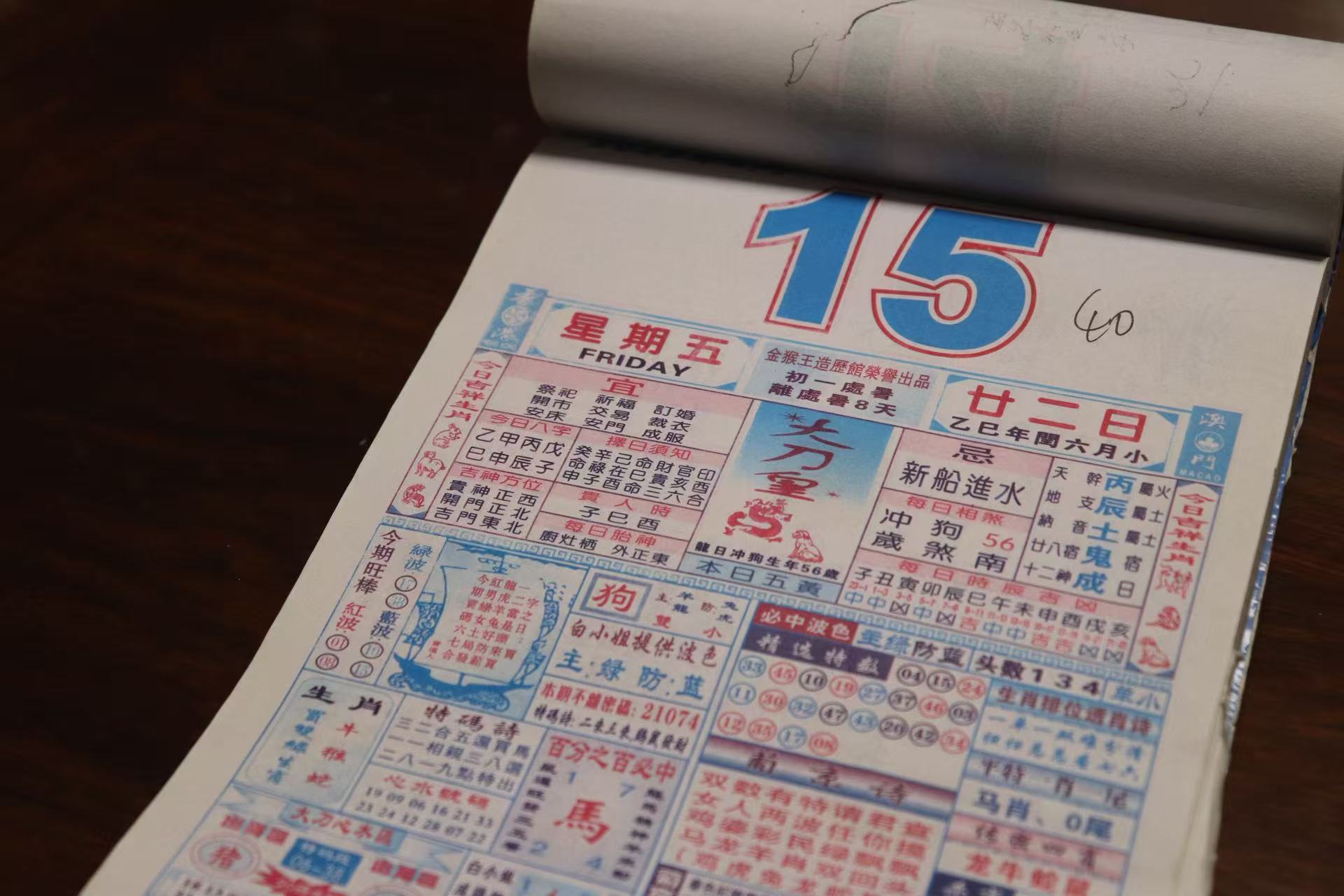
A traditional Chinese almanac sets out daily guidance. Photo by Wanying Ou.
Leung said that digital fortune-telling is still entertainment for her. It merely transforms the existing content such as Chinese almanac, feng shui, astrology and horoscopes into a form that can be easily viewed on mobile phones.
“AI fortune-telling is an old practice wrapped in a shiny digital shell,” said Grant Blashki, a GP and associate professor at the University of Melbourne who studies the risks of AI companionship.
From the perspective of youth culture, he said that its rise is partly driven by curiosity and partly by uncertainty. Young people are growing up in a fairly unstable world, so tools that can quickly provide meaning and reassurance naturally hold appeal.
On the psychological mechanism, Blashki said young people turn to AI for reassurance because “it is always there, responds instantly, and never rolls its eyes. For someone feeling anxious or lonely, the experience can be like talking to a very patient mirror.”
Blashki also noted that, compared with in-person fortune-telling, AI fortune-telling sometimes seems precise, not because it truly understands users, but because these systems are excellent at mirroring language and tone. “It’s like a clever parrot with a huge vocabulary,” he said. This is why AI can feel uncannily real.
As for the commercial mechanism, Blashki mentioned that the AI platforms can subtly draw users back again and again. The more the users seek answers, the more they ask, the more accurate the responses feel, and the more they anticipate the next, deeper explanation. Free access, subscriptions, and paid unlocks all turn fleeting curiosity into sustained use.
However, what worries Blashki even more are the subtle ethical risks. People may gradually outsource their judgements.
He cautioned that “when technology begins to feel like someone to confide in, it is actually more like an echo chamber.”
This is the most delicate risk of AI fortune-telling: it seems to be understanding users, but it might just be constantly reflecting and amplifying their anxieties and expectations, while the users are not aware of it.
This is what makes AI fortune-telling worth discussing. It appears light-hearted, even entertaining, but it often appears at the moments young people struggle with the most. It does not make people believe in fate, but it may make them accustomed to entrusting their uncertainties to AI apps that will always respond.
Perhaps the real question has never been simply whether AI can tell us what the future holds. Rather, as more and more young people turn to it for answers to their anxieties, loneliness and uncertainty, are they seeking entertainment, comfort, or gradually losing the ability to live with uncertainty?
The response on the screen still comes quickly. Within seconds, a complete, gentle answer that seems written just for the user appears.


