University of Melbourne students are inadvertently breaking copyright law by uploading course materials into AI tools, interviews with students and staff reveal.
Guidance from the University of Melbourne Copyright Office advises students not to upload third-party material into AI applications.
This includes library books, journal articles and course readings, as well as university intellectual property such as lecture recordings and presentations.
However, many students are not aware of the rule.
Bachelor of Arts student Ching Hang Darryl Yung follows the same routine after every lecture. He downloads the lecture recording, runs it through a transcription platform, pastes the text into Perplexity AI, and generates a summary.
What once took an afternoon, now takes less than 30 minutes.
Perplexity is a conversational and generative artificial intelligence (GenAI) application that uses large language models (LLMs) to synthesize information into concise responses.
It and similar tools are being widely used by students. AI translation tools are particularly useful for those students for whom English is not their first language.
Alan, a communication student from mainland China who asked to use only her preferred name, uses LectMate, a Chinese transcription app, to follow lectures in real time and Deepseek to check grammar in her essays.
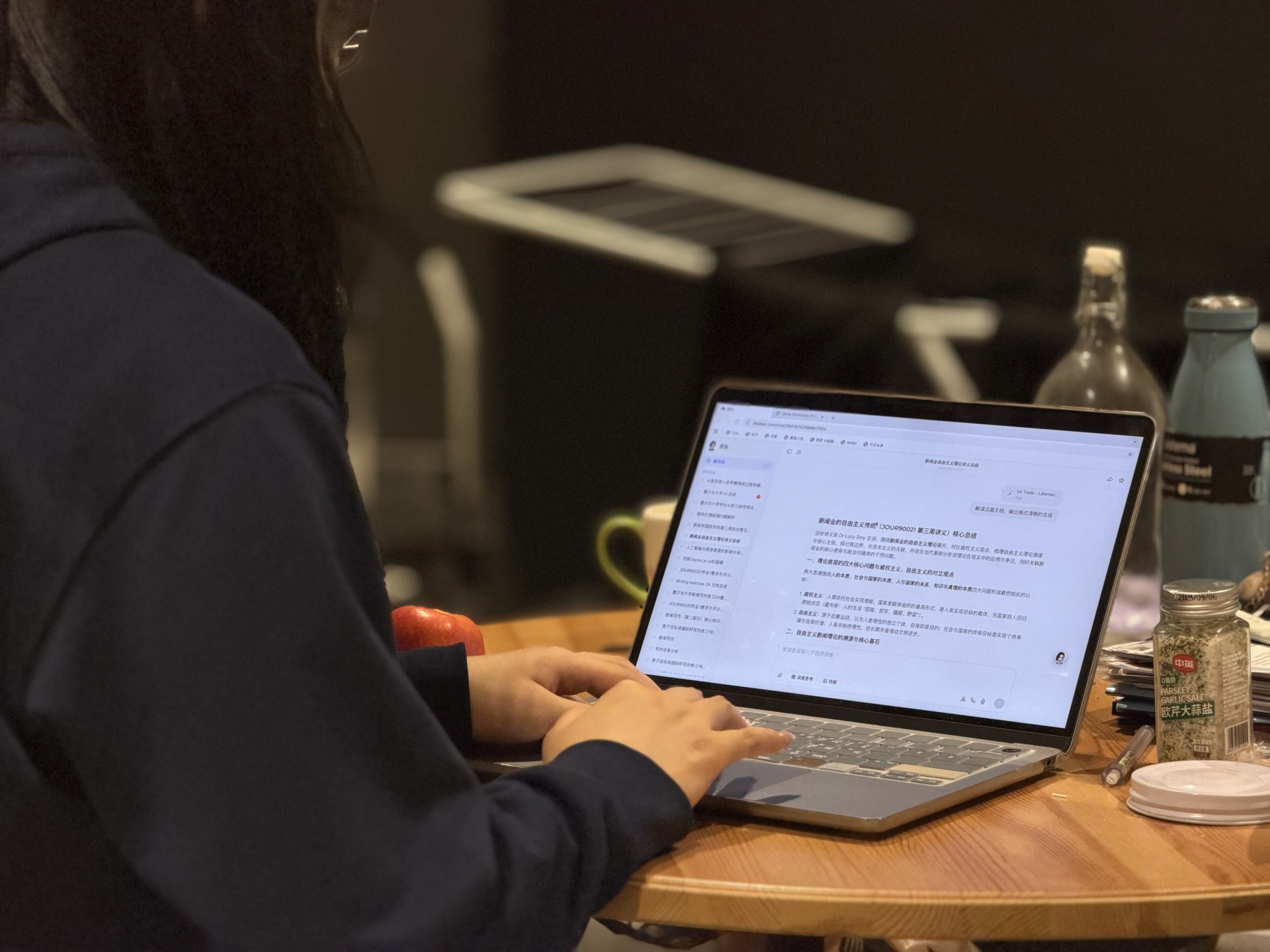
A student processes lecture content through a Chinese-language AI translation tool. Image: Xinran Yu
Breaching copyright law is not the only concern. University of Melbourne journalism tutor Mengjie Cai said students who feed texts into AI risk missing out on the actual benefit of course material—building knowledge.
“Some academic works are amazing,” Cai said. “You’d miss the whole thing.”
Cai said students should consider their favourite fiction novel—something they would never ask AI to summarise. Academic work deserves the same attention, she said.
Cai said that most assessors had methods for detecting AI, and that work produced through AI summaries rarely graded well.
The problem is sharper in a discipline such as journalism, where core skills such as interviewing and storytelling cannot be handed to a machine.
“You’re interviewing, storytelling, but suddenly you put all of it into AI,” Cai said.
“It’s doable, but ethically it’s not a good idea.”
First-year commerce student Mary-Jane Zhang said the risk with AI lay in how readily students delegate tasks they could be performing themselves.
“Tasks that are essential to what you’re studying, handing those to AI instead might affect the quality of your work,” Zhang said.
The technology also leads to greater uncertainty and mistrust between staff and students. Arts student Yung said he was once flagged by a tutor who believed his work was AI-generated.
“It was not,” he said. “I had to show handwritten notes and early drafts to prove it.”
The irony was not lost on him. The same tools he uses daily to summarise lectures, the very workflow he does not consider to be AI use, are enough to get his writing flagged.
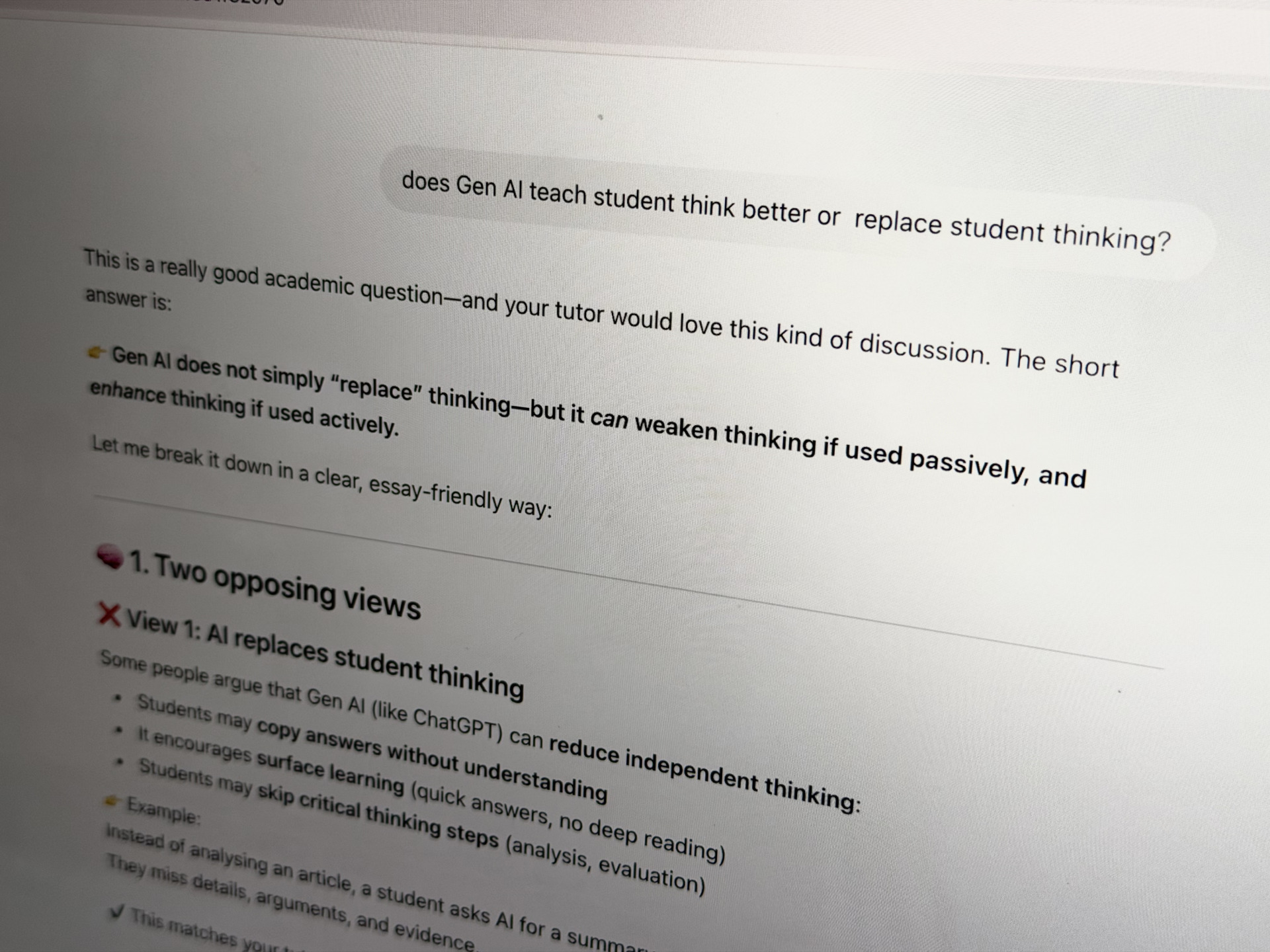
A typical prompt and response from ChatGPT. Image: Xinran Yu.
Since then, Yung has kept first drafts and notes on every piece of writing in case he is questioned again.
Zhang said the university’s rules were clear but difficult to access. Most students, she said, would never read a policy footnote.
“There should be a designated way to get that information across,” Zhang said. “Most students won’t look at it.”
Tutor Cai said a single policy applied across all university programs may not be effective, and that AI-use guidelines often need to be tailored to specific fields of study, in consultation with students themselves.
Some University of Melbourne programs encourage the use of GenAI through active learning strategies including exploring ideas, note-taking, and self-directed learning to enhance students’ skills.
But what concerns educators is when the delegation of critical thinking to machines becomes a genuine risk to learning outcomes.
In a 2025 article for the University of Melbourne’s Pursuit website, education researcher Dr Emily Frawley observed that students using AI to think and write for them miss the chance to practise the skill to create their own work.
“AI likes to wrap things into a nice little bow for us,” Frawley wrote. “Being human is messy … The skill you’re being assessed on is your ability to think through complexity.”