
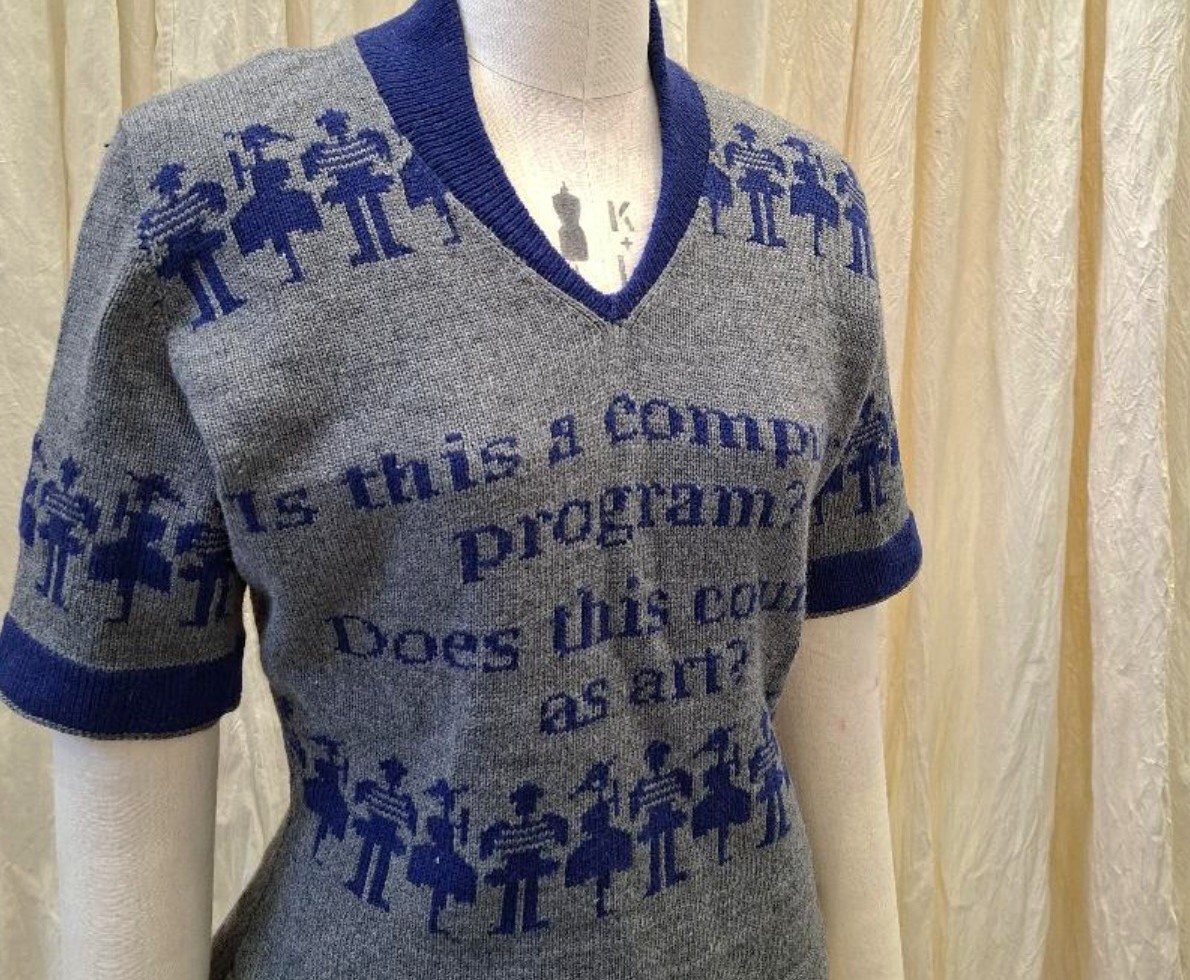
Melbourne textile artist and seamstress Valerie T Miller was hanging over a dumpster when she heard a group of police officers laughing and pointing at her from across the Woolworths parking lot.
Unbothered, Miller stretched further inside the dumpster, towards a piece of grey knitwear sitting on top of the waste pile.
When she finally pulled it free, perfectly intact and barely worn, she held up her new treasure as the police continued to laugh.
What they didn’t know was that Miller had just found the fabric that would later become the centrepiece of her contribution to the National Trust of Australia (Victoria) ‘reFashion/transForm’ exhibition—and it hadn’t cost her a cent.
Miller transformed the unusually-sourced material into original knitted shirts, which are now on display at the exhibition until 25 July.
The ‘reFashion/transForm’ exhibition showcases practices of transformation, adaptation, and reuse within both historical and contemporary contexts.
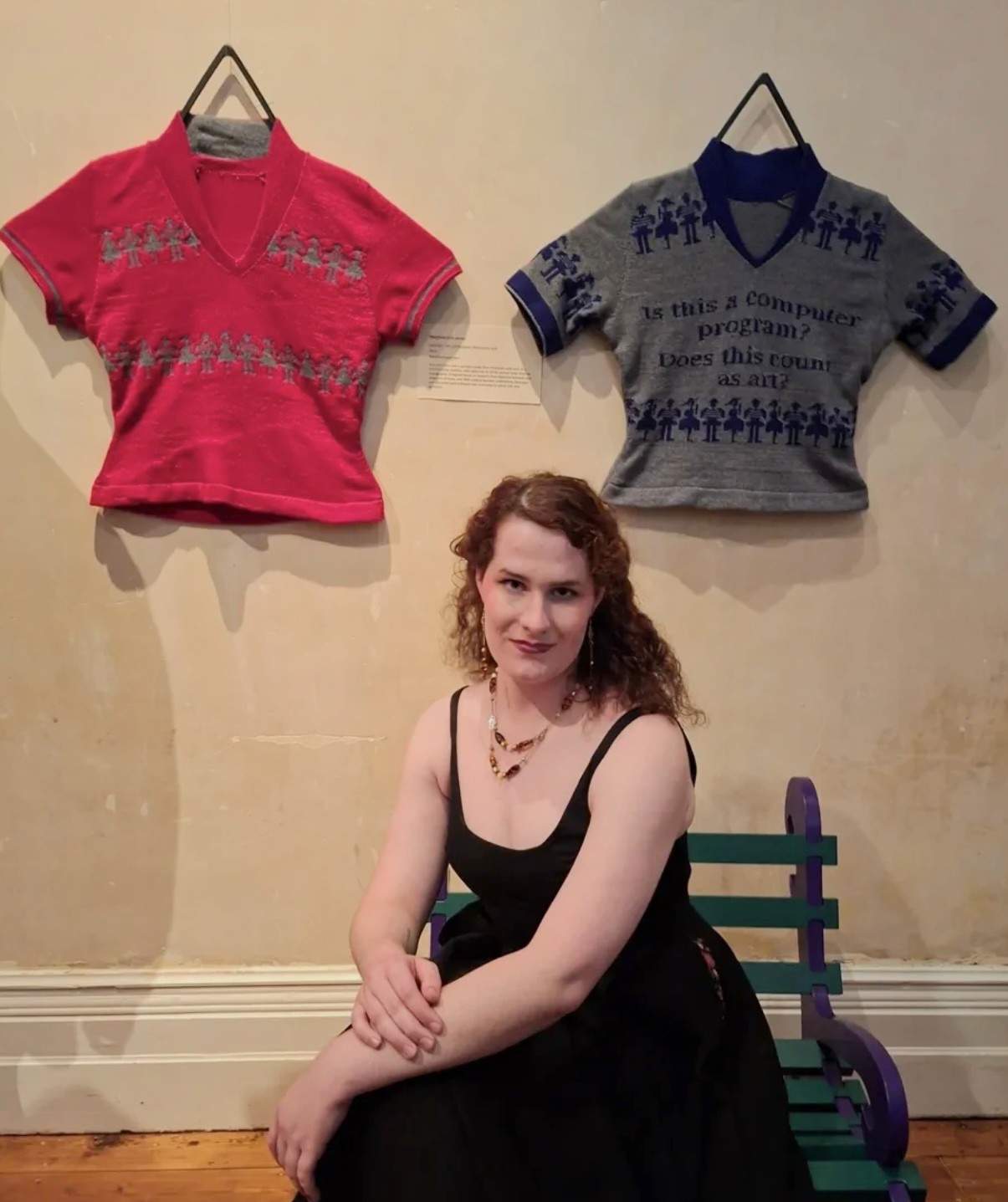
Miller in front of her knitted collection at the National Trust of Australia (Victoria)’s ‘reFashion/transForm’ exhibition. Image: Valerie T Miller.
Miller said it was divided between artists who had “re-fashioned”, meaning to mend or repurpose materials that still clearly show what they once were, and artists who had “transformed” their original design and purpose into something unrecognisable.
Miller’s work falls into the former category, with her knitted series, which she said was “all made from reclaimed wool yarn”.
She said the exhibition highlighted how slow and recycled fashion were “the standard for most of human history,” particularly before the rapid rise of the modern fast fashion industry.
Environmental group Clean Up Australia defines fast fashion as cheap, low-quality clothing that is rapidly produced by mass-market retailers.
Its research shows that the average Australian buys 56 new items of clothing per year, making Australia the highest consumer of textiles per person in the world.
According to the Australia Institute, more than 200,000 tonnes of clothing are sent to the country’s landfills each year—“the equivalent of almost four Sydney Harbour Bridges”.
In a study for the Monash Sustainable Development Institute, researchers found that of the 100 billion garments produced globally each year, 33 per cent were sent to landfill within the first year of purchase.
Carlton local and self-confessed regular “thrifter” Carla Fuebbeker said second-hand shopping had become a part of her weekend routine.
On a “successful” op-shopping day, she said she bought between one and 10 items of clothing.
“I know it’s toxic and I shouldn’t be doing this every single week but … I am,” Fuebbeker said about her tendency to overconsume second-hand clothes.
When her wardrobe becomes full, she said she tries to sell her items to vintage stores around Melbourne, or sets up a stall at the Camberwell Sunday Market.
With the unsold items, she said she donates them to op shops again.
Miller said the key to escaping this cycle of buying, wearing, and then donating again was “re-wearing, fixing, and repairing”.
She said that despite many thrifters’ best intentions, they were only delaying a garments’ journey to landfill, rather than actually reducing textile waste.
Miller said the broader, long-term solution was the creation of a circular textile economy—a system in which materials were continuously reused, rather than discarded after a single life cycle.
For example, she said wool could eventually be composted at the end of its life, returning nutrients to the soil that help grow grass for sheep to graze on, ultimately producing more wool.
“That is a truly circular economy,” she said.
Melbourne furniture designer and FUTURE re MADE founder Polly Cadden’s work is also on display at the ‘reFashion/transForm’.
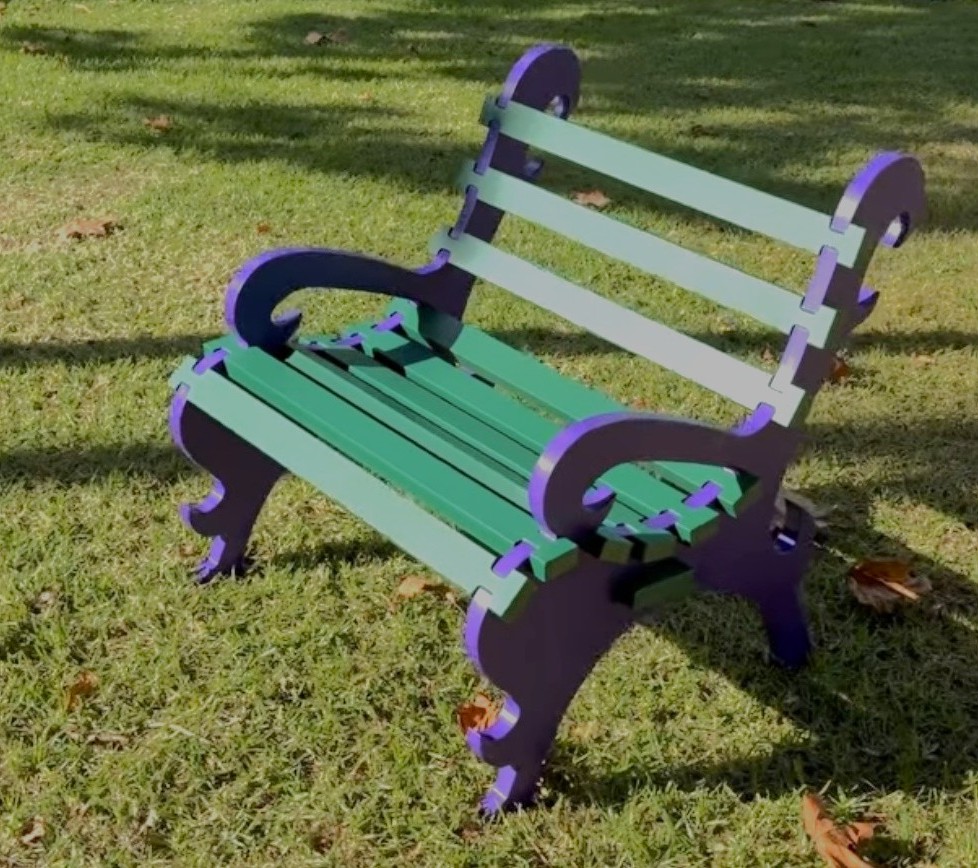
Cadden’s Parque chair, made from 90 per cent post-industrial waste. Image: Polly Cadden @futureremade, Instagram
Cadden described her contribution—a bench titled Parque–as a “true transformation” of materials.
Cadden said Parque was made from “wrought iron pieces” found buried in overgrown grass at the Ripponlea Estate Gardens.
She said her design was driven by “the satisfaction of bringing something back to life that was literally growing from weeds”.
Cadden said her work followed a “flat-pack without the fuss” idea, with each piece fitting together like a puzzle without bolts, screws or glue.
In addition to upcycling, her pieces incorporate high-density polyethylene, made from 90 per cent post-industrial plastic waste, while the remaining 10 per cent contains colour, fastener and UV.
Cadden and Miller want ‘reFashion/transForm’ to encourage audiences to rethink waste and reconsider the possibilities of discarded materials, to open their imaginations rather than putting sustainable projects in the “too hard basket”.
“I hope that people who look at their clothes afterwards [are] thinking, ‘what can this become?’” Miller said.


