“There’s no way that 13-year-old me who was playing national basketball would even be able to fathom that I, at 23, would be completely reliant on other people for care,” Iz Roth says.
Iz is a National Disability Insurance Scheme (NDIS) participant from Sydney. They are autistic and live with psychosocial disabilities, post-traumatic stress disorder, a connective tissue disorder, and comorbid impairments.
Iz says they had a traumatic childhood and have no informal disability supports like family members to rely on. As a teenager, they spent several years in and out of hospital for mental health treatment and experienced repeated homelessness.
Like many Australians living with disability, Iz has found trying to access vital supports through the NDIS distressing, unjust, and unnecessarily complicated.
With the federal government announcing intent to cut NDIS funding, kick at least 160,000 people off the scheme, and tighten eligibility criteria, disability advocates and organisations warn many more will be denied critical supports.
In 2019, Iz submitted their first of three NDIS applications with “not a lot of support”. They were rejected and referred back to the public mental healthcare system.
“Anybody who’s been in that system knows that it’s utterly fucked up,” Iz says.
“If I stayed with that system, I would not be here.”
In 2022, a case manager helped Iz access stable, secure accommodation through a now-defunded government women’s housing program. They submitted their third application for the NDIS that year and were approved, which Iz credits to their support team’s assistance.
“If you do not have access to good health professionals to write reports, or a case manager to actually push [the application] through and understand the process, you’re absolutely screwed,” they say.
The funding Iz received, including for psychology, a psychosocial recovery coach, and support workers, enabled them to make significant progress in their mental illness recovery for the first time. They finished a Diploma in Mental Health, started working as an aged care nurse and support worker, and roller skated regularly.
“I was in probably the best place I’d ever been in, like, eight years,” Iz says.
That came to a halt early in 2025 when they developed Myalgic encephalitis/chronic fatigue syndrome (ME/CFS).
ME/CFS is a debilitating, poorly understood chronic neurological condition affecting an estimated 219,000 Australians. Often triggered by an infection, it is characterised by extreme, unending fatigue. Its long list of symptoms includes widespread pain, cognitive difficulties, sensitivity to noise/light, and post-exertional malaise (PEM), with around a quarter of sufferers left housebound or bedbound.
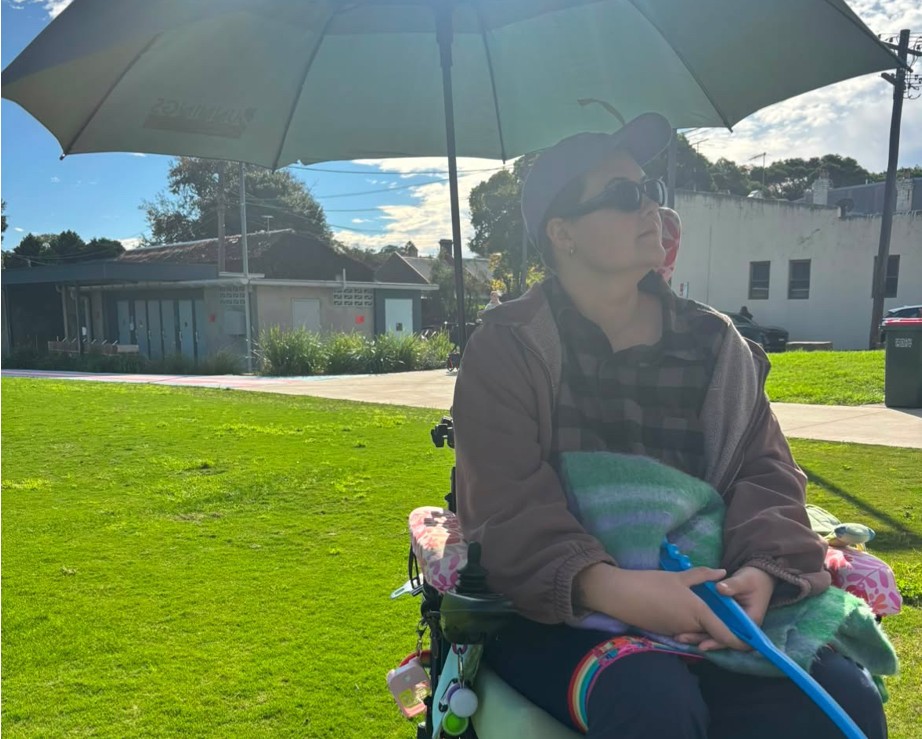
Iz’s case is severe, and they lost enough functional capacity within two months of onset to become mostly bedbound and require a powered wheelchair for all outings. Now, they are confined to their bed for 22 hours a day.
Even minor exertion can leave Iz in a PEM crash for a week or two. During these episodes, sound and light become painful.
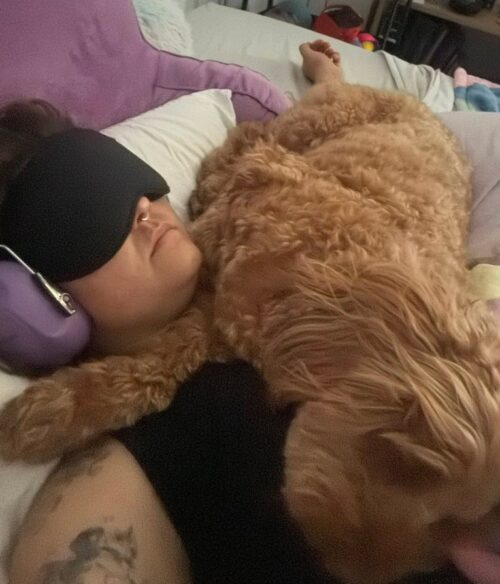
During post-exertion malaise episodes, light and sound become painful for Iz. Image supplied by Iz Roth.
In more severe cases, they experience “near partial paralysis” and cannot turn over, sit up, or speak. Sensory input becomes so unbearable they need to stay in complete silence and darkness with an eye mask and headphones on.
Iz now needs support with all aspects of daily life, and says developing ME/CFS made things so difficult that “the prospect of continuing to live in [that] existence” felt impossible. This led to hospitalisation following a suicide attempt.
Iz submitted a “change of situation” request for additional NDIS funding in late 2025, including for a supported independent living (SIL) arrangement and a powered wheelchair. This request was denied.
“They said because I’d been in hospital so long, I hadn’t demonstrated that I would need that amount of support in the community,” Iz says. “And they took away my psychology funding.”
Iz and their support team appealed the decision with the National Disability Insurance Agency (NDIA). Ultimately, they were told they hadn’t satisfied impairment “permanency” requirements and demonstrated significant impact to their function, contrary to specialist reports provided.
“They are actively denying what doctors are writing,” they say.
“These people have never even met me, and they’re deciding that I’m not disabled enough.”
In the absence of adequate support, Iz says their situation has become “urgent” and their treating specialist has now classed their condition as progressive. Disability support organisations, advocacy groups, and legal services they have contacted have all been unable to help.
Iz says they “never could’ve expected it to be so hard to access [support] for a physical disability” such as a wheelchair, which they have had to source themselves second-hand.
They have escalated their case to the Administrative Review Tribunal (ART), which handles external NDIS appeals.
NDIS exclusion, rejection and appeals
While Federal Minister for Disability Mark Butler claims the scope of the NDIS has “expanded to cover many Australians with less significant support needs”, most disabled Australians are not on the scheme.
Butler and colleague NDIS minister Jenny McAllister did not respond to Citizen requests for comment for this story.
The 2022 Australian Bureau of Statistics (ABS) Survey of Disability, Ageing and Carers found 5.5 million Australians, just over 20 per cent, had a disability that year. Only approximately 10 per cent of Australians with disabilities were on the NDIS in June 2022.
People aged 65 and over are ineligible for the scheme. According to the survey data and ABS estimates, fewer than 17 per cent of Australians with disabilities younger than 65 were on the scheme in 2022.
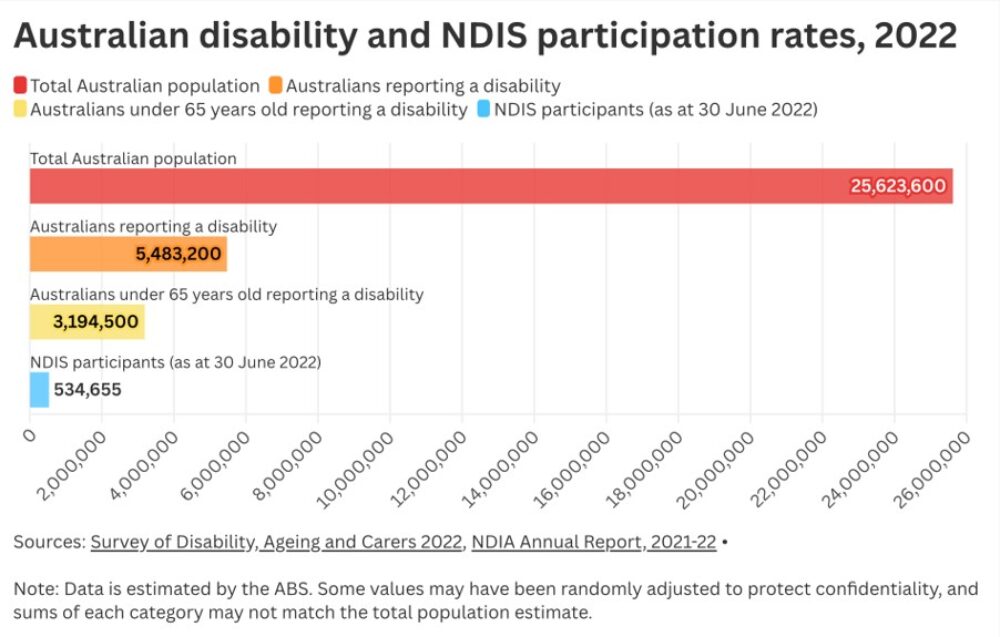
Graph created with Flourish.
Acceptance rates into the scheme have been found to vary depending on disability type, along with gender, age, and geographical area.
A report from the Australian Psychosocial Alliance found only 25 per cent of NDIS applications for people with psychosocial disabilities were approved during the last quarter of the 2024-25 financial year. It also found NDIS eligibility rulings “ignore expert assessments” and demonstrate a poor understanding of psychosocial disability.
The report found NDIS assessors denied an applicant satisfied condition permanence requirements to access the scheme on multiple occasions by not first trying medical treatments that were, in fact, inappropriate for their condition. It stated rejection letters often followed a rote, non-individualised format, and sometimes identified treatments inconsistent with NDIS legislation and expert opinion.
For example, ME/CFS Australia reports many people with ME/CFS are required to have already tried Graded Exercise Therapy—a treatment found to be ineffective and often harmful for ME/CFS sufferers—before being deemed eligible for NDIS funding.
Victor Korng, a casework lawyer from Geelong-based Villamanta Disability Rights Legal Service, also identifies this trend.
Korng says his organisation regularly sees the NDIA use a “checklist response” for evidence in ART appeals.
“They ask all participants for the items on their list, even when they are inappropriate,” he says.
Acquiring additional evidence like this in appeals is time-consuming, costly, and adds to participants’ stress, Korng says. He also says these requirements are “problematic when the Tribunal allows the [NDIA] to delay steps in the process, and then argue that reports are out of date”.
Korng says appealing an NDIS decision presents a variety of barriers.
“The process itself is completely inaccessible to most people with cognitive impairments,” he says.
Other barriers he identifies for participants include lacking informal supports, navigating crises resulting from funding cuts, tribunal timeframes, and tribunal accessibility.
Increasing demand for NDIS appeals
The ART’s most recent caseload report shows a provisional 3,566 external NDIS appeals were brought to the tribunal between mid-October 2024 and the end of June 2025. Almost three quarters of finalised cases resulted in a changed outcome.
Villamanta Disability Rights Legal Service has received a surge in NDIS appeals enquiries in the past three financial years, Korng says. Provided data shows an average of 65 enquiries per month for the financial year so far, up from 58 in 2024-25 and 28 in 2023-24.
Korng says while 647 people have sought Villamanta’s assistance in the financial year to date, the organisation has only been able to legally represent 28 people. He says the demand for NDIS appeal assistance is increasing, but inadequate funding limits advocacy capabilities.
“We do not have enough resources to help everyone, and we are hearing that many other advocacy organisations are in the same situation,” he says.
The service expects an increase in NDIS appeals enquiries if the government’s NDIS Bill passes in its current form, Korng warns.
Awaiting their own appeals tribunal case, Iz says they have “immense fear” about the outcome and its implications for their support. They also worry changes to the NDIS and funding cuts will make the scheme even more inaccessible for people who need critical support.
“I’ve already seen how hard it is to access the NDIS, and it’s only going to get worse from here,” Iz says.