Sonam* left Nepal for Melbourne to study nursing in early 2024, where she was joined three months later by her husband, Bishal.
He found a job working in aged care, without which the couple would not have survived financially while she attended classes and completed 1000 hours of unpaid hospital placements for her Master of Nursing Practice. Bishal’s pay covered rent and food, while Sonam’s savings and a loan from home went towards tuition.
“He made it possible for me to just be a student,” she says. “He wasn’t here to make money just for fun. He was here so I could finish my degree and placements without worrying about where I’m going to find the money for my next meal.” Bishal also provided care within Victoria’s chronically short-staffed aged care workforce.
Sonam, 29, who asks not to be identified, now works as a graduate nurse in a public hospital in Melbourne’s western suburbs. Asked whether she would be able to pursue the same path under Australia’s recently overhauled visa rules, she is unequivocal.
“I wouldn’t come to Australia,” she says.
As of October 2, most international students applying for student visas are no longer allowed to include family members as dependants unless they qualify for an exemption. Nor are students allowed to add partners or children after their student visa has been granted, regardless of their course.
Home Affairs Minister Tony Burke announced the changes on September 17 as part of a wider overhaul of Australia’s migration system to “end rorts and bring in the skills Australia needs”.
Australia’s aged care sector could be short of more than 110,000 direct-care workers within a decade, according to estimates by the Committee for Economic Development of Australia, while the federal health department projects a shortfall equivalent to about 70,000 full-time nurses by 2035.
Exemptions cover PhD students, who Burke told the ABC were “logically going to be older”, as well as students from Pacific and ASEAN countries, recipients of certain foreign government scholarships, and students sponsored by the Department of Foreign Affairs and Trade or the Department of Defence.
A Department of Home Affairs spokesperson said the exemptions applied to “limited cohorts in recognition of their contribution to Australia’s strategic interests, including bilateral partnerships and research and innovation capabilities”.
The upshot is that South Asian students, many of whom are doing masters by coursework for subjects such as nursing, social work and teaching, are hit hard.
“It’s not explicitly reflected in the policy as a distinction made on nationality or region. That’s something you unearth when you look at the fine print,” says Dr Melinda Hildebrandt, an education policy fellow at Victoria University’s Mitchell Institute.
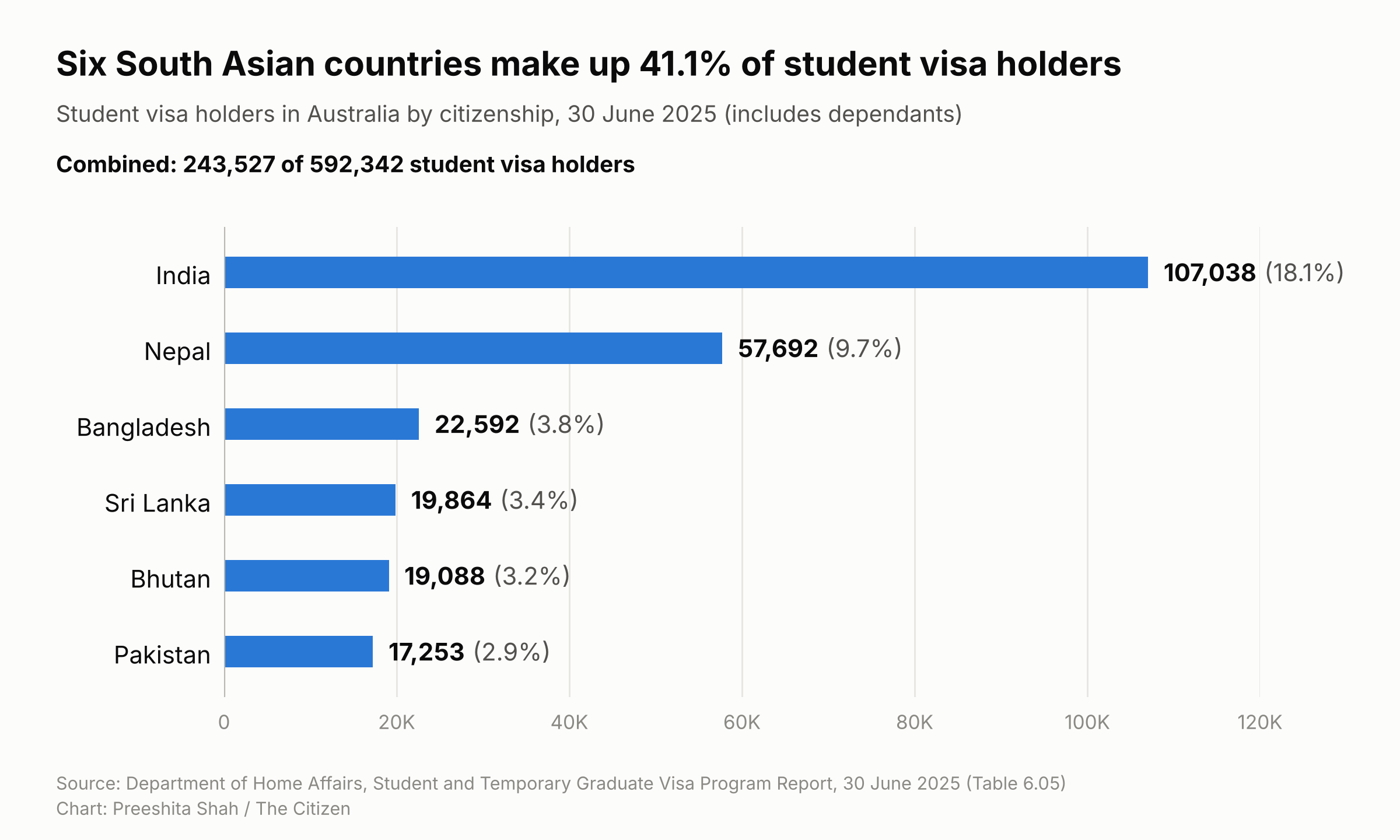
Before the pandemic, China was the leading source of international students in Australia. Since then, however, a growing share has come from India and Nepal. In June last year, these countries, along with Bangladesh, Sri Lanka, Bhutan and Pakistan, made up 41.1 per cent of student visa holders in Australia, including dependants, according to Home Affairs data. The data show 107,038 student visa holders in Australia were from India, and 102,990 from China.
Hildebrandt described the changes as a collision between education policy and “migration imperatives”, with international students caught in efforts to bring down net overseas migration.
“If international students represent a big share of temporary migrants coming to the country, then they are an easy group to point at if you want to bring that number down,” she says.
About 23,000 of the 28,831 visas granted to family members of university students in 2025 to 2026 were linked to postgraduate coursework students, according to an estimate by the Council of Australian Postgraduate Associations (CAPA).
The government’s main concern was vocational education, where students on short courses bring dependants at higher rates, says Jesse Gardner-Russell, CAPA’s national president.
But “coursework students are caught in the crossfire”, he says.
Experts have questioned the government’s assumptions about students’ ages and family circumstances.
“Degree type alone does not necessarily reflect a student’s age, family responsibilities or intentions,” says Professor Ly Tran, an education expert from Deakin University.
About 51 per cent of international postgraduate coursework students were aged 25 or over in 2024, according to CAPA, while 59 per cent of postgraduate research students were aged 30 or over.
“One of the gaps in the policy thinking and application is that it assumes there’s the undergraduate experience, usually younger people, and then postgrad research students who potentially have families,” Hildebrandt says.
For a South Asian masters by coursework student, the only exemption under the new rules is for those holding a government scholarship or sponsorship, which Hildebrandt expects would be rare for that kind of degree.
Other countries looking to rein in migration numbers related to student visas have drawn the line by course rather than rules that effectively filter by nationality.
The United Kingdom stopped most non-research postgraduate students from bringing dependants in January 2024, but research students remained eligible. Canada still allows spouses of masters students in programs of at least 16 months to apply for open work permits.
Gardner-Russell says many international students were “doing degrees in exceptionally valuable areas”, such as health and social work. Some stay in Australia through permanent migration pathways, he says, while many take their skills home.
“We’re really losing out on what the real benefit of international education is, which is spreading of our ideas and our systems to our neighbours,” he says.
In Sonam’s second year, a drop in the exchange rate left her family in Nepal almost $2000 short of a tuition payment. Bishal picked up extra shifts to cover it.
“If I was alone that month, I would have had to defer or even just drop out,” she says.
During student placements, “you’re working full shifts at the hospital, 7 in the morning to 3:30, sometimes late shifts, and you’re not paid anything. Nothing,” says Sonam.
Partners of masters students on dependant visas can work unrestricted hours. Students are generally limited to 48 hours a fortnight during teaching periods.
Priya*, a 27-year-old Indian student at the University of Melbourne, is also completing 1000 hours of unpaid placement as part of her two-year Master of Social Work.
Eligible domestic social work students can receive the Commonwealth Prac Payment of $338.60 a week during mandatory placements. International students cannot.
“If you’re taking a thousand hours of placements, you don’t have time to work,” Gardner-Russell says. “That also goes for international students, and it’s doubly so.”
Priya had expected her partner, who lives in the United States, to join her after she finishes her degree.
Her plans depend on a Temporary Graduate visa, which allows eligible international students to stay in Australia after completing their studies. The government has announced similar restrictions on including family members in graduate visa applications, but those changes have not yet been implemented.
The September announcement came as a shock, she says.
“It’s like a dead end. I don’t know what to do next.”
Some masters students are putting their studies on hold or deferring, while others are considering shorter degrees or universities in other countries, the University of Melbourne Graduate Student Association (GSA) said in a statement provided by its president, Amila Premakumara.
Restrictions on bringing family members may make Australia “a less attractive destination for many prospective students, particularly those who have partners and other international study options”, says Tran.
For these students, choosing where to study is “not simply a decision about the quality of a course”, she says. “It also involves considering whether they can pursue their education while maintaining their family life.”
Health care and education are among the areas where Australia has significant workforce needs, and international graduates have made an important contribution to both, she says.
“It is worth considering the possible consequences for sectors that rely on attracting and developing skilled graduates from overseas.”
CAPA has called for masters by coursework students to be exempt, arguing that longer postgraduate qualifications should be treated differently from short courses.
The Department of Home Affairs did not address why masters by coursework students were not exempt.
Priya and her partner are still planning a future in Australia, without knowing what the graduate visa restrictions will mean for them. For now, she is finishing her degree and saving for the next stage.
“It can be implemented any time,” she says. “So time is against me. That’s how I see it.”
*Names have been changed for privacy.
This story is co-published with The Saturday Paper.