Aidan Cusack had been a teacher for a week and a half when he walked off the job.
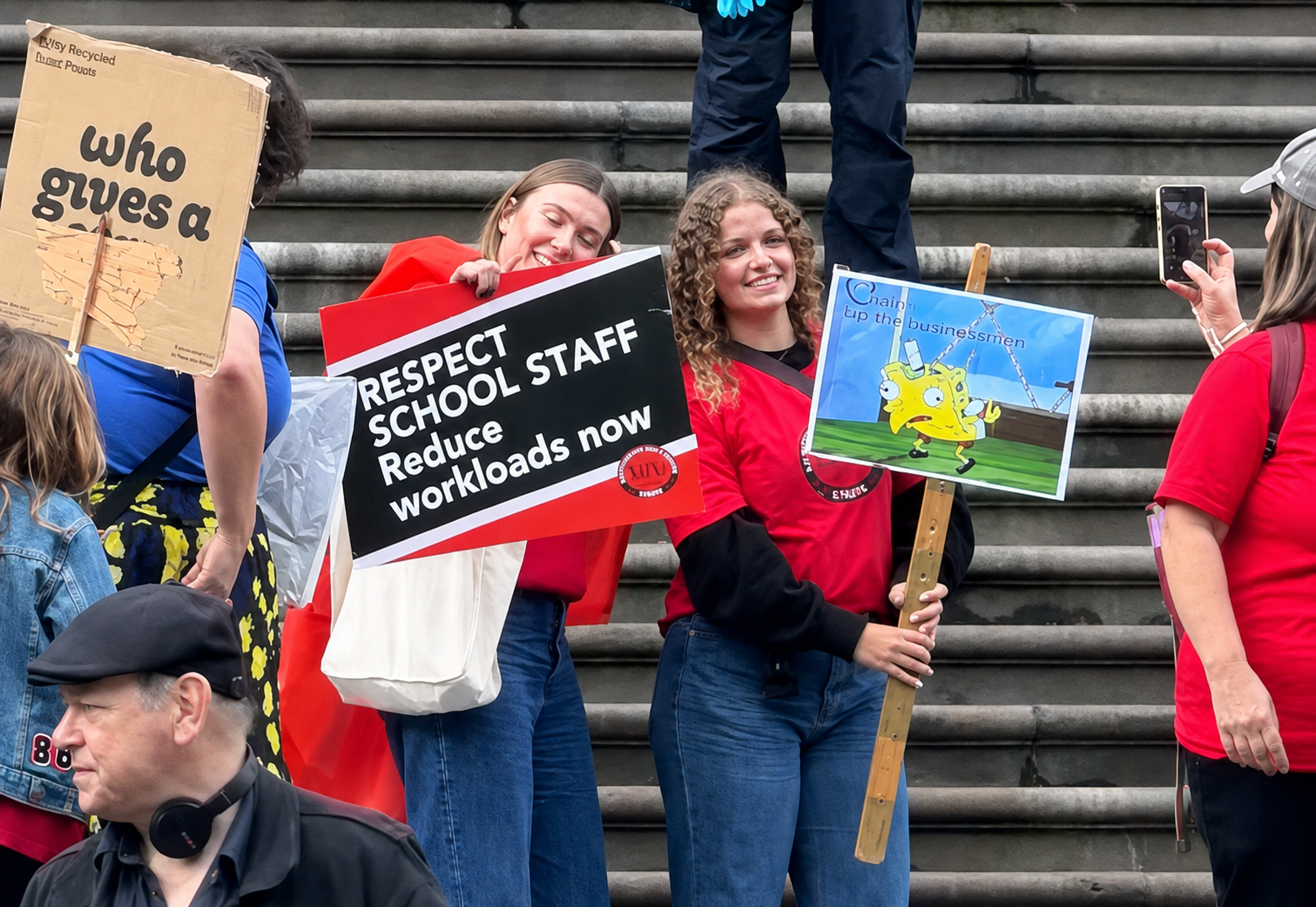
He joined tens of thousands of teachers who marched to the Victorian Parliament on 23 July, in their second statewide protest this year. Another strike is planned on 19 August if the state doesn’t improve its offer.
“I’ve only just entered the profession recently, but I can definitely tell you it’s not easy work,” says Cusack, 35, who moved into teaching as a career change.
With Victorian public school staff the lowest paid in the country, according to union analysis of state agreements, teachers say that the gap between what is being asked of them and what the state is prepared to pay them is substantial.
An entry-level teacher in Victoria will earn $79,589 in 2026, compared to $90,177 for the same role in New South Wales. At the experienced end of the scale, the gap widens from $118,063 in Victoria to $129,536 across the border.
“The reality is that we’ve got more teachers leaving the profession than there are coming in,” Cusack says.
“If you don’t really incentivise people to want to be teachers, then that trend’s just going to continue.”

“I’ve only just entered the profession recently, but I can definitely tell you it’s not easy work”: Aidan Cusack, a teacher of just over a week, who marched to Parliament with thousands of teachers. Photo by Preeshita Shah.
“There are factors that are driving the teachers to leave the profession,” says Dr Merryn Dawborn-Gundlach. “And there are factors that are stopping people from joining the profession as well.”
Dawborn-Gundlach coordinates a course at the University of Melbourne for people changing careers into teaching. She also researches teacher shortage and retention in Australia.
A 2024 Monash University survey of 8,000 Victorian teachers, school leaders and education support staff found only 31 per cent intend to stay in the profession beyond 10 years.
“More than 50 per cent of teachers leave within the first five years. That’s high,” Dawborn-Gundlach says.
“And I think the reason for that is, one, that they didn’t really understand just what the job entailed.”
Full-time classroom teachers work a median 50 hours a week during term, 12 hours more than they are contracted for, according to the most recent national teacher workforce data.
A UNSW study of nearly 5,000 Australian teachers found 90 per cent reported moderate to extremely severe stress, and 68.8 per cent described their workload as largely or completely unmanageable.
“Everyone thinks they’re an expert on teaching because they’ve been to school,” Dawborn-Gundlach says. “What they see, someone in the classroom, is the tip of the iceberg.”
Funding, right down to basic supply, is among the challenges teachers wrestle with on a daily basis.
Every student at Southern Autistic School has an autism diagnosis. The school receives $100 per student a year, $25 a term, to cover stationery, laminating patches and materials for cooking and science classes, according to Luisa Thiedeman, an education support worker at the school.
“There are six students in a classroom mostly. It does not go far,” she says.
The school runs student support group meetings in place of parent-teacher nights, bringing together speech and occupational therapists, mental health workers, teachers and school leadership. Thiedeman has sat in one that involved 12 specialists for a single student.
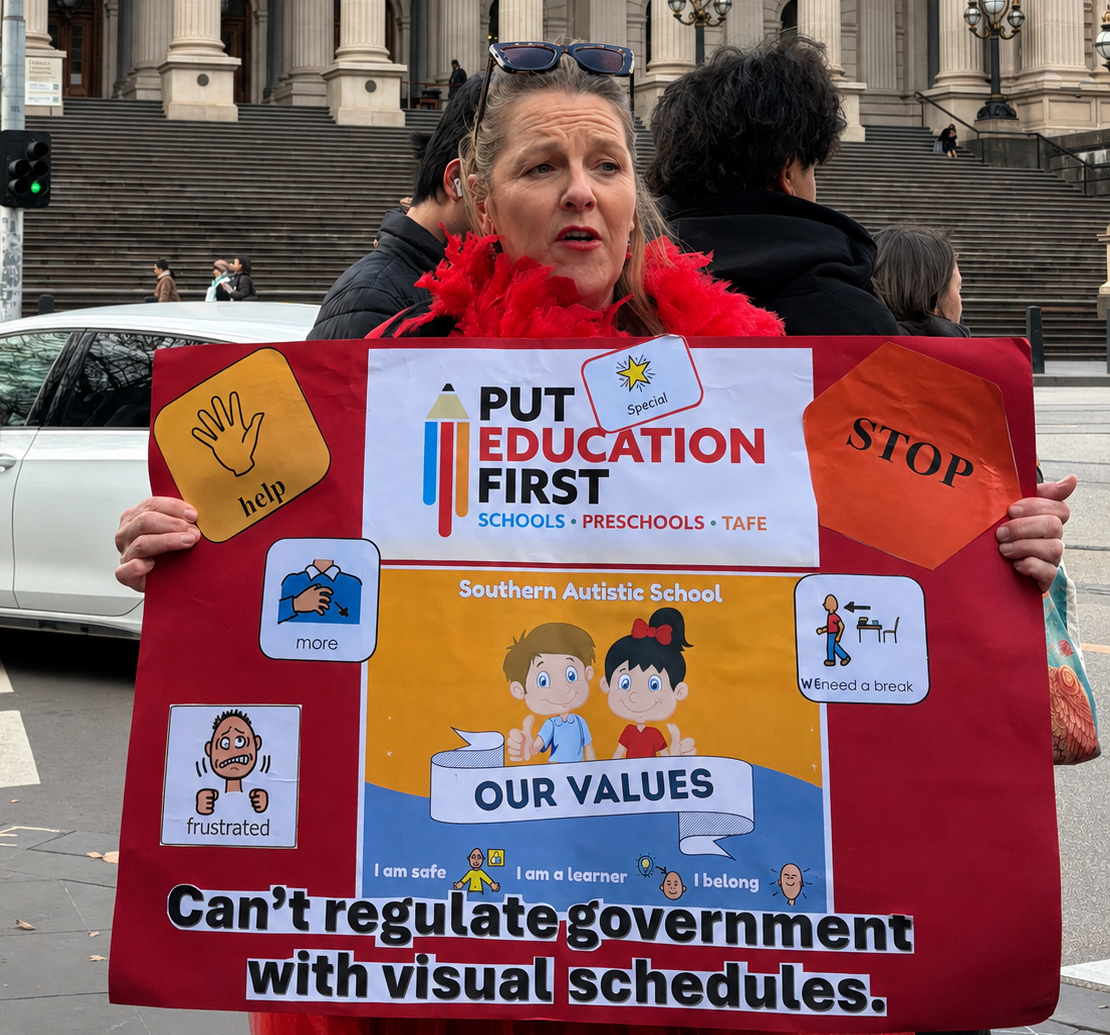
Luisa Thiedeman, an education support worker from Southern Autistic School, marches with a sign detailing her school’s support values. With only $25 per term for supplies across six students, educators like her say the funding crisis makes the job impossible without personal sacrifice. Photo by Preeshita Shah.
“We are unrecognised, underfunded and underpaid,” she says. “And we just want that acknowledged and resourced.”
Education support staff at schools like hers earn around $62,000 a year, according to Luisa. Marching meant forfeiting a day’s pay, which for a single parent raising two boys on one income is not a small decision.
“None of us want to leave,” Thiedeman says. “But I guarantee you, without a pay rise, some of us will have to.”
When asked last week about the claims of early career teachers, then Minister for Education – now Premier Ben Caroll – did not answer the specific questions. In a statement, his office said “the current offer would make Victorian teachers and education support staff the best paid in the country together with the best conditions”.
But the proposed offer was rejected by union members for the second time this year, again going against the recommendation of the union leadership
“This was a close vote and my door is always open to continue working with the AEU leadership to resolve this matter,” Carroll said.
Cusack is on part-time hours, and says even that is a lot to take on. His advice to anyone finishing a teaching degree now is to think hard before accepting a full-time load.
“It might be good to get some money out of uni, but that intense workload can burn you out,” he says.
“It might even turn you off the profession if it doesn’t improve.”