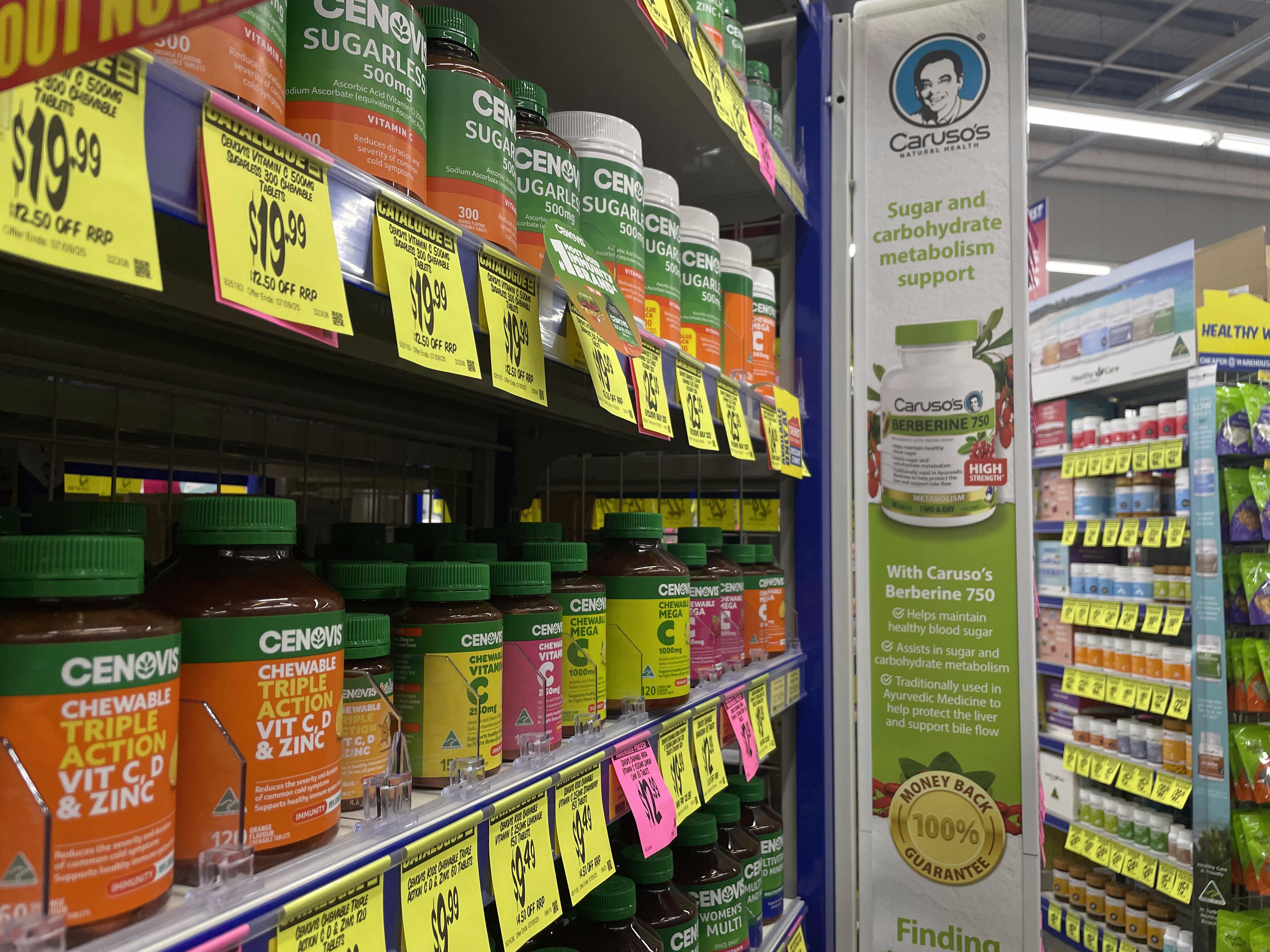
Desperation and hope, as well as customers, fill the vitamins aisles of pharmacies.
The shelves are packed with choices, with The Citizen counting 28 variations of vitamin C alone at one Melbourne suburban Chemist Warehouse store. In the pharmacy chain’s most recent online catalogue, 10 of the 40 pages spruik vitamins and supplements.
If you’re a believer in the powers of ubiquitous C to cure coughs, colds, even flu, surely the more the better? Why settle for 250mg, or 500mg, when you catch sight of Ultiboost High Strength Vitamin C 1000mg? Sold!

Swisse’s Ultiboost Vitamin C, which the brand’s website chatbot says is one of its two most popular Vitamin C products. Photo: Siena Kinkela.
The vitamin C market is a mainstay of the highly lucrative supplements market – a staple in household medicine cabinets and, according to the Sydney Morning Herald, a firm favourite in a complementary medicines market worth $6.3 billion last year. Some 45 per cent of that, valued at $2.84 billion, is attributed to vitamin and dietary supplement sales.
It’s a lucrative market built more on perception than science, and in the case of vitamin C, on capitalising on a regulatory system where products assessed as low risk don’t have to demonstrate efficacy. The expert view is that high-dose oral vitamin C products won’t likely harm us, but neither is there evidence they will help us. Producers aren’t allowed to promise health benefits, but that’s the message many consumers are finding in hyped-up, high-dose marketing.
An analysis of vitamin C products advertised by Chemist Warehouse online by The Citizen indicates that out of the 10 products in the catalogue’s cold, flu and immunity page with this word (mega) in the product’s title, eight were vitamin C supplements. Other ‘mega-phrasing’ used for Vitamin C products on this page includes: Ultiboost, High Strength, Ultra Potent, Mega C, Rapid-C, Extra C, Ultra C, and One-A-Day.
Medical experts have been battling for years to put a pin in this market, which they see as misleading and exploitative. One of them is Professor Peter McCaffery, co-director of the Medical Sciences Institute at University of Aberdeen, who worries that many consumers are vulnerable to “bigger is better” advertising, saying, “you can fool people into doing this. But I use the word ‘fool’ as if the people who buy these things are unintelligent, but that’s not the case.”
“You have very intelligent people making decisions based on how the human brain works,” he said.
Consumers are flushing money down the drain, he explains. Vitamin C is water-soluble, which means that excess consumed is excreted in our urine, says McCaffery. By contrast, excess lipid-soluble vitamins like A, K, E and D are stored in fats, and can be harmful if taken in excess.
While vitamin C “can be removed so easily from the body”, McCaffery says, that doesn’t mean that overuse is without harm in terms of exploitation and health literacy. He’s been arguing against the perceived “health miracle” of so-called high-strength supplements for over a decade.
The good news is that vitamin C’s low-risk properties mean it is considered unlikely to do you any physical damage unless you go way overboard. Experts warn of a list of uncomfortable symptoms if you take more than 2000mg, which is twice what’s known as the Upper Limit (UL).
Australia’s peak medical agency, the National Health and Medical Research Council (NHMRC), prescribes just 45mg of vitamin C as the recommended daily intake (RDI) for adults. This amount is enough to treat deficiencies and prevent scurvy, the “only well-established evidence for its use” according to the Therapeutic Goods Administration (TGA). In a statement to The Citizen, the NHMRC says “although some studies suggest potential benefits from intakes higher than those required to prevent scurvy, the evidence is conflicting.”
The latest ABS Health Survey for Nutrient Intakes says almost all Australians meet their nutritional needs for vitamin C in their daily food consumption, with only eight per cent of people over two years of age as having “inadequate” intake.
In its most recent report on Nutrient Reference Values, the NHMRC describes vitamin C as saturable and dose-dependent. It cites a 1979 study that found “absorption fell to 50% or less with doses above 1000mg, or 1g/day”. As the president of the Australian Medical Association once observed in an ABC Four Corners interview, “what a lot of Australian families have is very expensive urine”.
Vitamin C supplements, like all medicines in Australia, are regulated by the TGA. Non-prescription medicines are categorised according to their risk, with the lowest, an AUST L label, meaning no pre-market evaluation is required.
Instead, there’s only what the ABC investigation described nearly 10 years ago as a “trust-based system” – and which remains unchanged – where the evidence about whether a product does what it says is kept by the manufacturer. Vitamin C products almost exclusively fall into this category, so the dosage isn’t regulated and transparency isn’t required.
In terms of marketing, requirements around the advertising of therapeutic goods is enforced primarily by the TGA in its Advertising Code (2023). Section 8 states: “advertisements must be accurate, balanced, not be misleading and only contain substantiated claims”. Additionally, an example of breach of code used in Section 8, focused on safe and proper use, includes representing a product as “miraculous” or “infallible”.

Most Vitamin C products on pharmacy shelves are listed medicines, which don’t need to prove they work before they’re sold. Image: Shutterstock
Vitamin C was the first artificially produced vitamin in history, available for consumer purchase since the 1930s. Its medical benefits were recorded as early as the 1750s, with recommendations that “all sailors be issued with a daily ration of lemon juice” to curb rising scurvy diagnoses during long sea voyages.
It has been used therapeutically since then for a range of reasons, from immunity to aided iron absorption to antioxidant boosting, all of these being enlisted for sales and profit in the contemporary pharmaceutical market. Leading Australian manufacturer Blackmores sells a 500mg and 1000mg dose of vitamin C, for $15.50 and $48.99 respectively (for 120 and 150 tablets). Both doses are well over the recommended daily intake.
Two-time Nobel Prize winning biochemist Linus Pauling is cited by Roger Shahani, the head of complementary medicines contract manufacturer Australian Nutraceuticals, and many others as the expert who popularised megadose vitamin C in the 1970s, claiming that he dosed himself with ten grams a day as his self-proclaimed ‘cure all’ for everything from the common cold to cancer.
“That old adage has persisted … like ‘oh, what’s the harm, right? I’ll just pop an extra vitamin C and I’ll be fine’,” says Dr Katie Suleta, research director for graduate medical education at HCA Healthcare in the United States.
Her work includes tackling misinformation around supplement marketing worldwide, including marketing myths around supplements she identifies in a Conversation article from 2024.
One of these is “the belief that more of a good thing is always better”, and she uses vitamin C as her example. Interviewed by The Citizen, she explains “vitamin C does thread that needle very nicely in ways that other supplements just don’t, because other supplements haven’t quite broken through the way that Vitamin C has. Because it was one of the first vitamins that we knew about, and it is important”.
Shahani says that the “bigger is better” rhetoric is “a bit of a fad, and it’s not just in vitamin C it’s across the board”. He mentions the rise in doses for probiotics as well, an area in which his father, Dr Khem Shahani, was a research pioneer.
“There’s a lot of studies that show that these ingredients are good for you, but there’s not a lot … that show necessarily that more is better,” he says.
In a statement to The Citizen, the NHMRC says for vitamin C products with concentrations higher than the recommended daily intake “most studies lack the dose-response data necessary to determine average requirements”. In other words, there isn’t enough research comparing doses to show that taking more does more.
While the discussion around megadoses of vitamin C is rarely about potential harms, this is not to minimise the profound damage that can occur from mis-use and mis-dosing of some complementary medicines. Recent reports of vitamin B6, melatonin and vitamin A poisonings all included links to misleading health information, or poor health literacy leading to poor use of these medicines.
Dr Suleta wants to see more regulation to tackle marketing misinformation, saying “the onus being on the consumer is just really, really unfair, and it expects a whole lot from people that I think most people don’t have time for”.
Manufacturers of all supplement brands mentioned by name were contacted by The Citizen and invited to respond to our enquiry about the products and their claims and marketing. No responses were obtained.