
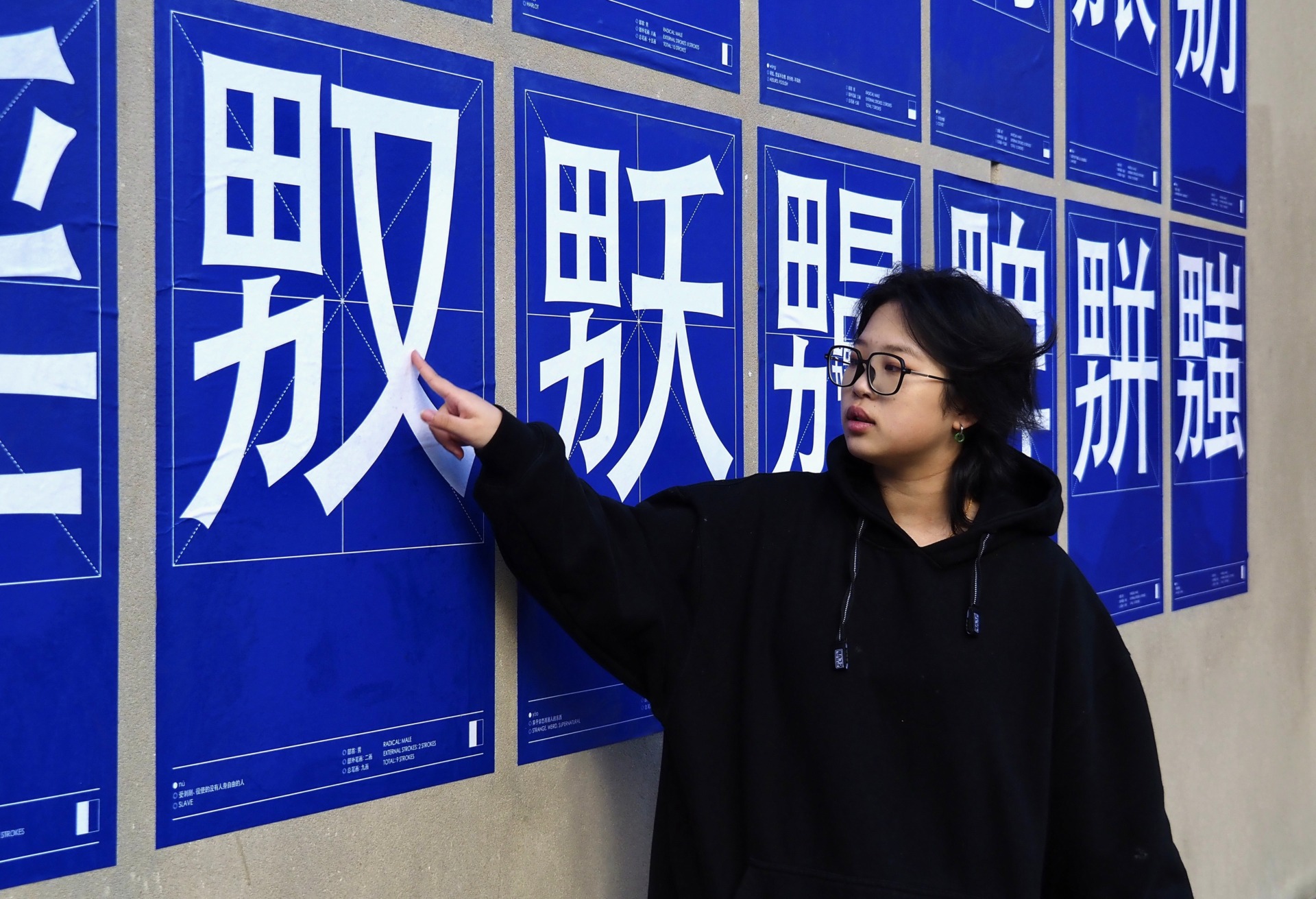
On a concrete wall in Southbank, 22 posters of Chinese characters catch the attention of passersby.
They stop to look, talk with their companions, and some even ask others to take photos of them in front of the posters.
The design work, A Man in Her Place, was created by University of Melbourne student Yongyi Zhu.
In written Chinese, “女” can function as an independent character meaning “woman” or “female” and can also be a radical—a special component linked to meaning—in other characters. A number of characters with negative connotations contain the “女” radical, such as “奸” (treacherous) and “婪” (greedy).
Some negative words and phrases are also composed of such characters, including “嫖娼” (go whoring) and “嫉妒” (jealousy).
The term for male—“男”—is a compound character made up of “田” (field) and “力” (strength), that is not used in the same way.
A Man in Her Place challenges the gender bias within Chinese characters by swapping out the “女” (female) radical in some characters for “男” (male). For example, it replaces “女” in “奸” (treacherous) with “男”, to make it closer to “男干 ”.
“Those negative characters with ‘女’ radical are increasingly catching my eye,” Zhu said.
“I started to wonder whether there was a problem with the characters themselves.”
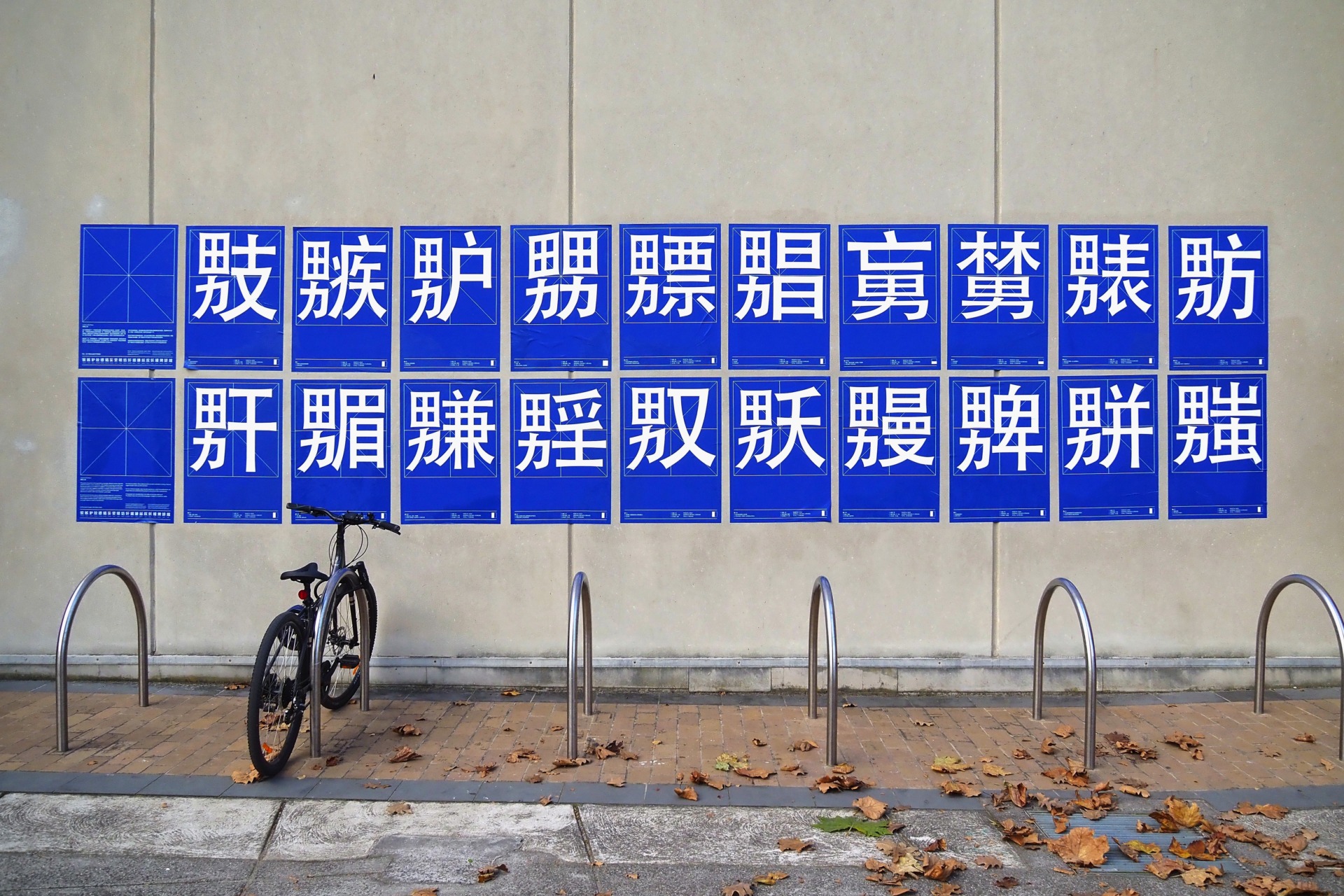
A Man in Her Place on display at Southbank, Melbourne. Image: Miao Chen.
Zhu said Chinese characters had pictographic and structural features that always hid deeper meanings.
In Shuowen Jiezi, the first Chinese dictionary compiled in 100 CE during the Eastern Han Dynasty, the pictographic features of Chinese characters were explained through the “Six Principles of Chinese Character Formation”.
The character “女” in Great Seal Script, an early form of Chinese characters in a patriarchal society, looks like a kneeling woman, visually reflecting the status of women at that time.
After its debut, A Man in Her Place has received support from the University of Melbourne, the Victorian College of the Arts, Melbourne Design Week and multiple exhibitions in Australia, attracting many visitors.
Jianan Tang travelled to Melbourne from Brisbane to see the project in person.
Tang said it showed how language was a powerful force and language habits could subconsciously influence perceptions.
“This influence can be reflected in daily life,” Tang said.
“When my dad is driving and sees someone driving badly, he will subconsciously say ‘female driver’. I immediately correct him every time.”
However, not all feedback on the project has been positive.
The day after A Man in Her Place was posted on Rednote, photos of the work and screenshots of some visitors’ posts were shared on X, attracting misogynistic backlash.
Zhu has been forced to shut down her social media, including Rednote and Instagram, to deal with the ongoing harassment.
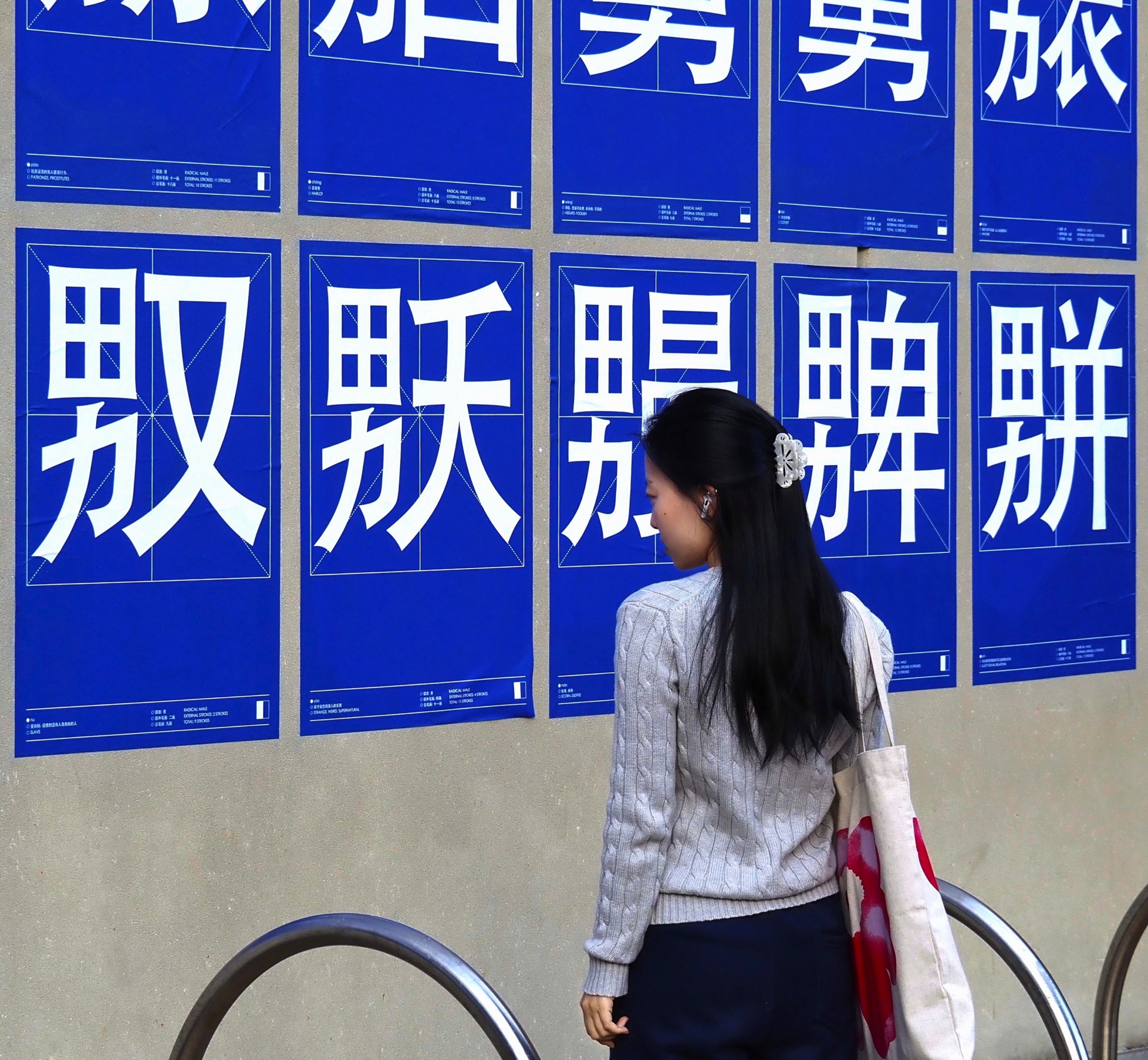
An interested passerby checking out Zhu’s artwork. Image: Miao Chen.
As a Chinese man living in Xining, Qinghai Province, Richer Zhang had a different reaction when the design popped up on his social media feed.
When he saw the work for the first time, its strong visual impact stood out.
Zhang said he had merely focused on learning the structure and meanings of Chinese characters at school, and never noticed combinations like these before.
“These negative characters and swear words associated with women feel like a direct attack on women’s dignity,” he said.
University of Melbourne sociolinguist Ikuko Nakane said due to patriarchal structures, religious and cultural beliefs, women had been linked with negative words for centuries around the world.
Chinese characters were not an exception, Nakane said. Swear words in most languages worldwide were often related to women or women’s bodies.
The word “hysteria” in English derives from the word “hystera” in Greek, meaning uterus. In French, the masculine noun “entraîneur” for men means coach, while the feminine form “entraîneuse” can refer to a hostess.
Nakane said Zhu’s work made people consider the role of language and cultural assumptions about gender.
“Words don’t just have ‘dictionary’ meanings, they also carry interpersonal and social meanings,” Nakane said. “Changing our linguistic behaviour can impact the way we perceive and treat each other.”
Meicen Zhou, who studied Chinese calligraphy and now works in calligraphy education in Australia, said the work enabled her to step outside the traditional calligraphy aesthetic for the first time.
Zhou said many Chinese characters with the “女” radical were the result of the long-term evolution of historical and social structures, and cultural concepts.
She said, as a bold attempt, A Man in Her Place needed to be understood from multiple perspectives rather than just at the gender level.
“Characters are also a form of cultural expression,” Zhou said.
“There is no need to overturn tradition, but to rethink it while inheriting it.”
Creator Zhu said she was not trying to solve such problems through her work, but to at least encourage a conversation.
“It is still an artwork first,” she said. “I just want people to think about it.”


