As student protests against the war in Gaza have spotlighted ties between Australian universities and international weapons manufacturers, some universities have downplayed the relationships. But documents reveal several are deploying a very different message in their dealings with government and industry.
In promotional materials and capability statements shared with potential partners, Group of Eight universities and other institutions spruik their expertise and capacity to contribute to AUKUS Pillar two – the second part of the unofficial military alliance forged to enable technology transfer between the UK, the US and Australia.
At a June 2024 event at the Australian High Commission in London, hosted by the Group of Eight peak body representing some of Australia’s top universities, chief executive Vicki Thomson told the gathering that the universities were “at the forefront of Australia’s defence and security research effort and are integral to bringing AUKUS to successful delivery”.
In a paper prepared for the AUKUS Pillar II and research engagement roundtable, Thomson stated that: “Go8 universities undertake 70 per cent of all university based research and receive more than half of the total university sector’s defence [research and development] investment”.
Meanwhile the top-ranked University of Melbourne strongly advocates its capabilities in areas ranging from electronic warfare surveillance to submarine systems through its lobby organisation, the Defence Science Institute – a joint venture between the Victorian government, the Defence Science and Technology Group and the university – and other promotional material.
The university has a lot at stake, having invested at least $2 billion to build a new campus at Melbourne’s development project, Fishermans Bend, where it will relocate its engineering school and conduct much of its defence research, alongside government and industry partners.
The Fishermans Bend development in South Melbourne, touted as Australia’s biggest urban renewal project and incorporating residential, industrial, manufacturing and community hubs, has been beset by a series of delays, including a failed tramline and a secret deal between the university and Melbourne council, inspiring a 2024 art installation titled ‘What Killed Fishermans Bend?’.
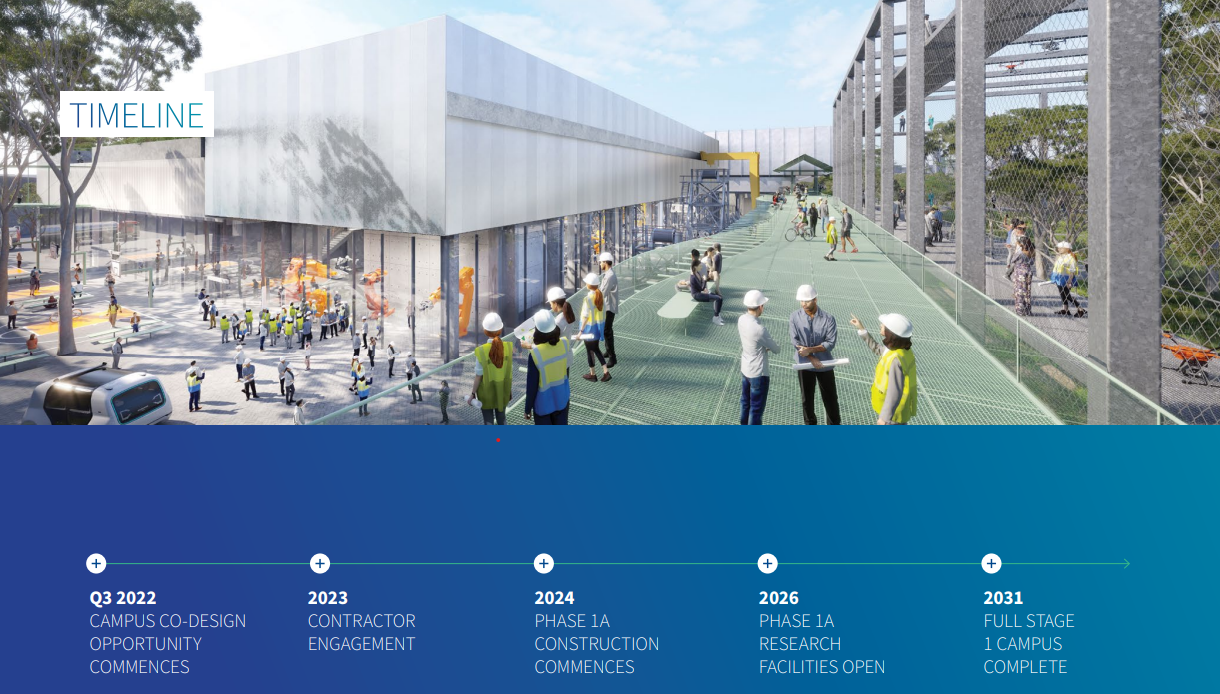
The new precinct, now due to be completed by 2026, is set to house the university’s “state of the art facilities” which will focus on “advanced manufacturing, defence technologies, materials and energy,” and offer “an unprecedented collection of research and testing facilities to enable interdisciplinary collaboration and partnerships with the Defence sector and support the advancement of defence-related manufacturing capability in Australia”.
In a document advertising its new campus to potential industry partners, the university also boasts that the precinct has been designed to “encourage interaction between the university and industry, with shared zones located adjacent to the central cores creating ‘bump-spaces’ where different occupants will regularly cross paths as much as possible”.
In an August 2023 public hearing, the university petitioned the Department of Defence to “consider greater connectivity” between its new Fishermans Bend facilities and the Defence Department’s specialist Defence Science and Technology Group through a pedestrian access gate at the DSTG site that the university hoped would “enable DSTG staff easier access to the University of Melbourne’s campus”.
In June 2023, then Victorian Minister for Industry and Innovation Ben Carroll said at a public accounts and estimates hearing that the state government was contributing to the growth of the defence industry through its investment in the Defence Science Institute.
Carroll said that Fishermans Bend would get “big major companies like Boeing and BAE [Systems] combined with the university engineering school”.
“Add to that the Commonwealth government’s Defence Science and Technology Group located down there and you basically get the ecosystem growing,” he said.
The university’s publicly recognised ties with Boeing and BAE Systems have been specifically targeted by anti-war student activists, including by disrupting a 2024 Boeing session on empowering women in STEM hosted by the university.
Protesters also highlighted a so-called “industrial project” with BAE Systems, accusing the university of attempting to “jargon-ise and use euphemisms” to obfuscate its work on weapons systems.
In March 2024, protesters said that by contributing to research used by weapons companies, the university was complicit “in the genocide that’s taking place in Gaza right now”. At that time, a spokesperson for the university said it “strongly rejects the protesters’ claim”.
Previously BAE Systems has said it planned to build a manufacturing centre in the Fisherman’s Bend precinct, though recent documents do not reference the centre. BAE Systems do not respond to questions from The Citizen. A proposed map from the Victorian government shows defence-related companies Boeing and Siemens, as well as the DSTG, closely located to the university’s new facilities.
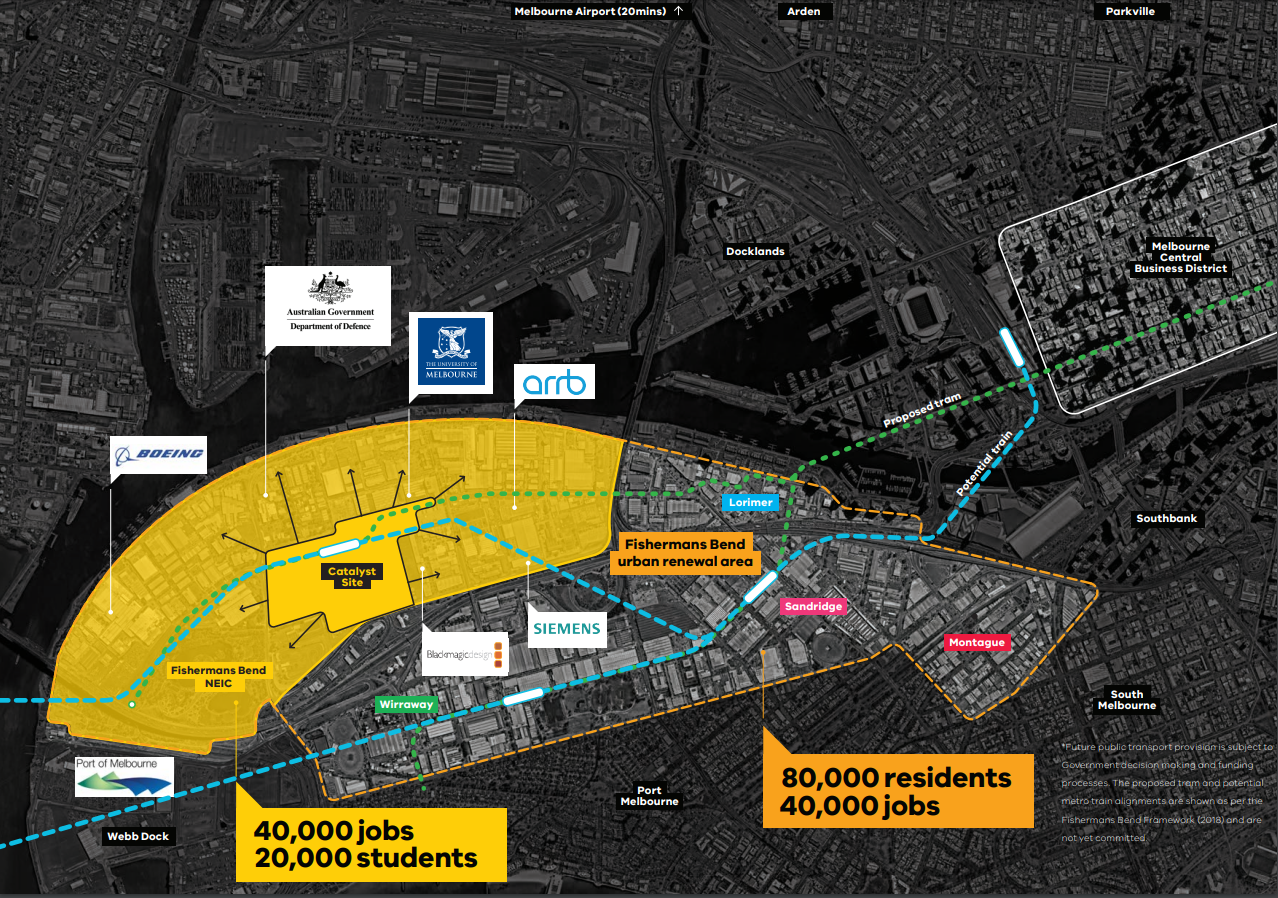
Map of proposed organisations located at Fishermans Bend precinct, including Siemens, Boeing, the Defence Science and Technology Group, and the University of Melbourne. Photo: Victorian Government
A university document outlining the Fishermans Bend development says the campus will be “advantageously located within the cluster of defence industry and research entities”.
“It offers a site for multinationals and [small and medium enterprises] to engage in the defence ecosystem, alongside large government and industry players, supported by our state-of-the-art materials fabrication laboratory, ocean simulation facilities and autonomous robotics testing sites,” the university says.
In the Group of Eight document, the University of Melbourne said its research has led to “new capabilities and technologies including autonomous systems, improved electronic warfare surveillance and detection, advanced sensing including phased array radar and sonar and quantum technologies, cybersecurity and AI applications”.
The university says it has contributed research towards “submarine propulsion system optimisation, advanced functional materials, submarine atmosphere control, drag reduction of ships and submarines, multifunction radar, radar tracking and sonar systems” as well as efforts to “understand wakes of underwater vehicles in order to design new tactics to reduce detection”.
It also says its “expertise” holds “direct relevance to AUKUS Pillar II” and that a “suite of undergraduate, postgraduate and specialist degrees offered at the University can be tailored to meet the specific AUKUS needs in core and specialist areas relevant to Pillar II capabilities”.
Underscoring its commitment to the project, the university was reported to have spent about $2.8 million to fund a public artwork in a secret deal with the City of Melbourne, in exchange for its support for the university’s campus.
There are close ties between university administration and the City of Melbourne, both through official partnerships, such as its “Sustainable Development Goals” collaboration, and through relationships with councillors.
Previous Lord Mayor Sally Capp was appointed by the university as a Vice Chancellor’s fellow after she retired from the mayoral office in June 2024. Current Lord Mayor Nick Reece has been employed at the university since 2013, and is presently serving as a director of enterprise strategy.
A spokeswoman for Reece told The Age last year that he had “recused himself from any discussions between the university and the City of Melbourne since his election in 2016”.
University of Melbourne Vice Chancellor’s Fellow Jon Faine AM, speaking at a public university forum in August last year, said that the university’s position was that it did not do “any specific weapons work”, but that it does conduct “dual purpose research”.
The World Health Organisation defines dual-purpose research as “research that is intended to provide a clear benefit, but which could easily be applied to do harm”.
A 2017 “capability portfolio” released by the Department of Defence’s Science and Technology Group lists the University of Melbourne, alongside other Australian universities and weapons manufacturers, as contributing to the development of “undersea combat systems” and “undersea weapon systems”.
A BAE Systems document from February 2024 states that researchers from the University of Melbourne were part of a team that produced a system, called “Trusted Autonomous Ground Vehicle injected in an Electronic Warfare (Tagview) application” was implemented onto its ‘M113 Optionally Crewed Combat Vehicles‘.
“We are starting to understand how we can actually utilise these vehicles as combat vehicles,” Australian Army Captain Balazs Bauer says in the video.
In a BAE Systems press release, University of Melbourne head of the department of electrical and electronic engineering, Professor Chris Manzie, said that the project was “a great demonstration of how academia and industry can work together to develop capability and highlights the important role research can play in supporting national interests.”
The university did not respond to detailed questions from The Citizen about the Fishermans Bend precinct or the weapons projects. Manzie did not reply to requests to be interviewed.