
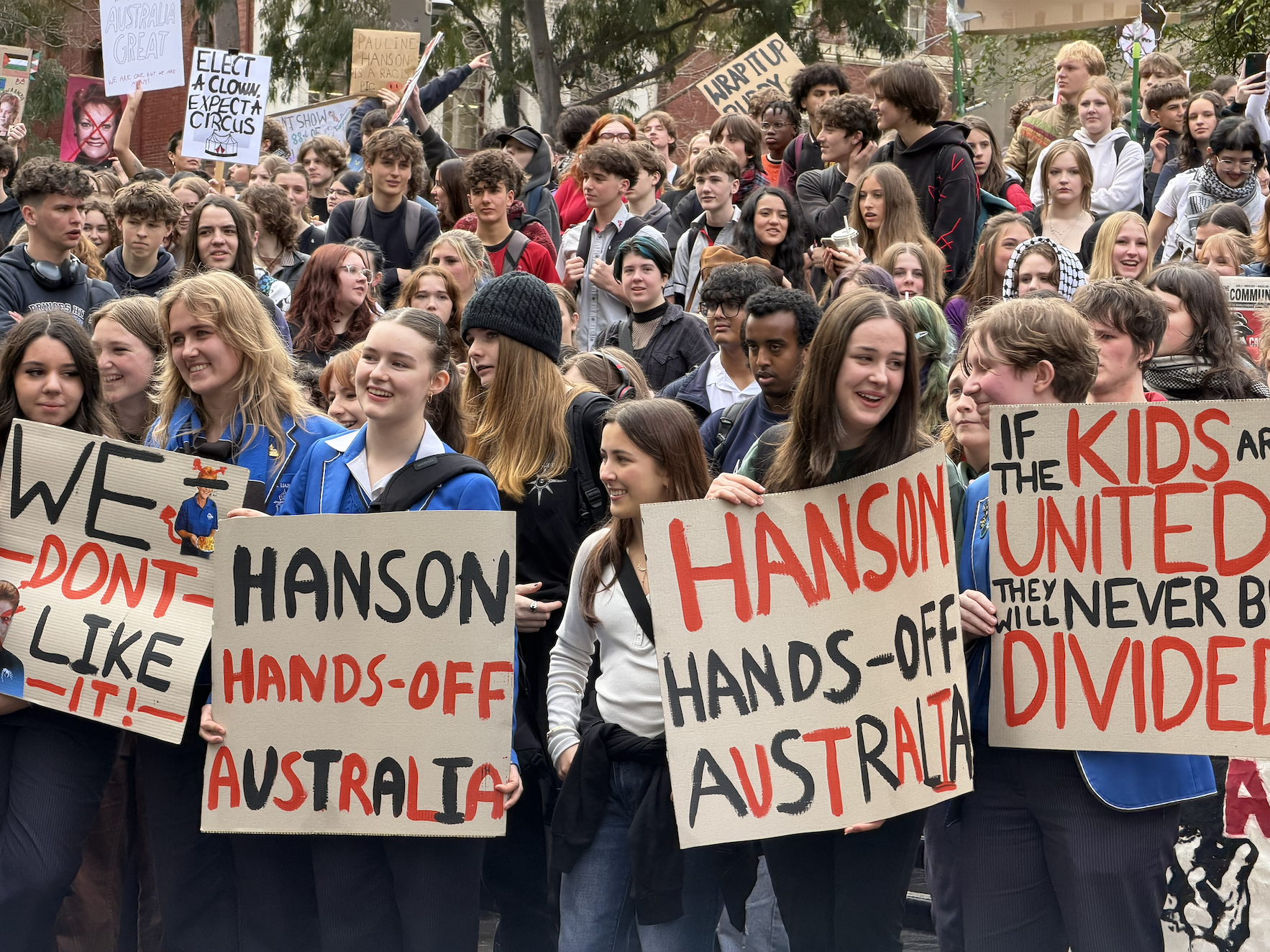
Wearing her school uniform, undeterred by warnings from her school that she may face reprimands, 16-year-old Anna recently caught the tram from her Melbourne high school into the city to protest a party she is too young to vote against.
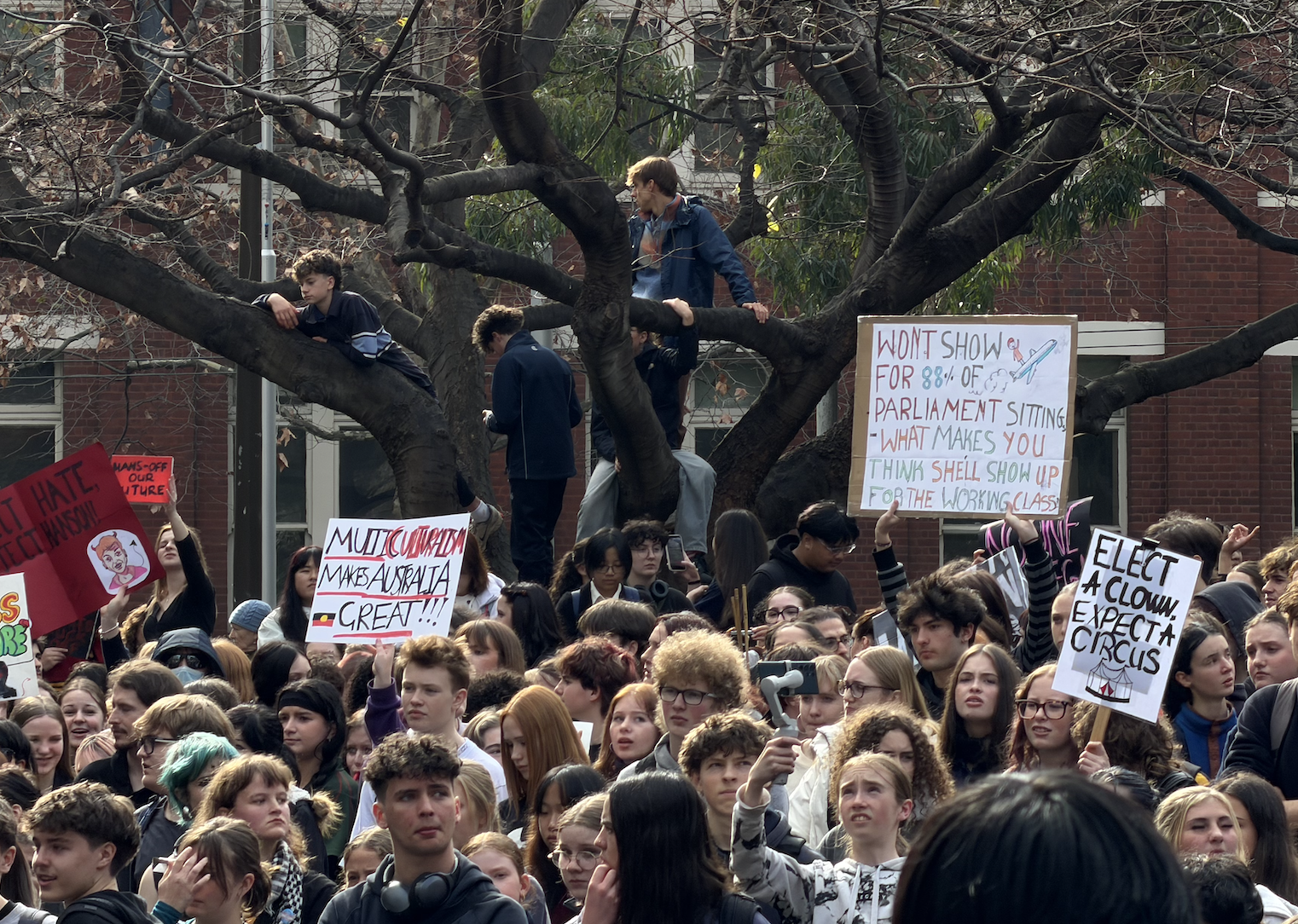
Students watch the speakers from the trees outside the State Library during the nationwide school walkout. Photo by Preeshita Shah
It was the first time she had ever attended such an event, Anna said. “I’ve always been a good girl.” She’d made a considered decision to attend the protest out of conviction, travelling in on her own.
Anna joined a crowd of around 1300 people, according to Victoria Police estimates, who marched through Melbourne on 13 August, part of a nationwide student walkout against Pauline Hanson and One Nation. The event was described by the organiser, the National Union of Students, as a protest against racism. A second walkout is planned for 17 September, 10 weeks before the Victorian election.
“I’m here today because I need to enact more on my beliefs, instead of just sitting at home and reiterating information I find online,” said Anna, who was alerted to the protest by Instagram, before word spread through her year level’s group chat.
There were many school uniforms in the crowd outside the State Library, students climbing up the Redmond Barry statue and sitting in the trees during the rally.
One Nation’s primary vote in Victoria has climbed to 22 per cent, according to an August survey by RedBridge Group and Accent Research for the Australian Financial Review. The party, which has never won a seat in Victoria’s lower house, polls 17 per cent among Gen Z voters, adults aged 18 to 29.
“Gen Z are just different,” says Simon Welsh, director of research and reputation at RedBridge Group.
“If you look at not just the One Nation vote on Gen Z, but also the Greens vote on Gen Z, that’s 32 per cent. So that tells you about the overall progressive skew of those young voters coming through.”
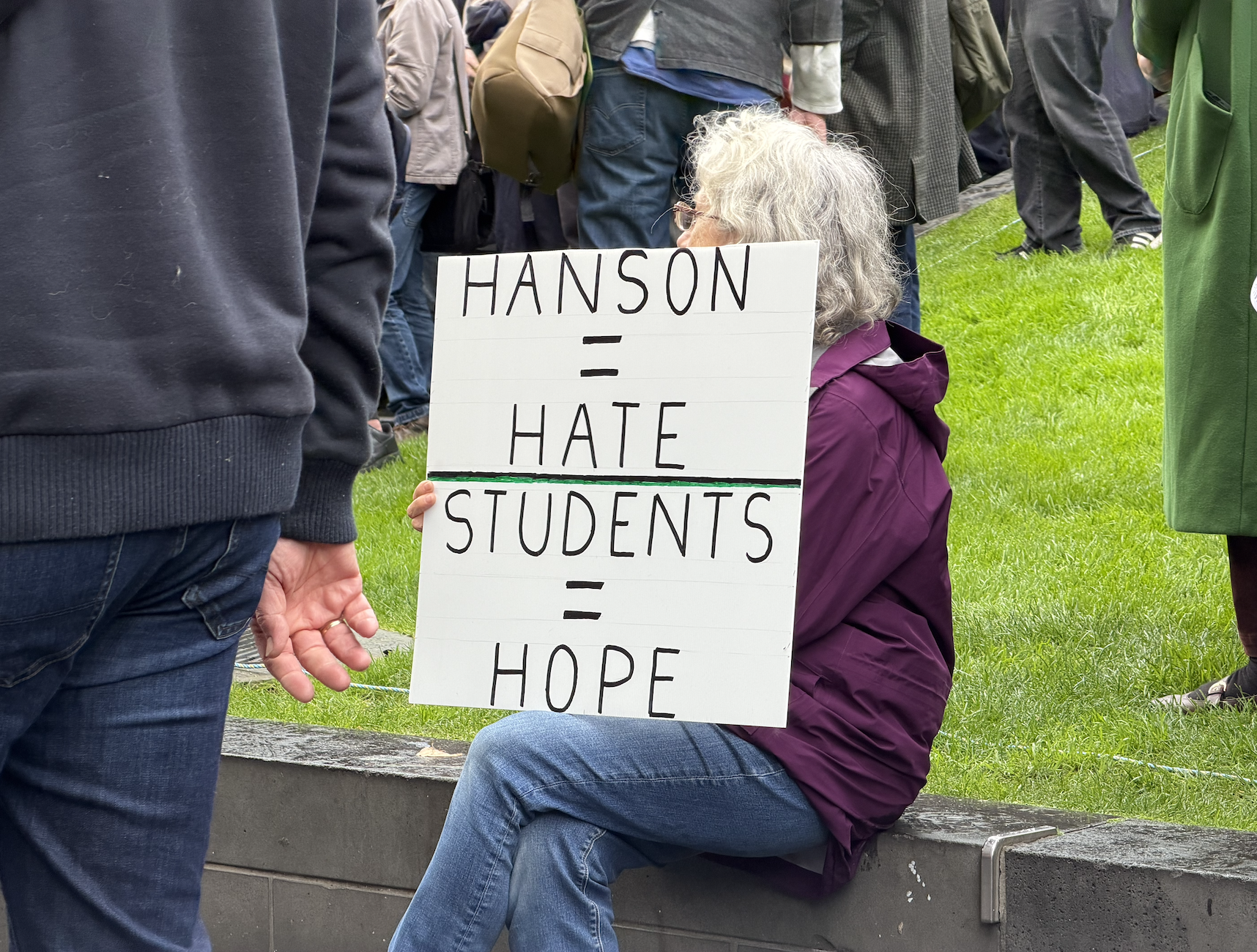
A woman watches the student rally with a sign reading “Hanson = hate, students = hope”. Pauline Hanson’s net favourability is minus 17 among Victorian voters overall, and minus 45 among Gen Z. Photo by Preeshita Shah.
Hanson herself is deeply unpopular with Gen Z voters. Her net favourability in the cohort is minus 45, the RedBridge survey found.
By comparison, new Premier Ben Carroll sits at plus two with the same voters, and Opposition Leader Jess Wilson at plus three, though a quarter of Gen Z respondents had not heard of Carroll and a third had not heard of Wilson. None said they had not heard of Hanson, according to the survey.
Australian voters have historically started their political life leaning to the left and moved to the centre as they aged, Welsh says. That pattern is breaking.
“The issue is that a lot of those life markers which draw people to the centre are not happening at all,” says Welsh. “People can’t afford housing, they’re not having kids. So those sorts of age things are getting pushed out.”
Welsh says the young votes One Nation is winning are not votes for its immigration politics.
“It’s not that they’ve shifted to the right or suddenly become obsessed with right-wing immigration rhetoric. Often it’s in spite of that,” he says.
“They are just there because they are so fed up with the major parties. They’ve just become so disenchanted that they’ve jumped off the progressive pile and they’re into the anti-establishment pile.”
The students at the walkout share that frustration with the major parties.
Students from 115 high schools had reported walking out, says Aidan Wujanto-Hawe, a third-year University of Melbourne student who helped organise the protest with the Socialist Alternative group on campus.
“I think it shows that the major parties are outmoded and young people need new political vehicles,” he said.
“Students like myself don’t have any sort of avenue or organisation that represents us. We need to start building different political alternatives.”
Most of One Nation’s Victorian support, across all ages, is new. Of Victorians intending to vote One Nation at the Victorian election in November, 70 per cent did not vote for the party in 2022, according to an Accent Research survey for a University of Melbourne election study.
The poll found more of Labor’s 2022 voters moving to One Nation, at 13.4 per cent, than to the Coalition, at 11 per cent.
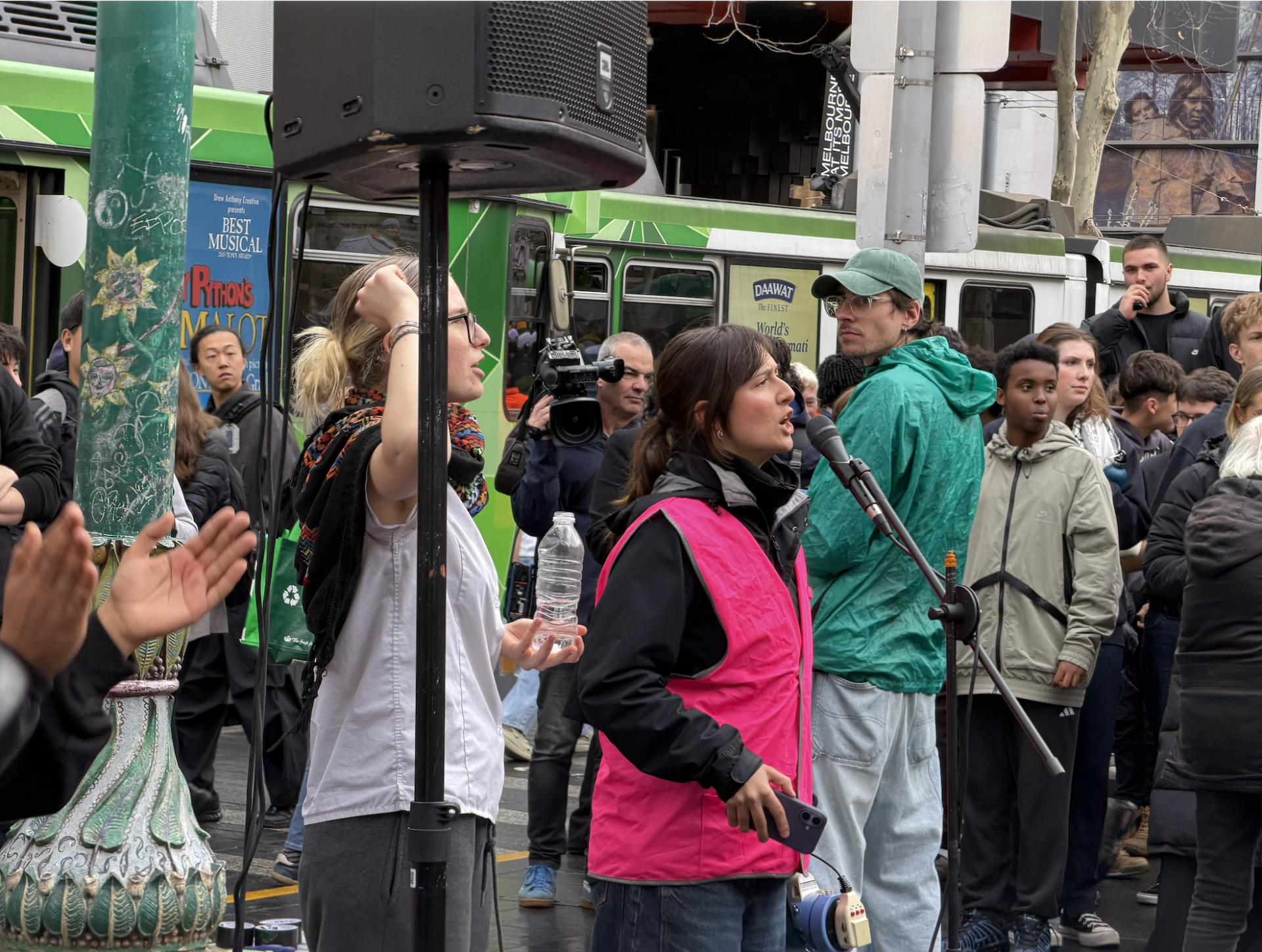
Jules Apula, left, an organiser of the High School Anti-Capitalists and of the nationwide walkout, at the Swanston Street rally. Photo by Preeshita Shah.
The high school students who marched will not appear in a poll until they turn 18.
“Students have always led the way, really, in radical social struggles,” says Jules Apula, an organiser of the High School Anti-Capitalists, pointing to student roles in global political movements.
“I think students are inclined to actually take a stand earlier at times. And it helps that the media attacks you so much, acts like you’re too stupid to form a political opinion, or too left-wing to actually be able to express it.”
But these actions have been dismissed by ministers as well.
“I want kids at school learning, and I think I’ve been pretty consistent in that, in whatever protests have happened over the years,” said federal Education Minister Jason Clare, when asked at a press conference whether students should be leaving school to protest.
“We’re a democracy, if people want to protest on the weekend, then fill your boots, but I want you at school when school is on, learning,” he said.
Professor Philippa Collin, who has surveyed and interviewed student protesters since 2022, is unconvinced by the argument put forth by some that students do not grasp what they are marching about.
“It’s the kind of criticism that gets levelled at students as a way of cutting them down, rather than having any basis in logic or reason,” says Collin, a political sociology specialist at Western Sydney University’s Institute for Culture and Society, who researches young people’s political participation.
“We just assume that adults are more knowledgeable by virtue of age, and that’s certainly not the case,” she says. “We don’t require anyone to do a test or prove any level of understanding about any issue, let alone the electoral system, before they vote.”
“Protest is a way for people to express their views, especially those people who don’t have access to some of those other formal mechanisms within democracy.”
Anna does not have that access yet, and marched for classmates with even less of it.
“As a white Australian, I feel like I need to be there for my other classmates who can’t go, for a plethora of reasons, one being racism is still too prevalent in this country,” she says.
Collin’s research, which tracked the school climate strikes from 2018 to 2024, has found student protests were increasingly tied to the elections around them.
“Young people taking part in these actions, as well as those who are organising them, are really aware of the intersecting issues, but also how they relate to the politics of the day,” she says.
“There’s an incredible ability to simplify. It’s not about dumbing down, it’s about cutting through.”
The elections ahead may keep the walkouts going, Collin says, with Victoria in November, New South Wales next year and the federal poll in 2027.
“I do think that young people are trying to influence those, and that’s an impetus to keep the strikes going,” she says. “Certainly in 2018 and then ’19, each protest became bigger than the last, and this kind of builds a sense of possibility and solidarity.”
With the current numbers, Welsh says, the Coalition is the only party that can reach majority government in November, with One Nation positioned to win 10 or 12 seats – “an extraordinary result for Victoria”.
The Citizen attempted to contact One Nation for comment, but the party did not respond. Victorian Minister for Education Gabrielle Williams also did not respond.
Apula says the students will be there at the next scheduled protest either way.
“We’re not going home. While you stick around, we’re going to keep coming back,” she says. “That’s why we’re coming back on September 17th.”
A 17-year-old student at the march says being too young to vote is beside the point.
“We are the voice of this generation, because we are the future generation,” she says. “We are going to be the next voters. We are going to be 18 this year. So why is it that big a deal that we can be political like she is?”
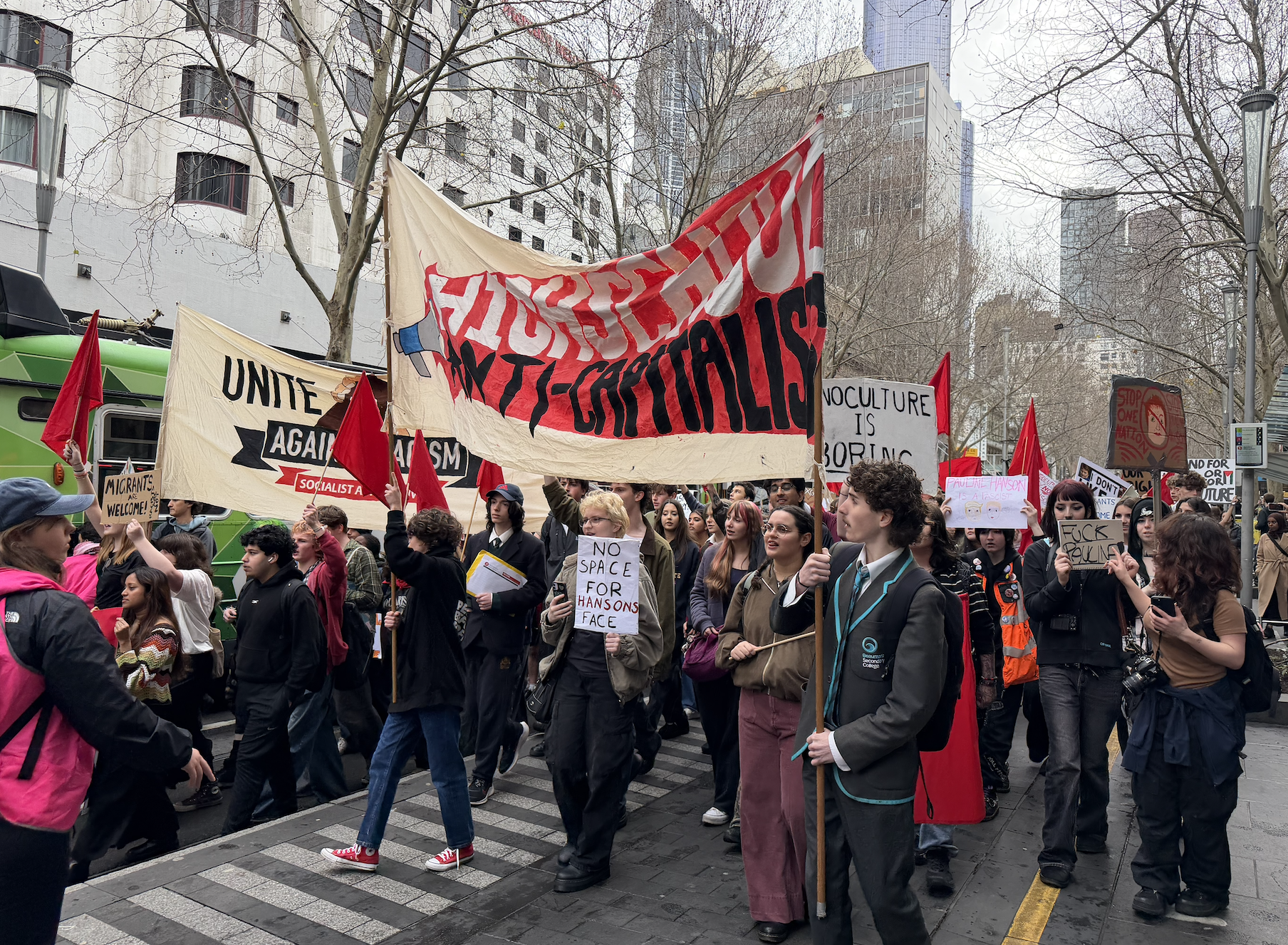
Students march down Swanston Street behind the High School Anti-Capitalists banner on August 13, 2026. Organisers have called a second walkout for September 17. Photo by Preeshita Shah.


