Chelsea’s boyfriend walked into their shared apartment three weeks ago and told her he needed a break.
“From what?” she asked.
“Life,” he said.
He left her with the dog and checked in once a week now, to see how she was going with it all. Apparently, he had moved closer to a dead-end job that he hated.
“As far as I’m concerned,” she said, “we’re over.”
I’d met Chelsea* 25 minutes ago, but I already knew about her love life. I was also wearing her sunglasses, which she’d offered me as the sun peeked through the slats of the beer garden wall. She was crocheting a baby blanket for her younger sister—Hawthorn colours, egg yolk yellow and warm brown.
“What’s the point in being with someone if they have to think about whether they want to be with you?” I asked.
“Exactly!” she said, puncturing the air with a crochet hook.
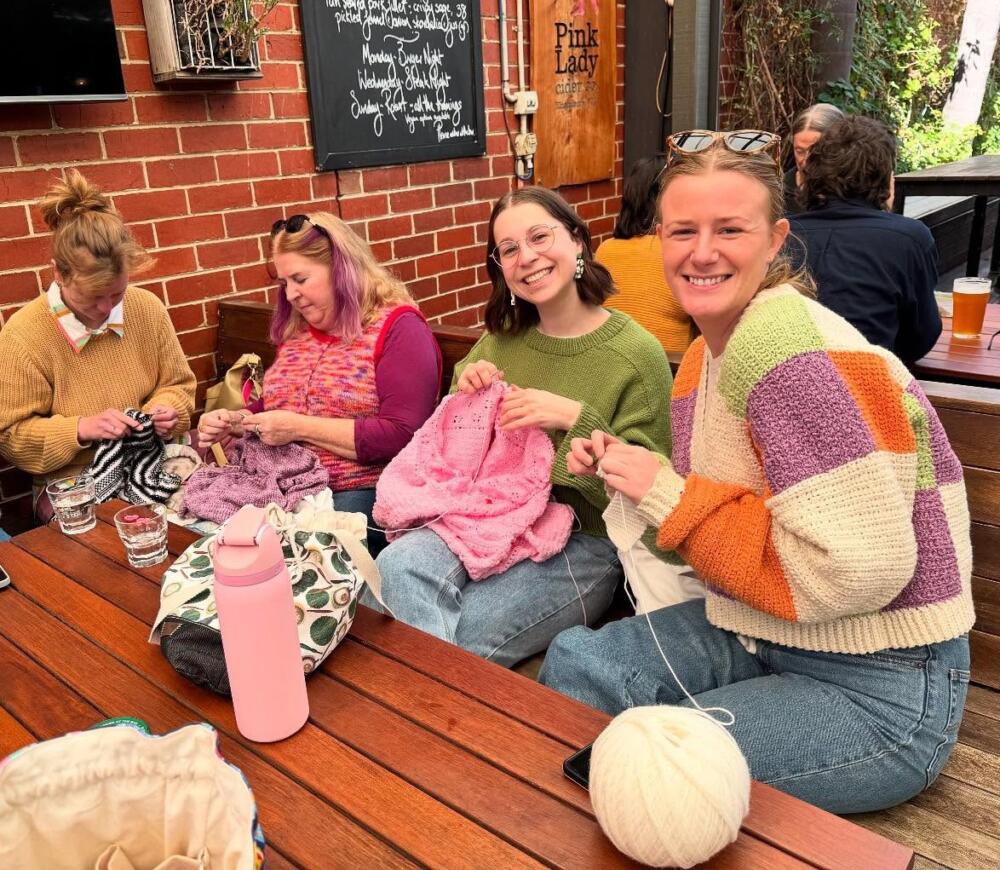
It was the first Melbourne winter afternoon with a cloudless sky, the kind that helped you remember the sun existed. People wore short sleeves aching for the first sting of sun in months and became optimistic despite the obvious chill. Armoured against the weather were the crafters of the Melbourne Stitch Collective, who packed into the thawing sunlit courtyard of Fitzroy’s Rainbow Hotel in sweaters of every colour, shape, stitch and fibre. Spread across three wooden booths, they tried to stop their balls of yarn from tangling with each other. Handsewn craft bags were propped neatly at feet under slated tables hosting pints and parmis. Each crafter donned a handmade garment, every colour of the rainbow in the Rainbow. They took up the whole corner of the courtyard, steins mixing with skeins.
Skein: A highly contested word in the knitting community. Is it “skine” or “skeen”? I’m never sure! A length of thread or yarn, loosely coiled and knotted.
Patterns are the currency of crafters. They come after your name and before your fibre. Words were used to describe wool that I’d never considered before. Toothy, airy, gruff, stringy. When you told your fellow crafter what wool you were using you would, naturally, hand it to them to feel. Wool was passed around pints and over chips.
Cashmere, wool, linen, cotton, a cotton-wool blend, a cotton-linen blend, merino, cashmerino, merino held with mohair, mohair. The merino is the bulk but the mohair adds the fluff factor. Cotton is breathable but it’s heavy. Wool is warm but it’s itchy. Cashmere is soft but it’s expensive. Alpaca, sheep, goat, rabbit.
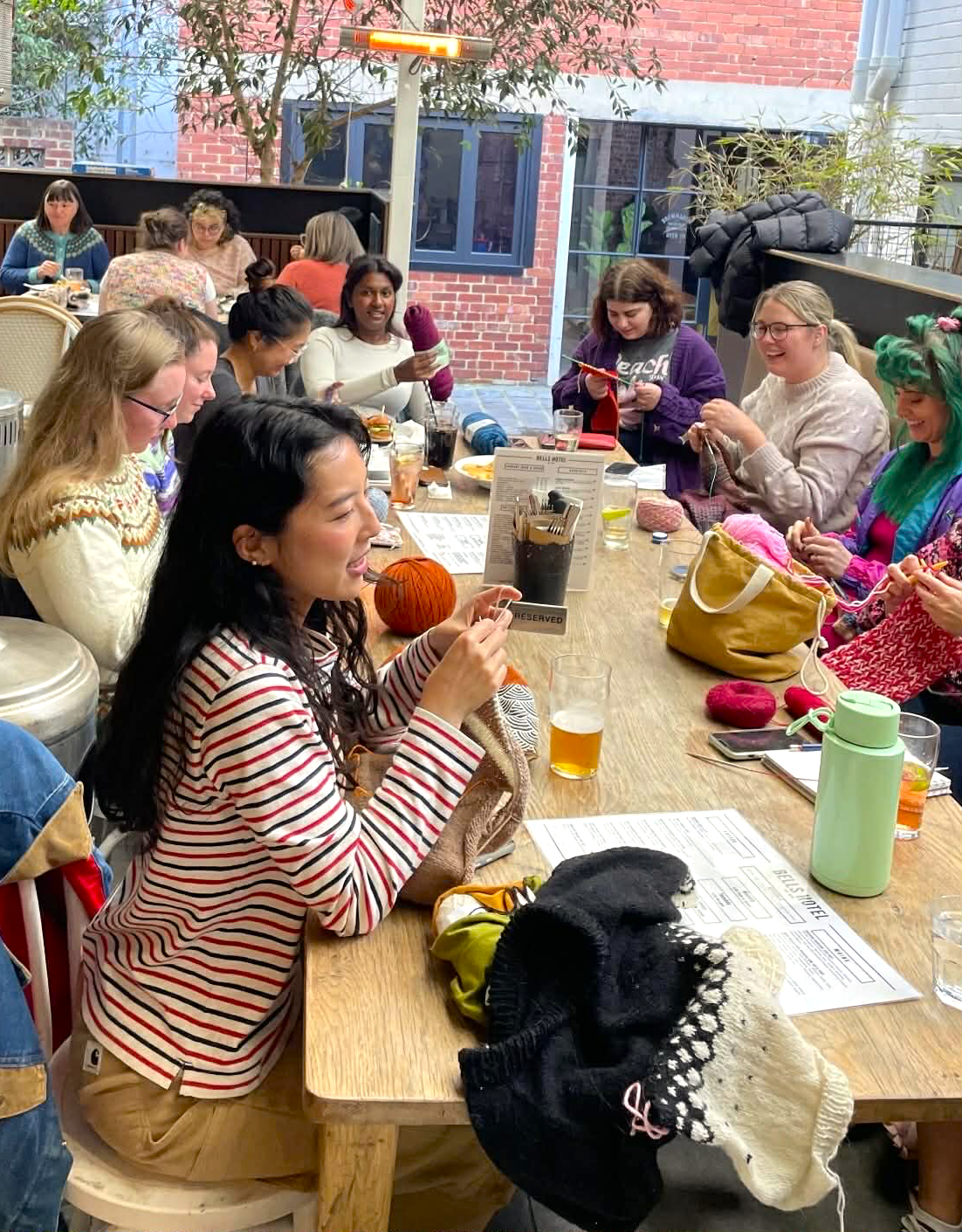
Melbourne Stitch Collective crafters at the Rainbow Hotel, Fitzroy. Photo by Maxine Ford.
A vague competency in the jargon of fibre arts can take weeks to decode and years to master. Knitting derives from the Germanic word knütten meaning “to tie” or “knot”. It uses two or more needles to weave a fabric through a series of interconnected loops, and is not to be confused with crochet, which uses one hook. Do not get the two confused.
Knotted with nerves, I decided not to wear a sweater of my own making, conscious of my wonky stitches around the expert crafters. A young man and his grandparents huddled together across the courtyard, peering over at the group with curious eyes. I felt like I was part of a circus, but one that everyone wanted to be included in. Where the collective went, eyes followed, warmed with the desire to be a part of something too.
For many outside its orbit, the crafting world can seem isolated and finicky, reserved for faded floral armchairs and the quaint grandmas that wither away in them. The Melbourne Stitch Collective unravels this story. Chatting over clacking needles, runaway balls of yarn trail behind them and sweep up the dust of musky corners as they journey from pub to pub.
“It’s important to knit in public and show that it’s a thing that people do,” said Jaime, founder of the collective.
“It’s not just for grandmas, and it’s a thing that can bring us together.”
Jaime (or @jaime_creates on Instagram) would fidget with anything in reach—her skin was picked, nails gnawed and hair twisted before the hook fell into her hands, dropped in by a fellow crafting friend. Admittedly, she had always been good with her hands. She was the girl on school camps sitting in the corner completing orders of braided bracelets, an important currency of middle school. She found reprieve in the twisted world of crochet as a way to manage her undiagnosed ADHD. For many knitters, crochet was the gateway drug that pulled them into the addictive culture of crafting. Fixated on the ways a yarn can be looped, Jaime’s obsession turned into a small market page on Instagram, which later became a platform to launch her knitwear designs and connect with fellow knitters.
One of many in Jaime’s sizeable following contacted her and asked if she could use her platform to organise a meetup of fellow crafters. Eager to connect beyond the digital, Jaime agreed and received more than 30 responses to her callout. The first knit meetup was held in Carlton Gardens in May 2022. Four hours passed as knitters sat on dappled gingham blankets and chatted all things crafty, finally meeting the people they had only ever connected with online. Now, the Facebook group has more than 3000 members.
“So many of the people that come never had any friends before that knit, and now they do,” Jaime said. “You know the way you have friends from all different aspects of your life? It’s just another one. Some of my best friends I’ve met through knitting now.”
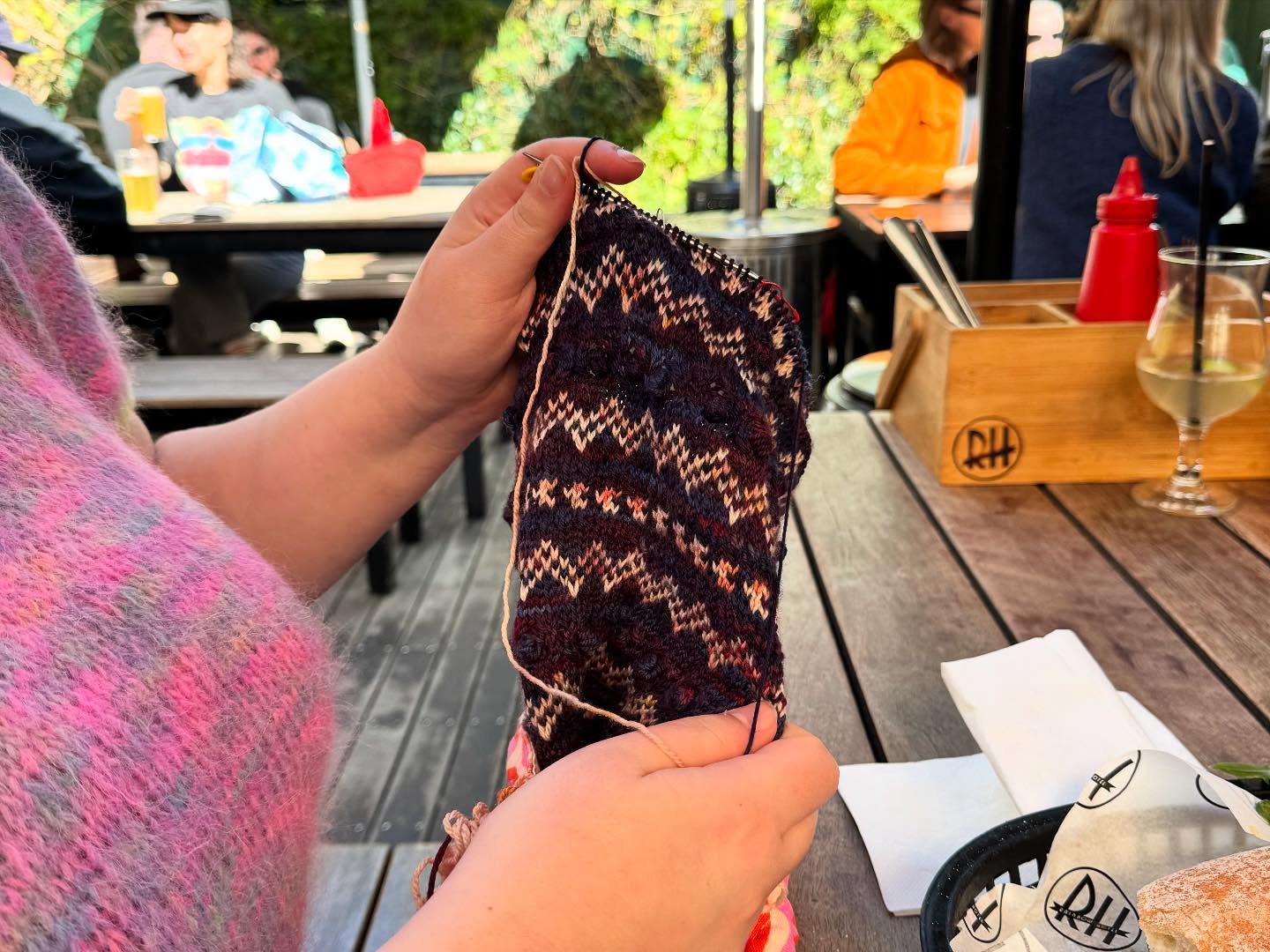
Photo: @melb.stitch.collective Instagram
Ashy (who goes by @herdingfibres on Instagram) was an attendee of the original event. After a few meetups, Ashy reached out to Jaime and asked if she wanted help running it. Now she’s one of the key organisers—and one of Jaime’s closest friends. Ashy sat at the latest pub wearing a blue and pink colourwork sweater with three different yarns (wool, cotton, acrylic).
Across from me sat a woman (balloon sleeved sweater, blue variegated wool, 6 ply) from Ballarat. She had travelled three hours by train to get there. She comforted Ashy who, the night before, cut off the hem of her sweater and was worried she’d made a grave mistake.
“It’s not a fluke,” said the woman from Ballarat, “it’s just the journey to better!”
There are a few key factors to picking the right pub for a stitch collective meetup, Ashy told me:
- There has to be enough lighting.
- It has to be close enough to the city.
- The pub has to be relaxed about the amount purchased and have no booking fee.
The collective gained its name from a joke delivered by a passing elderly gentleman: What is this, Melbourne’s Knitting Collective?! They laughed, so they kept it.
Melbourne’s temperamental weather pushed them to the pub, where Jaime said they get a lot of interest. “People feel like they can approach us and tell us their connection and ask questions,” she said. “For every person that comes up to us I’m sure there’s five people that didn’t but are still taken by it in some way.”
Before the knit meetups, Jaime had never set foot in a pub. “It’s not a place I ever thought I would feel comfortable,” she said. “I just always associated pubs with sport, men and beers.” Smoke driftied in from the smoker’s area and the knitters’ noses crunched. “I hope that smoke doesn’t get in my yarn,” someone said. Everyone hummed their agreement.
Before it was considered a woman’s hobby, only men were allowed to learn the craft. The guild of commercial knitters was first mentioned in Paris in 1268 and was one of the most important artisan guilds of the time. In the late 16th century, the first knitting schools were established in Lincoln, Leicester and York. Knitting eventually became a highly desired skill in a lady’s repertoire and one of the only acceptable ways for women to earn a personal income.
For Bella (tank top, pink mohair) knitting was “the only thing that has made meetings tolerable. I’m surrounded by men.” With a quick flick up of her camera, Bella knits away from the hawkish gaze of the Zoom call. When I met Bella, she was one week away from submitting her PhD in physics.
“There’s not much left to do,” she assured me. “Just general editing and feedback.” Next to Bella sat her husband, Frank (white and blue striped sweater, linen cotton blend, 4 ply), who she met during her undergraduate degree. While Frank scrolled his phone, Bella would knit in front of the TV or in line for a restaurant. Admitting his jealously, Frank finally asked Bella to teach him and has been knitting for the past year and a half. They hoped to travel to Denmark one day and explore the wool shops together.
Sitting across from me, Pia waited for her sister to arrive and help her with the German short rows of her purple sweater. “I don’t need the extra stimulus from TV or music,” she told everyone. “I can just sit and knit. It’s enough. You don’t have to have anything else.”
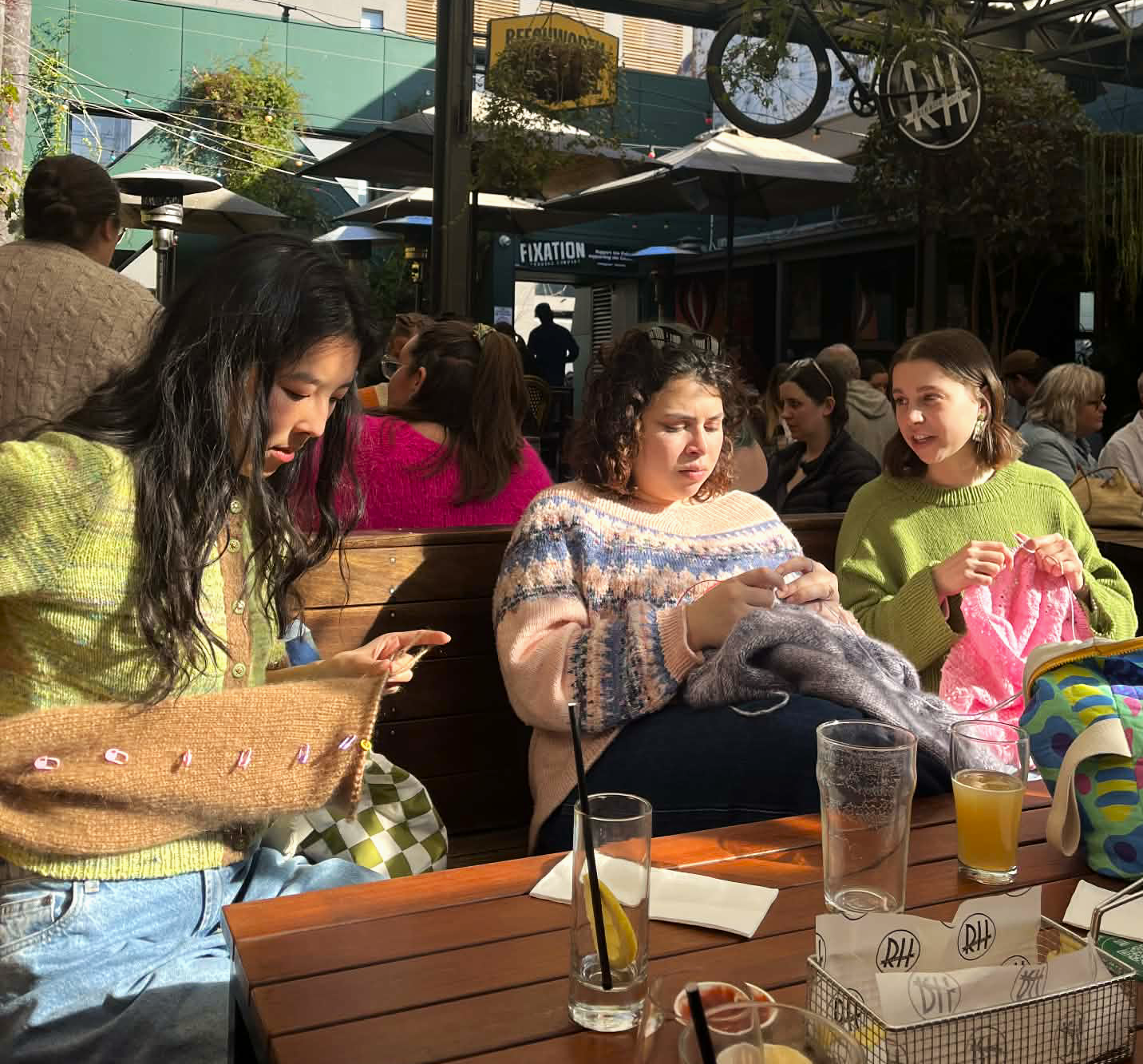
Melbourne Stitch Collective crafters at the Rainbow Hotel, Fitzroy. Photo by Maxine Ford.
During the pandemic, many people turned to crafting as a way to distance themselves from their screens. BBC Business reported that in the summer of 2020, the UK saw a general rise in yarn sales of 16 per cent. Sales at the British craft company LoveCrafts almost doubled while the department store John Lewis saw the sale of crochet hooks go up by 36 per cent. An Arts and Craft consumer report by the US research firm Mintel noted that younger consumers were the main demographic identifying as crafters.
Although younger generations seemed to dominate the world of yarn nowadays, the craft collective was not exclusive in age. Smattered among the colourful sweaters, seated in the pub’s hazy afternoon light, were heads of speckled grey as knitters of all ages came together.
“There are plenty of people that come that are of a completely different generation that I never would’ve spent time with or socialised with,” Jaime said. “There’s that commonality and it bridges generational gaps.”
I attended the next meetup in October. I finally felt the courage to wear one of my pieces—a dark maroon cable-knit sweater, the first of its kind in my closet. I gingerly zipped off my black coat and placed it on top of my spotted pink bag. Ashy looked up.
“Oh my god, I love your sweater!”
“Thank you,” I said. “It’s my first cable-knit.”
“That’s amazing, it looks machine knit!” Although antithetical to knitting’s pursuit of conscious production and slow consumerism, this, I realised, was a compliment of the highest regard. I was showered in them along the waxy pub table—how the colour suited my skin, how the tension was seamless, how I had perfectly balanced the ratio of wool to fluff. I gave pattern details and yarn brands on request and was awarded by Ashy with the “Knit of the Day”. My face matched the deep rosy red of my very first cable-knit sweater.
We continued to knit, crochet and craft. We ordered chips, drank beers and exchanged patterns. We talked about our projects, stitches, jobs, relationships. Then we left, slowly, one by one, over hours, as someone had groceries to do or a dinner to attend. Bags over shoulders, yarn trails behind. The knot that tied taut around my heart when I first walked in had begun to loosen, and I felt a little warmer with my new sweater on.
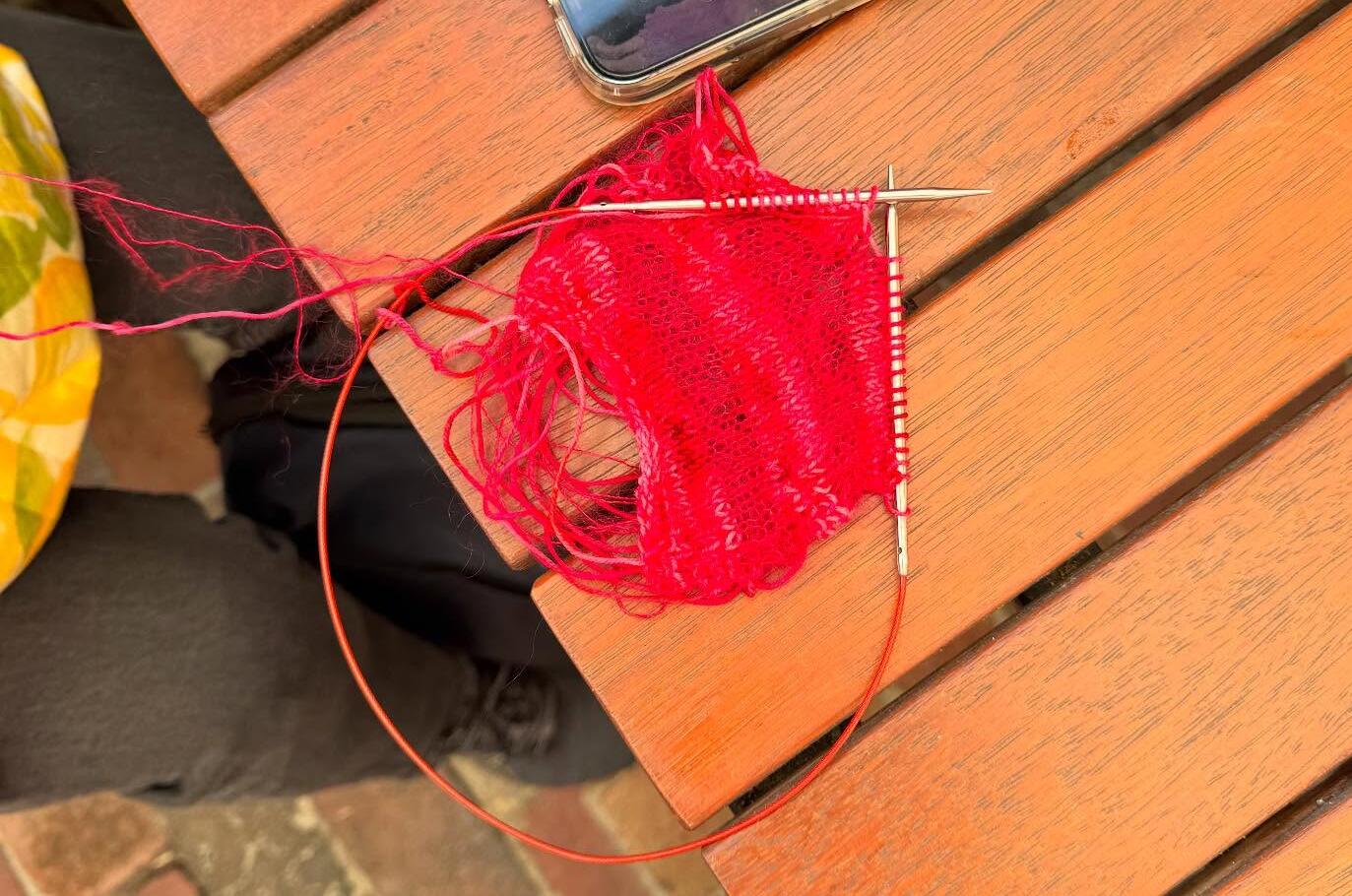
Photo: @melb.stitch.collective Instagram
*Name changed at interviewee’s request.