On 17 January 2026, the Iceland capital of Reykjavik hosted a celebration concert marking the 30th anniversary of the cult children’s TV show, LazyTown.
Among the attendees was a 26-year-old superfan known online as “IlexVici”, who flew from the UK to attend. The sold-out show far exceeded her expectations.
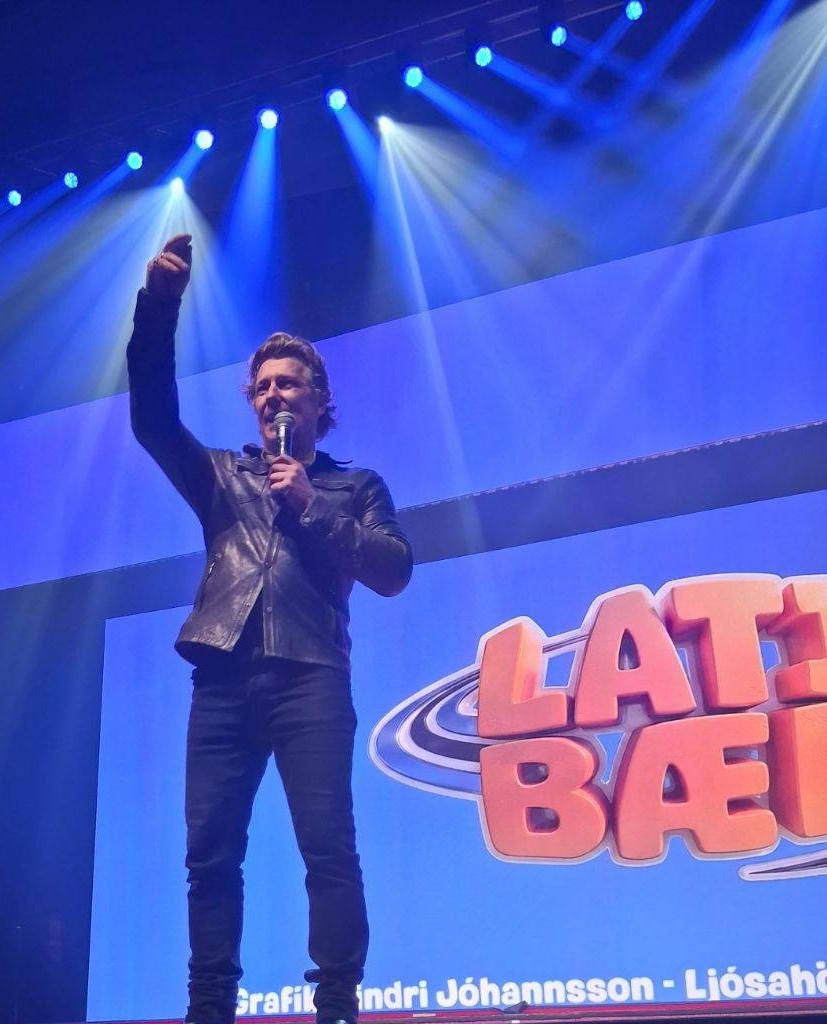
LazyTown creator Magnús Scheving onstage at the 2026 celebration concert. Photo credit: IlexVici
“It was so much better than I thought it was going to be,” IlexVici said.
“I wasn’t expecting so many actors and the whole-ass play to go with it. I was kind of expecting it to be like going through a playlist. It was a whole play with obviously the music mixed in.”
LazyTown began in 1995 with Iceland author Magnús Scheving’s Go LazyTown!, a children’s book which aimed to promote healthy and active lifestyles.
The LazyTown TV show premiered on Nickelodeon in 2004, blending puppetry and live action. It starred Scheving himself as Sportacus, a blue athletic superhero, and Stefan Karl Stefansson as Robbie Rotten, a purple-suited supervillain striving to keep the town lazy.
While the anniversary stage show featured live actors and established performers, IlexVici said she saw what she believed to be AI-generated images being used in some backdrops. Recent promotional material on the LazyTown website has sparked similar concerns among its dedicated fanbase.
Scheving was contacted for comment on the alleged use of AI in the production but did not respond.
IlexVici said she couldn’t help feeling a little disappointed by the alleged AI use, but would still happily watch the stage show again.
“There were so many hired actors—like, there was an army of Sportacuses and Stephanies [another popular character],” she said.
“There were a whole lot of people who were hired for this, and they were way more active than I thought they would be.”
Keeping active is a big part of the LazyTown brand—over years, the TV show entertained and taught children the importance of staying active through its songs, characters, and life lessons embedded in each episode. In a 2007 interview with BBC Bristol, Scheving said he wanted to provide a “role model for health for kids”.
Throughout its four-season run, LazyTown was nominated for a Daytime Emmy Award and won the International category at the BAFTA Children’s Awards. Its final season aired in 2014.
Part of LazyTown’s legacy has been the many memes it’s spawned over the years. One of the most famous was the “We Are Number One” song and its various remixes, which went viral in support of cast member Stefansson, who died of cancer in 2018.
IlexVici herself became a fan and joined the online LazyTown community in 2024 because of the viral Twitter debate: “Who’s stronger, Homelander from The Boys, or Sportacus from LazyTown?” For her, the 30th anniversary concert was a chance to celebrate the show with like-minded people.
“The show means a lot to me, and so does the music,” IlexVici said.
“I wanted to celebrate it with other people. LazyTown hasn’t been on air for probably 10, 15 years. A lot of the people who grew up with it have their own kids now.”
One of the secrets to LazyTown‘s success was the effort put into each episode and the close attention to detail from its staff and crew.
The show’s composer, Mani Svavarsson, told The Citizen that he devoted many hours to making the music and that it was a collaborative effort between him, Scheving, and the show’s writer, Mark Valenti.
“I would be writing the song on a Monday and getting it approved from Magnús, and then have lyrics written the next day,” Svavarsson said.
“This had to happen really fast, and it had to be top-notch quality. We didn’t want to throw out any simple song.”
Decades on, LazyTown continues to inspire fans worldwide. It’s also one of many programs that have caught the attention of adults, despite being designed for children. Other titles such as Bluey, Adventure Time, My Little Pony, and Avatar: The Last Airbender have spawned flourishing online fan communities on social media platforms like Discord, Tumblr, and Reddit.
According to University of Melbourne media and communications lecturer Dr Cassandra Barkman, the popularity of such shows has to do with how they’ve been designed to cater to both kids and their parents.
“I think part of it is that a lot of animated shows have a little bit of an incentive to appeal to more adult and mature audiences, for a couple of reasons,” Dr Barkman said.
“One of them is that parents have a lot of control and authority over what kids watch to one extent or another. If you are a parent of a child, you’re going to have much more specific intentions of ‘I’m going to sit them down in front of the TV to watch X, Y, and Z program’, which means to actually get a TV show in front of more kids, it’s really beneficial for shows to also be appealing to adults or a wider range of people.”
Dr Barkman said the stigma around adults enjoying children’s content was slowly disappearing. But at the same time, the “made for kids” label might lead people to dismiss the IP’s storytelling potential.
“There’s absolutely been stigma, historically,” she said. “I think things have gotten better, but I also don’t think things are necessarily perfect or there’s full acceptance just yet.”
Despite its loyal following, LazyTown’s episodes are not readily available on streaming services. One of the few legal ways to watch the full show is through Iceland’s TV networks. On the official YouTube channel, viewers are met with poorly-subtitled clips of questionable visual and audio quality.
For many, the best way to watch LazyTown is through fan-made archives filled with gigabytes of TV show episodes from different regions and CD soundtrack rips, as well as scanned and cloned content from hardcore collectors.
The mission to share LazyTown media began in 2006 on the forum site GetLazy, created by a Canadian fan known as “EdIsLeado”, who joined the community as a teenager. He fell in love with the show when he first saw it on TV in his living room and wanted a platform to connect with like-minded people.
EdIsLeado says that the forum site’s name has a double meaning. The first references the season one episode “Lazy Scouts,” where Robbie Rotten disguises himself as a Scout Master and invites the kids to join his scouting troop, singing a catchy jingle: “Get lazy, get lazy, everybody gotta get lazy. Get lazy, get lazy, Lazy Scouts.”
The forum’s other meaning is a shortening of “Get your LazyTown content here,” as EdIsLeado, along with the rest of the community, archived as many episodes as possible and made them accessible to others.
“I wanted to create the community to connect with other people and share some of the shows I had recorded off the TV,” EdIsLeado said. “I thought it’d be great to create a place for everyone to chat.”
His goal was a success, and it continues to this day. On the LazyTown Community Discord server, people share photos of their vast collections. Whenever an official LazyTown product appears on sites like eBay or Discogs, members are notified in a chatroom specifically for merchandise. They even discuss strategies if a product is listed for auction.
Turner Broadcasting/Warner Bros. had owned the LazyTown TV, brand and IP rights since 2011, but that all changed in May 2024 when Scheving bought the properties from the entertainment conglomerate for a reported US$1.7million (AU$2.4million).
While no reboot or follow-up has since been officially announced, Svavarsson hinted that something could be in the works.
“What I’ve heard regarding LazyTown‘s future, if there will be more production, is maybe turning it into some kind of animation,” Svavarsson said. “He [Magnús] is not creating an episode or trailer, more just little tests to see how it is.”
The announcement sent excited ripples through the LazyTown fan community, but the concert and its promotional material also sparked concern.
On the LazyTown website, before being redirected to a product page, there was a video featuring the show’s main characters, whose appearances and movements fans suspected were AI-generated, as they were unlike anything in the original.
According to IlexVici, the promotional video shifted public sentiment about LazyTown‘s future, as fans debated whether new technology threatened the show’s authenticity.
“There’s a bit of worry about what’s going to happen in the future if AI is being used already,” IlexVici said.
Fans on the LazyTown Community Discord have criticized the alleged use of AI and attempted to contact Scheving, with no response.
Dr Barkman said, if AI was being used, it would go against the very ethos that LazyTown espouses.
“The idea and the perception that kids will just gobble up any sort of slop that’s put in front of them is very unfair,” Dr Barkman said.
“Kids deserve better, at the end of the day. It is fair to say that [if AI is being used] LazyTown is being pretty hypocritical. One might even say they’re being lazy themselves if they’re relying on AI for their content.”
Thirty years after its creation in Iceland, LazyTown has become more than just a kids’ show. It has become part of pop culture to the point where fans of all ages have tuned in. But after seeing the current direction the brand is heading in, these fans hope their favourite show doesn’t succumb to new trends or cash grabs to stay relevant.
“I think the future of LazyTown would be very bright if they continue the way that they are now,” IlexVici said. “As long as they don’t use AI.”