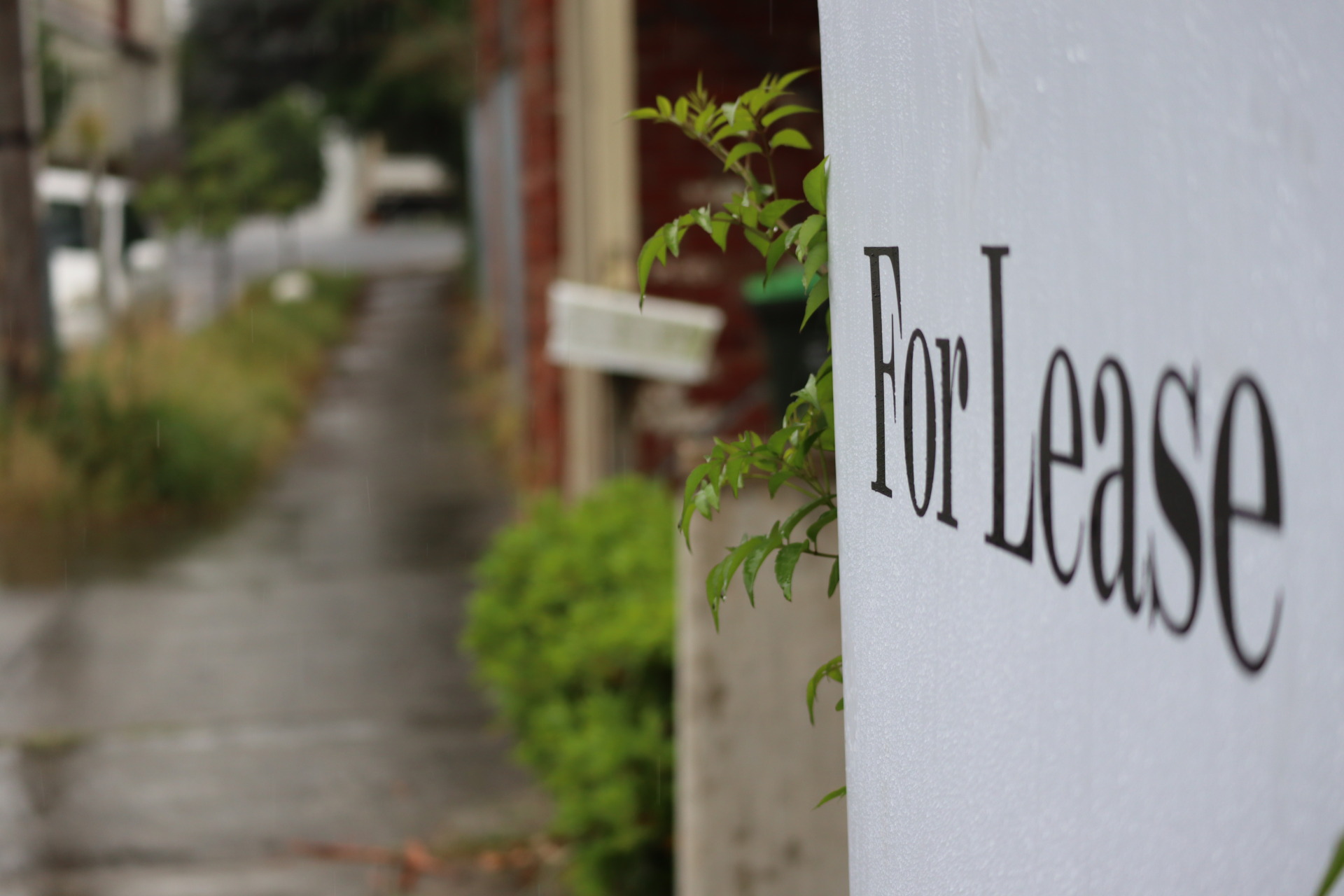
Advertising a place for lease is a cost for the landlord initially, but finding a replacement is usually done by the tenant. Photo: James Worsfold
For Noah, renting was already a costly experience. Six months after moving into a share house in Melbourne’s south-east, the 27- year-old public servant discovered his housemate was paying significantly less rent than he was, despite claiming the better bedroom, a car spot and most of the storage space.
When his rent was increased, and feeling unable to renegotiate arrangements with his housemate, Noah decided the better – and cheaper – option would be to move in with his partner.
But an expensive roadblock stood in his way.
When it came to transferring his share house lease to a new tenant, the real estate agency managing the property required Noah to pay administrative costs of $400. (Noah asked not to be identified because of concerns about potential backlash in future housing applications.)
Since the burden falls on renters – not agents – to advertise and find a replacement housemate in such circumstances, Noah struggled to see how such a cost was justified. “It just doesn’t stack up,” he says.
Noah is far from alone. Ben Cording, community education lawyer with Tenants Victoria, says lease transfer fees are a problematic issue in “pretty much every share household”.
Cording is one of several housing advocates concerned that real estate agencies are exploiting a legal ambiguity to make extra money at the expense of renters already crunched by cost of living and housing crises.
With few avenues of appeal except the costly and often slow option of the Victorian Civil and Administrative Tribunal (VCAT), the situation may be forcing some vulnerable renters, including those fleeing violence, to play the role of regulator.
An investigation by The Citizen has found the practice of agents requiring renters to pay transfer fees of hundreds of dollars is widespread across Melbourne, despite regulations suggesting some fees are excessive and potentially a breach of tenancy laws. While dozens of tenants have revealed to The Citizen the hardship or anxiety the fees have created, a spokesperson for the Real Estate Institute of Victoria (REIV) said it was unaware of the issue.
Under Victoria’s Residential Tenancies Act, it is illegal for landlords to demand a payment from renters in exchange for consent to transfer a lease. They are, however, allowed to ask tenants to bear the cost of writing up a new rental agreement.
This has created a grey area for real estate agents to charge large administrative fees, Cording says. While the charges are ostensibly on behalf of landlords, the lawyer says in his experience, many appear to be unaware of the impost, which he describes as a “fictitious transaction”.
There are concerns about the impact of the fees on people living in vulnerable situations. Lease transferring often occurs because of difficulties or tensions within a household. In some circumstances people are trying to leave to escape domestic violence, or move in with a sick family member to provide support.
“They’re desperate in some situations,” he argues.
“Sam”, an anonymous respondent to a survey on lease transfer fees conducted by The Citizen in late 2024, reported needing to transfer a lease to escape domestic violence during the pandemic. When Sam asked for the $300 fee to be waived due to these circumstances, they say the agent refused.
The survey identified 15 real estate agencies across Melbourne that had reportedly charged tenants at least $220 to transfer their lease, with about half the respondents able produce emails or documentation verifying their claim. Several were identified as having charged over $300 and one $400. The Citizen put these claims to all 15 agencies. All declined or did not respond to requests to comment on the specifics of the claims or their lease transfer practices in general.
What Melbourne real estate companies charge for tenants to transfer their lease
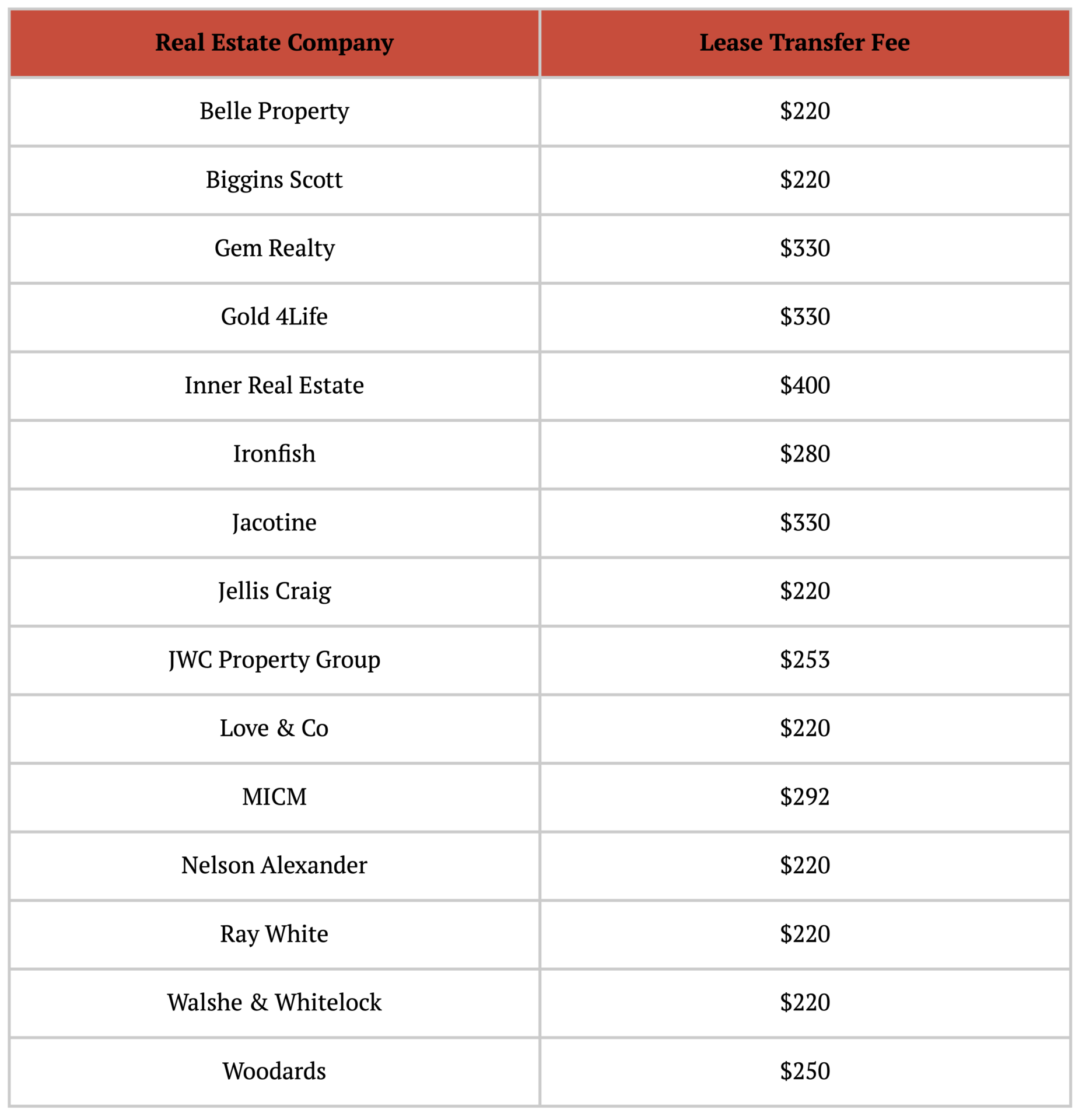
The Residential Tenancy Act has required that lease transfer fees be “reasonable” since 2021, though VCAT has ruled against expensive fees for at least 14 years.
Tenants Victoria says it considers fees exceeding $130 to be unreasonable. A past VCAT ruling found that the cost should directly reflect the work involved in transferring a lease, which is generally no more than a couple hours work.
Although VCAT decisions are not bound by past rulings, the Office of the Commissioner for Residential Tenancies told The Citizen this historical decision provides useful guidance as to how fees should be calculated.
After researching the law and a lengthy negotiation with his real estate company, Noah was able to reduce his fee to $80. Despite the arduous process, Noah says he was lucky he was informed enough to call out these “predatory tactics”.
Of 36 respondents to The Citizen’s survey who were charged over $220, 53 per cent did not protest their fee to their real estate agent, saying they were not aware they could, or did not feel comfortable. Of those who did, only 30 per cent were successful.
“We were the ones who found a replacement housemate, and when we complained about their fee, they just said it was their policy.
“Shocking.”
– Anonymous renter responding to The Citizen’s survey.
Though tenants may contest fees through VCAT, advocates say it is unfair that the burden of policing falls on a vulnerable cohort.
Harry Millward, general secretary of the Renters and Housing Union, says there is a “deep-seated fear” among renters that standing up for their rights will put them at risk of eviction.
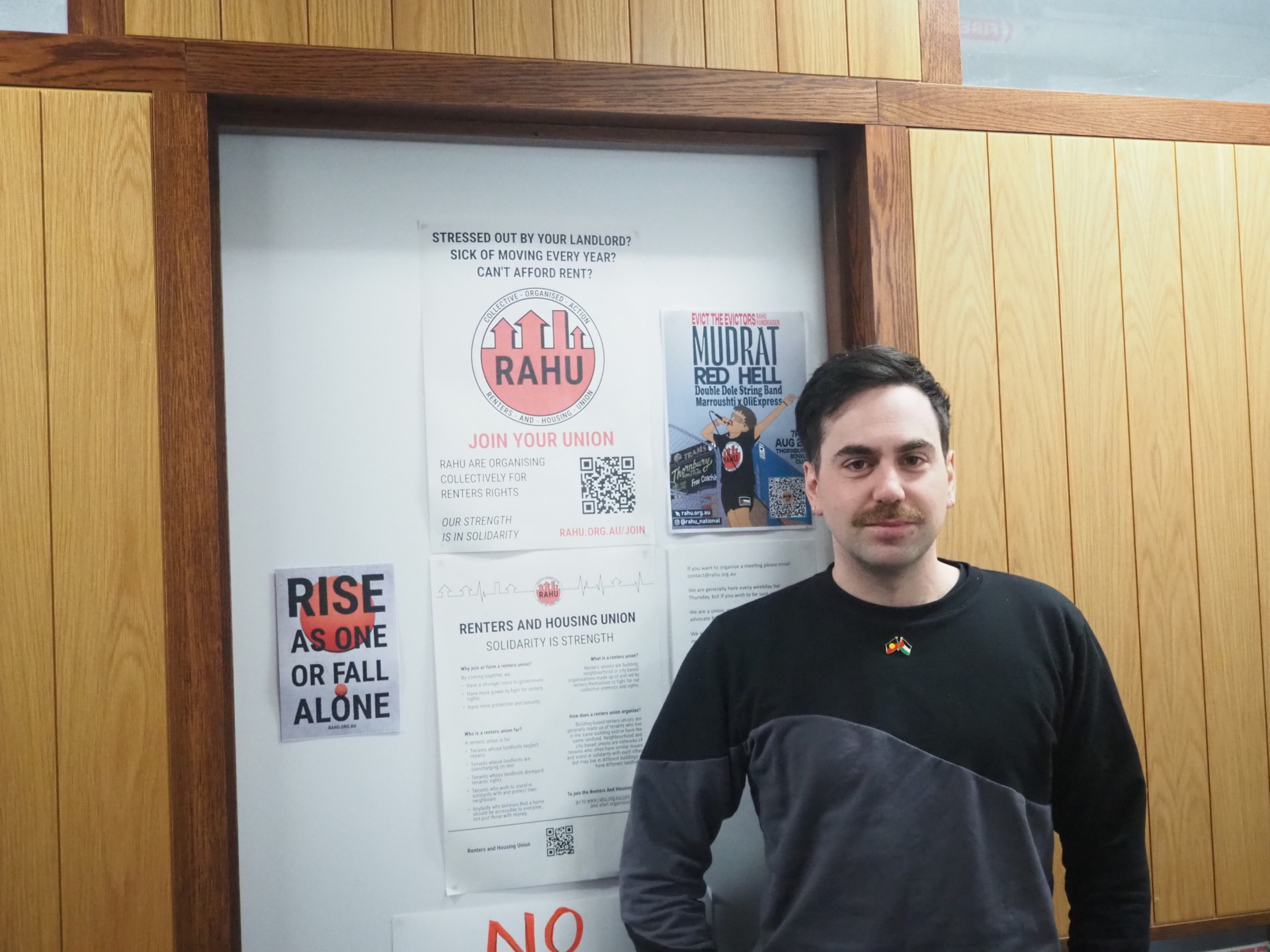
Harry Millward, from the renters’ union, says the current system is putting the stress, cost and onus on tenants to enforce the law and their housing rights. Photo: James Worsfold
Either the outgoing or incoming tenants, or both, may be charged the transfer fee. With Melbourne’s vacancy rate at 1.3 percent, many tenants would rather not create tension when securing a rental in a tough market.
Applying to VCAT can also be an expensive, drawn-out process, Millard says.
VCAT requires a fee of $72 to make a submission, and renters often have to pay expensive transfer fees under protest, leaving them out-of-pocket for months before their complaint is heard.
Victorians spent an average of 45 weeks waiting to hear their cases in VCAT in the 2022-2023 financial year. Despite making progress this year, the tribunal’s case load is still more than twice what it was before the pandemic.
Millward says this system rests on renters understanding complex legislation, which is “inaccessible” for most tenants, let alone those from non-English-speaking backgrounds.
Even the most legal-savvy renters have found VCAT difficult to navigate.
Joseph Kneebone, a medical student at the University of Melbourne, says excessive lease transfer fees had been a “pet peeve” of his since he moved to the city. After transferring his lease in January, he decided to challenge the $220 cost at VCAT, even after the agent dropped the fee to $120 to avoid the hearing.
Despite taking several law classes during his undergraduate degree and spending hours gathering evidence, Kneebone felt out of his depth at the tribunal intended to provide “fair, efficient and affordable justice” for everyday Victorians.
He says that during the hearing, the VCAT member assessing the case was using “very legal language”, and that he could only just follow along.
“It was as if the member expected both sides to be lawyers,” he says.
Kneebone says his submission was denied due to what he considers a technicality. Although he received email consent from the incoming tenant to represent her, VCAT found this was not a sufficient “certificate of authority”.

Joseph Kneebone says he was further out of pocket after taking his lease transfer fee to VCAT. He says the tribunal process was very legalistic and he felt out of his depth. Photo: James Worsfold
He left VCAT further out of pocket, required to pay $200 to the real estate agent in legal costs on top of the $120 lease transfer fee.
VCAT does not publish data on the number of tenants seeking to challenge lease transfer fees. However, it would appear to be an issue of strong public interest, as a previous case relating to such fees has been accessed online more often than any other residential tenancies case, according to legal website AustLII.
“This sharehouse had people moving in and out every three months, so there were constant payments of this $220 fee.”
“The fee for the lease transfer was too high to even consider moving so I stayed until my lease ended.”
– Anonymous renters responding to The Citizen’s survey.
Despite this, Sarika Bhalla, communications manager at the REIV, says the industry peak body is unaware of concerns about lease transfer fees in excess of $200.
“I haven’t heard that being raised in residential [leases].”
Tenants who come up against “something which is unreasonable or unlawful” should raise their concerns with the head of the real estate agency or Consumer Affairs Victoria, she says.
If provided with evidence of excessive lease transfer fees, Bhalla says the institute’s response would be to send educational material to its members about best practice in the sector. She adds that not all real estate agents are REIV members and that there is no legal requirement for agents to undertake ongoing professional development.
While rental rights advocates see lease transfers as a necessity for sharehouse tenants changing jobs or fleeing violence, for example, former VCAT member and lawyer William Holloway describes it is a “convenience that bears a cost”.
If a tenant wants to leave outside their rental contract, says Holloway, who has since represented property owners, agents and renters, it is appropriate that they, not landlords or real estate agents, foot the bill. He believes up to $200 is reasonable to charge for an agent’s time.
Holloway says this cost should reflect due diligence on the part of the real estate agent, such as security checks, preparing a new condition report and transferring the bond.
However, the work involved in transferring a lease appears to vary, and most tenants find their own replacements online.
Noah, the 27-year-old renter from Melbourne’s southeast, says his agent asked for $400 to advertise for a new tenant, but the tenant who replaced him was recruited by his housemate, not the agent.
Ben Cording says in a vast majority of cases real estate agents are “simply signing a form”.
“Two-hundred and twenty dollars applied to every tenant transfer made sharehousing an expensive proposition. Frequently, the lease or bond would not actually be updated, so you get nothing for this fee.”
“We, the tenants, do all the work! Why are we charged for this fee?”
“I though the fee was ridiculous since we were saving them work! Me and the other housemates took on the task of find a replacement, reducing their paperwork, and yet we were still charged for this!”
– Anonymous renters responding to The Citizen’s survey.
While high lease transfer fees are a hot issue for renters, Cording says there has been little political appetite to address it.
He advocates the legislation of a prescribed fee to be paid within months of the transfer occurring, ensuring the transfer is not withheld and renters are not overcharged.
“[The fees] don’t benefit renters, landlords or the government, so why should we allow it?” he said.
In September 2023, the Victorian Government announced the creation of Rental Dispute Resolution Victoria, a free service where tenancy disputes, including those regarding lease transfer fees, could be resolved without a formal VCAT hearing.
While the legislation for this body is held up while parliament breaks until February, a spokesperson for State Treasury says the service is still expected to be operational as planned by mid-2025.
Shadow Minister for Consumer Affairs Tim McCurdy, however, told The Citizen the Coalition has expressed concern about the lack of detail and vision from the Government for how RDRV would be set up and run.
Harry Millward from the Renters and Housing Union criticised the reform for ignoring the root of the problem.
With nobody else stepping in to enforce the rules, Millward says Rental Dispute Resolution Victoria will be no better than VCAT and it will be still up to renters to police unfair fees or poor conditions.
“Why should people have to spend a huge amount of time and labour to argue why they should be living in conditions fit for human habitation?” he says.