
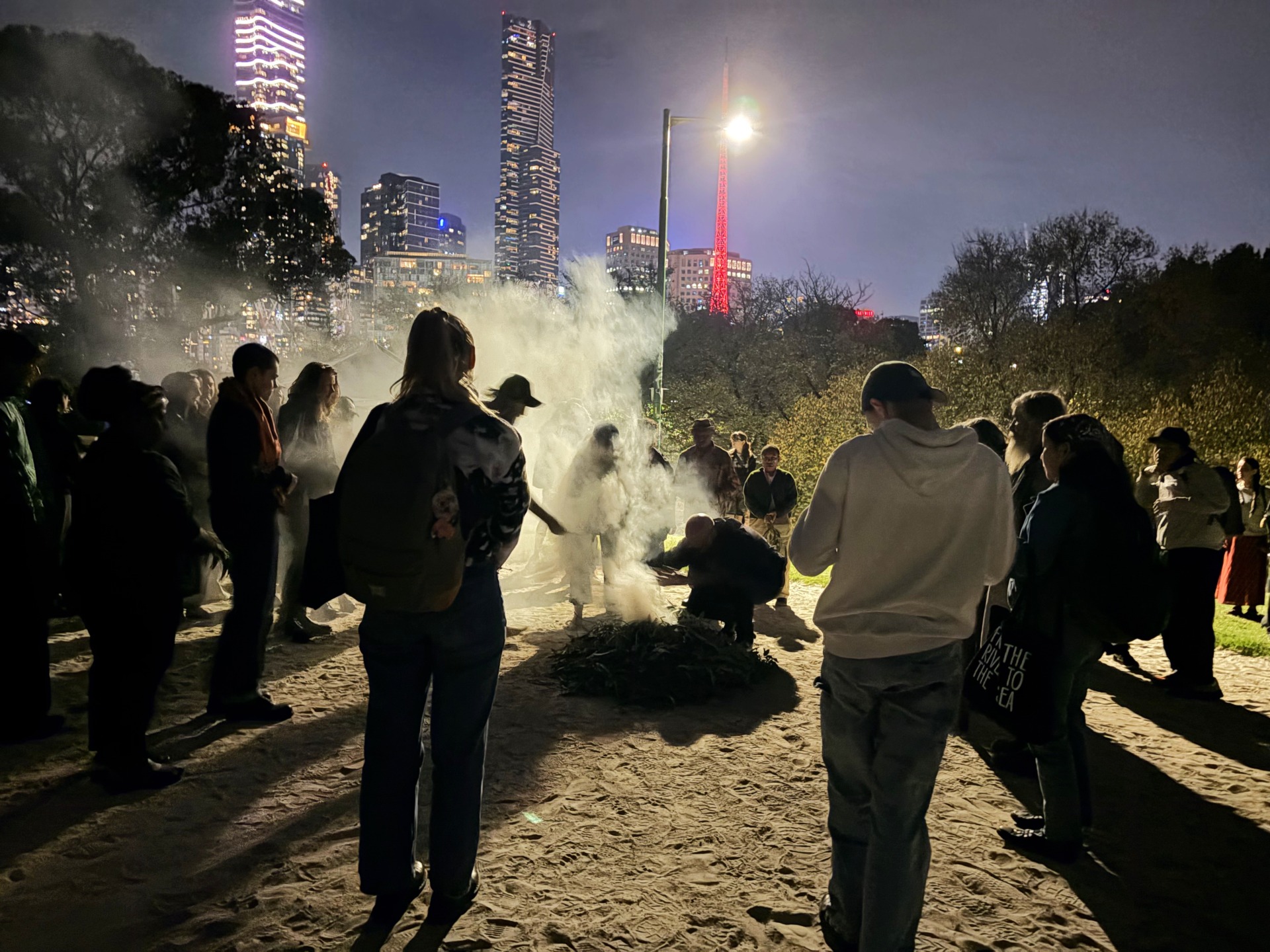
Above the bustle of St Kilda Road and the flows of the Birrarung—the traditional name for the Yarra River—stands Camp Sovereignty, a space of sanctuary on Boonwurrung country.
As the sun set over the skyline on the evening of Anzac Day, activist, leader and Krauatungalung elder Uncle Robbie Thorpe took up a microphone to initiate the Fallen Warriors Ceremony.
“This used to be known as King’s Domain,” Thorpe said. “This is Camp Sovereignty—we took it back.”
The crowd of around 100 responded with applause.
“We want to bring our fire back in our country,” he said, as smoke rose from the Camp’s fire centred in a circle of sand.
On a day of recollection and mourning of Australian war dead, the Fallen Warriors Ceremony was a reminder to people that commemorating the Anzac legacy wasn’t the only opportunity to remember.
Tents, vans, makeshift kitchens and stalls bordered the circle as people of all ages gathered to commemorate the First Nations warriors who died defending their land from settlers in the Frontier Wars—a series of conflicts, massacres and acts of resistance that took place around the country between 1788 and 1934.
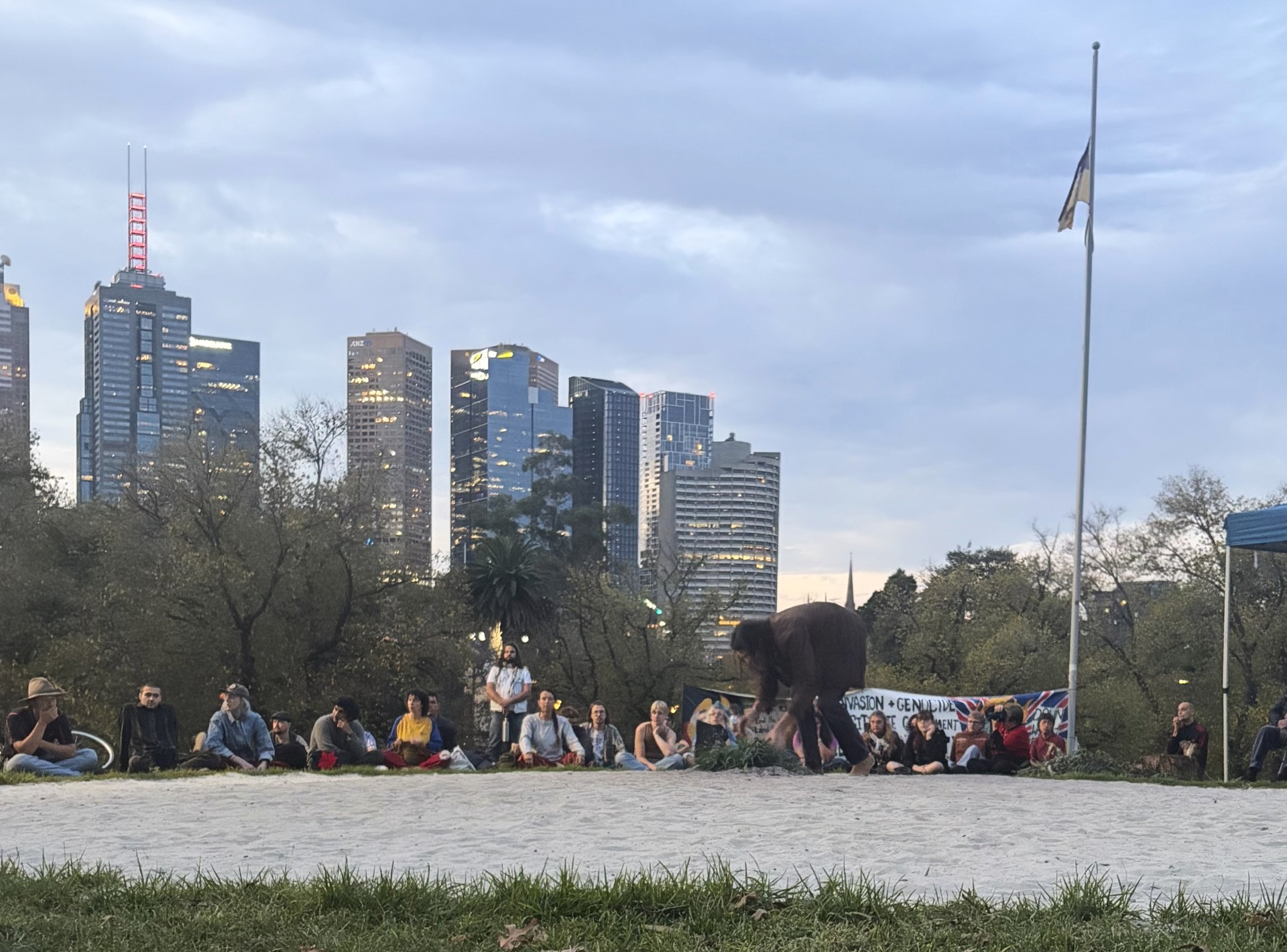
An organiser lays the first branches for the ceremonial fire. Photo: Matt Melia.
Camp Sovereignty was established by Thorpe and other First Nations activists in 2006 as a demonstration against the Melbourne Commonwealth Games. Coinciding with the games, the site was occupied by protestors for 60 days.
Thorpe was the architect of the “Stolenwealth Games” and the “Black GST” (ending Genocide, acknowledging Sovereignty and securing Treaty) movements, which sought to direct political attention to Indigenous rights.
Activism during the genocide in Gaza and movements around land rights inspired Thorpe to re-establish Camp Sovereignty on Invasion Day 2024 in the Domain Parklands, a historically significant gathering place for people of the Kulin Nation.
Activists at the Camp have also called for the “King’s Domain” name to be decolonised and changed to something befitting the area’s Indigenous historical and cultural significance.
Gumbaynggirr activist and academic Gary Foley said Camp Sovereignty “plays the same role as the Tent Embassy”, the protest and occupation site Foley co-founded in Canberra in 1972.
“We need things like Camp Sovereignty to sit there as a silent reminder of the ongoing failure of Australians to face their history,” Foley said.
Ashes from the tent embassy were brought over to Camp Sovereignty to re-start the ceremonial fire in its 2024 re-establishment.
The Camp’s sacred fire burns in honour of the ancestors buried at the site from 38 different Indigenous nations after their remains were repatriated from Museums Victoria in 1985. The flame burns concurrently with the Eternal Flame at the nearby Shrine of Remembrance.
The 25 April Fallen Warriors Ceremony also paid respect to Aboriginal soldiers in the Australian Defence Force.
Aboriginal writer and activist Professor Tony Birch spoke at the event.
“If we think of the notion of ‘lest we forget’, we live in a country that can’t remember,” Birch said.
“We live in a country that suffers from strategic and purposeful and wilful amnesia.”
He recounted atrocities committed against Aboriginal people during early colonisation as well as more recent institutional abuses.
Birch illustrated the injustices faced by Aboriginal servicemen through the story of a girl who was removed by authorities from her family on the Framlingham Aboriginal Reserve shortly after the First World War.
In the family’s search for her, the girl’s aunt reminded the chief secretary of Victoria of the Indigenous men of Framlingham who, despite not being seen as citizens of Australia, volunteered to fight in Europe.
“The very men who had died, their children, their nieces and nephews were being taken from their family, after they had fought and died for a country that didn’t recognise them,” Birch said.
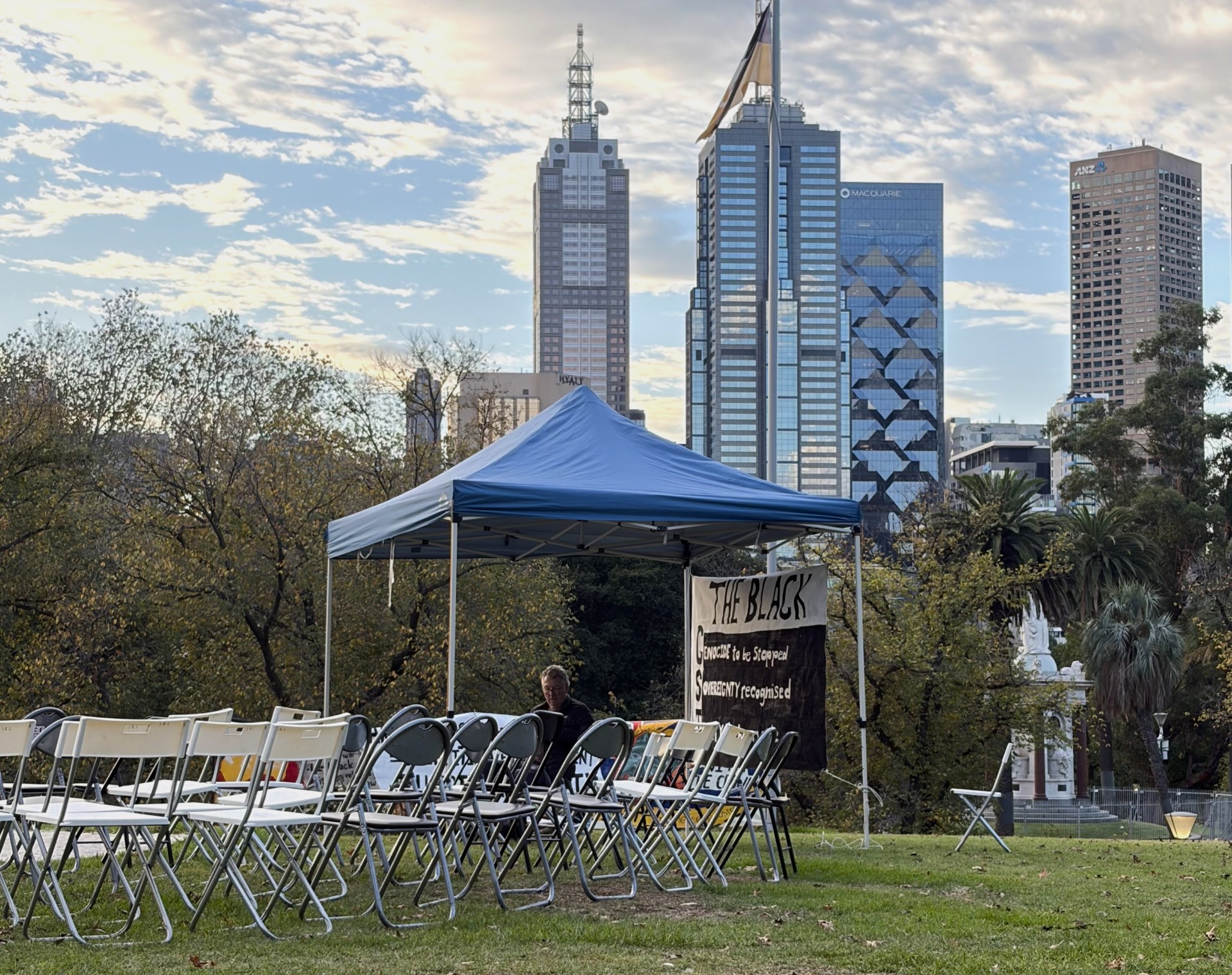
A lone gazebo with a “Black GST” sign sits before the Melbourne skyline. Photo: Matt Melia.
Dances of mourning, storytelling and calling out to ancestors took place in between speeches.
Camp Sovereignty Fire Keeper and Gunditjmara Djab Wurrung Lorewoman Yaraan Couzens Bundle performed a dance of mourning.
Dressed in traditional garments, her face coated with the white ochre of mourning for the Gunditjmara people, Bundle stated her position as being “in support of the elders that brought the fire back”.
Bundle assumed the role of fire keeper following an attack on Camp Sovereignty last August, when members of the Neo Nazi group the National Socialist Network stormed the site and assaulted occupants.
She said Camp Sovereignty sought to “offer younger generations the opportunity to be innovators of a sustainable world, upholding the law of the land, sky and sea”, through imparting various practices of care for country such as fire management.
Bundle said the Camp was “a place where our law is accepted and upheld” and that offered “a place of united understanding and growth”.
Thorpe brought the ceremony to a close.
“This is the beginning, we want our fireplaces burning all around our country,” he said, inviting all to participate in a smoking ceremony where branches were laid into the ceremonial fire.


