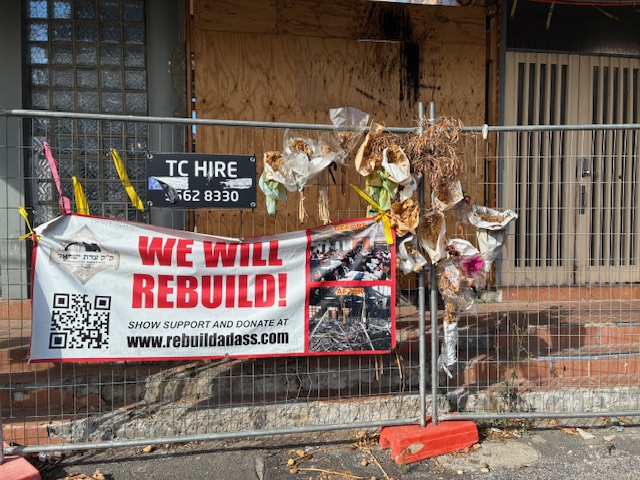
Windows were smashed, petrol was splashed through the main hall, and within minutes flames engulfed the Adass Israel Synagogue at the heart of Ripponlea’s Jewish community.
Almost two years after that 6 December 2024 attack, the charred remains of the synagogue are a scar that has yet to heal.
For many, the devastation went far beyond physical damage. Local Orthodox Jewish community member Aharon Fried said he woke that day to hundreds of messages.
“I thought it was something small,” Fried said. “Then I got here and saw the fire trucks. I knew it was serious.”
Firefighters managed to contain the blaze, saving several Torah scrolls from a fireproof safe, though some suffered extensive heat damage.
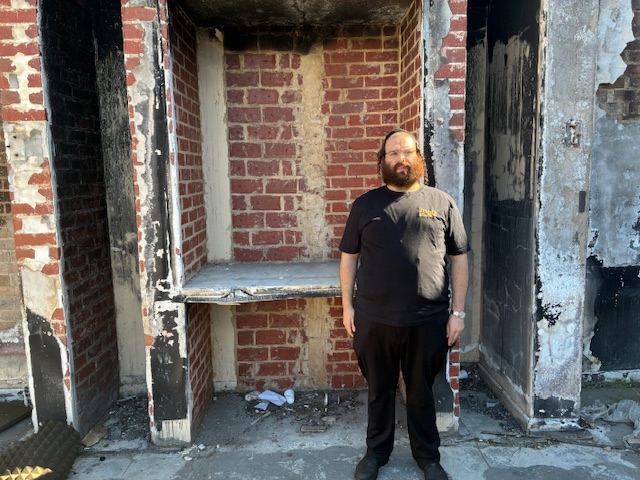
Aharon Fried stands in front of the place where the Torah scrolls were kept inside the synagogue. Photo by Lewis Weir.
The scrolls were sent for restoration and are expected to be fully repaired and replaced later this year, at a cost of $250,000.
The building itself was gutted.
“This was our place,” Fried said. “We used to come here morning and night … three prayers a day, study groups, mental health programs.”
Congregants now gather in temporary spaces, inside a converted factory and a large tent erected nearby. But those makeshift solutions just aren’t the same.
“It’s not home,” Fried said. “People are taking it tough. We’re trying to adjust, but it’s smaller, it wasn’t built for this.”
Mentor rabbi Shlomo Baruch Abelesz echoed this sentiment.
“It has been hard sometimes,” Abelesz said.
“The younger students have been very patient. Sometimes there aren’t dedicated rooms for them to learn or to socialise and we have to move them around.
“I know it has been confusing and mentally difficult for many in the community.”
The synagogue, established in 1965 by European Jewish migrants and Holocaust survivors, became a cornerstone of Melbourne’s Orthodox Jewish community. For families like Fried’s, the connection spanned generations.
“My great-grandfather came here after the war,” he said. “My roots are set in this place, 100 per cent.”
“My grandfather helped build those bricks.”
For older members in particular, the destruction represented the loss of something deeply personal. Debates have since emerged over whether elements of the original structure should be preserved or demolished.
“They didn’t want to demolish it,” Fried said. “They wanted to keep it as a memorial.”
Abelesz said one sticking point was the bricks themselves, laid by early congregants and Holocaust survivors.
“There were many debates about what to do with the bricks,” he said.
“I think, for now, we are just tearing down the building and nothing is happening. But it would be nice if we could do something. The building is very meaningful to us.”
Even as grief lingers, the focus has shifted towards the future. In an 18 March 2025 statement following the firebombing, Prime Minister Anthony Albanese pledged $30 million to rebuild.
Plans for a new synagogue are underway, with construction expected to finish in 2030.
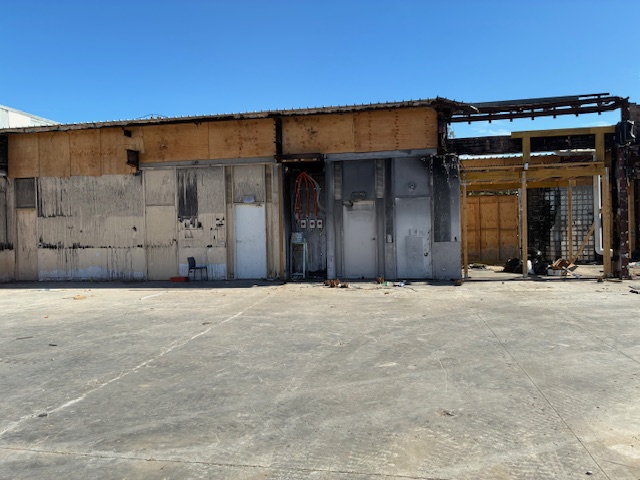
The empty lot that the Synagogue used to be on. The black melted and charred walls are still visible. Everything in the image will soon be torn down. Photo by Lewis Weir.
“Yes, everyone is ready for the new synagogue,” Abelesz said.
“It will be different. The building will be more modern, and it will be built with the white bricks like how you see the synagogues in Israel.
“I’m excited for the next generation to study and pray in the new building.”
The Federal Government has contributed approximately $32 million to the Adass Israel Synagogue in the wake of the firebombing, including $250,000 for the Torah scrolls, $1.2 million for security upgrades, and $30 million from 2025-26 to restore the synagogue and community centre.
Still, there are mixed feelings about what might be lost in that transition.
“Some of us don’t know if the building will have the same heart,” Abelesz said.
In the months following the attack, support poured in from across the broader community and government, with grants assisting recovery efforts and locals visiting the site to pay their respects.
“The support we are getting shows a lot to us,” Fried said. “We’re not being abandoned.”
Abelesz said a strong culture of care emerged in response to the adversity.
“Everyone is looking after each other,” he said.
Temporary spaces, despite their lack of facilities, have been able to start rebuilding connections within the community.
Fried said programs like “Brothers in Unity”, a mental health initiative once housed in the synagogue, were slowly finding their footing again.
“You can see everyone’s tight knit here,” Fried said of the new setup. “We’re making it work.”
The future building will include modern security features, reflecting the realities of the attack, while also aiming to restore a sense of safety and home.
Despite what has happened, many are choosing to look forward.
“We’re going to get our home back,” Fried said. “We’re not going to give up. We’re going to make it work.”